
The widespread expectation of the global economy heading for a soft landing will be put to the test amid major political change and the risk this creates for economic stability.
Uncertainty will challenge both central banks as they chart monetary policy and investors as they grapple with the new US administration’s policies, a vulnerable Europe, and a struggling China.
We believe investors should focus on the long term and the opportunities presented by environmental sustainability, the energy transition, and the shift to a low carbon economy. We see transition finance, climate adaptation investment and natural capital allocations moving to the top of the priority list for sustainability-minded investors in 2025.
Elsewhere, we see artificial intelligence continuing to drive innovation, creating new investment opportunities. Private credit offers investors a rich pipeline. For those focused on income, there is a broad set of fixed income opportunities, and for those keen on diversification benefits, emerging market debt can be a rich furrow to plough.
Explore the key local trends and opportunities we see for Asia Pacific investors below.



Watch Now
Chief Market Strategist Daniel Morris teams up with our regional economists to present a summary of the expectations and implications for global markets this year. Watch this 4-minute video as they discuss key themes while addressing US inflation outlook, geopolitical tensions in Europe, and challenges in emerging markets including China.
The outlook for financial markets

Daniel Morris, Chief Market Strategist, London
The Republican party’s sweep of the US election is likely to boost equity markets, particularly those in the US, if the pattern of the first Trump administration is any guide. The risks are that either growth accelerates by too much and the US economy overheats, or that large tax cuts prompt a negative reaction from the bond market. We will have to wait until there is more clarity, not only on any policy proposals, but also on what can actually be implemented.
Aside from political developments, developed market central banks are cutting policy rates. This should boost both equities – as shorter-term financing costs fall – and fixed income, as the policy rate component of bond yields declines. Of course, anticipating the reaction of markets is not as simple as that because the other, arguably more important, factor driving asset prices is economic growth.
Investors should initially be circumspect in anticipating positive equity returns during a rate-cutting cycle given that four out of the last five such cycles in the US coincided with a recession. Not surprisingly, the onset of a recession led to negative returns in equities alongside gains for government bonds.
The critical consideration in anticipating returns for next year is whether 2025 will be exceptional in not having a recession.
A preference for US equities
The consensus view has been that the US will indeed see a soft landing – that growth will slow, but remain positive as core inflation moves back towards the US Federal Reserve’s 2% target. Europe has already had a slowdown, but we believe 2025 should see a modest rebound. Economic growth would be supportive of equity markets and earnings, leading to price gains in the year ahead.
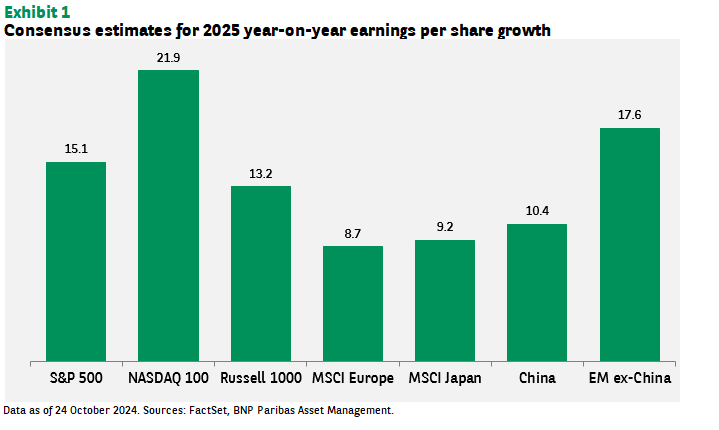
Our regional preference remains the US. Enthusiasm for artificial intelligence was the primary driver of rising earnings in 2024; the bulk of earnings derived from the types of stocks making up the tech-heavy NASDAQ 100 index, while the rest of the market saw barely positive growth.
In 2025, the distribution is expected to be more balanced, even if NASDAQ earnings growth is still superior (see Exhibit 1).
European equities should also see market gains, but once again lag most other major markets. The region remains hindered by the overhang of geopolitics and structural challenges facing its largest economy, Germany.
Consumer demand in Europe will need to rebound much more strongly than we anticipate for consumer-linked sectors to thrive. Exporters will benefit from robust US growth, though tariffs remain a worry. China is unlikely to pull in European products the way it has in the past as growth in China slows.
The potential for superior returns in China will depend primarily on actions from the central authorities. China remains distinct in its dependence on government policy to drive economic growth and hence corporate profits.
While we anticipate more stimulus from Beijing, it does not look likely there will be a major change in economic policy; Beijing will probably continue to focus on investment in new, developing industries rather than nurturing household consumption or bailing out property developers.
We question whether these privileged sectors will be able to generate growth for the whole economy at the rate the authorities would like. Without a stronger rebound in the property market, consumer sentiment is likely to remain depressed. Looking to exports to make up the slack may also prove insufficient due to rising global protectionism.
Chinese earnings should nonetheless rise, at more than 10% year-on-year if consensus estimates are correct, though this is not that much more than Europe at 9%. Valuations are low relative to history, but there may now be a permanent discount to multiples versus the past, meaning price-earnings ratios will not necessarily revert to the mean.
Fixed income – Opportunities and concerns
The risk to market expectations for short-term rates in the US comes from the potentially inflationary impact of the new Trump administration’s policies (tighter immigration, tariffs, tax cuts). At this point, however, one can only speculate on what will actually be implemented.
Longer-term Treasury yields could rise to reflect an uncertain inflation outlook
Longer-term Treasury yields could rise to reflect the uncertainty about the outlook for inflation, to say nothing of the US budget deficit. An extension or expansion of tax cuts would only lead to a further deterioration in the fiscal outlook.
As always, however, it is unclear if and when the market will decide to fully price in these risks. We would anticipate ongoing support for gold prices as investors look for alternative safe haven assets.
Investment-grade credit should provide superior returns relative to government bonds as spreads remain contained alongside steady economic growth.
While spreads are narrow – both in the US and in the eurozone, and both for investment-grade and high-yield – they are relatively better for eurozone investment-grade credit, and we see this asset class as offering the best risk-adjusted returns.
Sustainable thematics make their own case in 2025 and beyond


Edward Lees, Co-Head of the Environmental Strategies Group, London
Ulrik Fugmann, Co-Head of the Environmental Strategies Group, London
The outcome of the US election leaves question marks over the future pace of progress in tackling climate change and other environmental challenges. But regardless of the political landscape in the US and elsewhere, the economic drivers and real-world needs are powerful. Here are three themes for 2025.
Power demand drives clean energy story
As homes and businesses electrify, populations grow, and electric vehicle adoption accelerates out of the current slowdown, global demand for power is forecast to increase by 100% by 2050.
In the US, demand is growing for the first time in almost two decades as efficiency improvements can no longer balance out additional power demand. Artificial intelligence and the data centres needed to support its infrastructure drives significant additional power demand capacity. The thirst for power to support artificial intelligence technologies alone is such that clean energy is becoming seen as a second derivative on the AI theme.
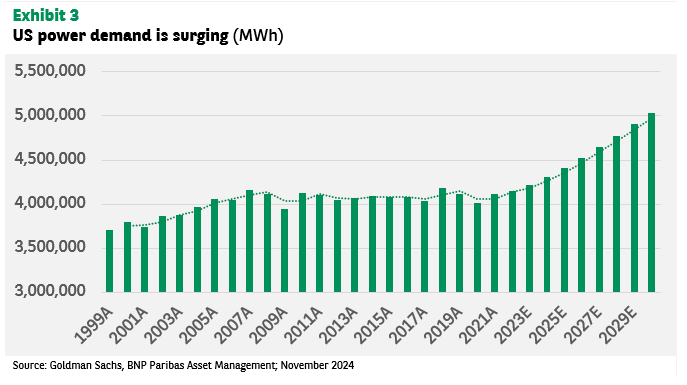
Global power demand growth is creating an urgent need for clean, affordable and readily available supply – and that has to come from renewables. As the falling cost of solar panels, wind turbines, hydrogen electrolysers and batteries drives a significant increase in adoption, the marginal cost of producing additional renewable energy nears zero.
Wherever climate sits on the political agenda, traditional energy cannot compete, due to the higher operating costs and price volatility related to extraction, transport and conversion, and the limited availability of further efficiencies to unlock. Indeed, energy security and a more volatile geopolitical landscape further complicates dependence on fossil fuels.
Wherever climate sits on the political agenda, traditional energy cannot compete
On the demand side of the equation, research¹ suggests there is a significant increase among consumers and corporations in their desire to use new energy sources in homes, vehicles, communities and as part of broader societal goals. Indeed, technology companies have emerged as the biggest buyers of clean energy globally, and this is expected to grow in importance and size.
A ready supply of cheap, clean energy has the potential to be a deflationary force for the global economy. To reach that point, though, investment will be vital. One area of opportunity is in grid connectivity. Almost 2 600 gigawatts of electricity generation and storage are actively seeking grid interconnection today, and the backlog has grown by 30% in 2023 alone. To enable power to flow where it is needed, there is a significant structural need to upgrade grids and connect supply.
The environmental solutions theme has been out of favour since 2021, as investment in capital-intensive solar, wind, battery and other renewable projects has stalled in the face of a higher interest-rate environment. As central banks embark on a coordinated global interest-rate cutting cycle, project economics are beginning to look more attractive, while the efficiencies companies have been forced to find over the past three years will represent a powerful tailwind.
As a result of the secular need for power demand, decarbonisation and growth in artificial intelligence and critical environmental infrastructure, we expect environmental solutions companies to be supported by macroeconomic tailwinds, close to all-time low valuations and cost advantages that could drive significant outperformance relative to global markets.
The goal – Real zero, not net zero
The limitations of net zero are becoming clear, with the reliance on carbon offsetting resulting in companies producing more, at greater environmental cost. Analysis by Carbon Brief shows two-thirds of the world’s biggest companies with net-zero targets are using offsets to help them meet their climate commitments.1 According to the 2024 Net Zero stock-take, while more and more countries, regions, cities and companies are setting net zero targets, 5% or less meet Net Zero Tracker’s procedural and integrity criteria.2
In 2025 and beyond, it will be even more important to invest in companies that can help us reach not net zero, but real zero. Alongside clean energy producers capable of crowding out gas and coal, companies operating in the circular economy, whose products and services reduce the need to produce or extract new resources, represent another important piece of the puzzle.
Business models and sectors offering potential investment opportunities include resource recovery companies in the waste management and environmental services sectors, as well as companies working to extend product lifecycles or offering sharing platforms.
These companies are often characterised by high degrees of product innovation and long-duration growth, where deep research and know-how is needed to address the associated risk by investing in newer technologies. However, for investors who can take a long-term perspective and invest in solutions that will have positive real-world impact, we believe the potential rewards are significant.
Weather events highlight investment needs, opportunities
Catastrophic flooding in central Europe, south Asia and the US this year is the latest reminder of the increasing threat global weather patterns pose as temperatures rise. The effects of climate events are felt across our society, in our food systems, supply chains and water cycles, creating the need for significant additional expenditure and investment.
As well as strengthening the case for faster progress on climate mitigation, this creates opportunities for companies providing adaptation solutions – both those involved in dealing with the aftermath of climate-related disasters and those building the more robust infrastructure required to withstand the challenges ahead.
Water is an area in which investment is urgently required. Both droughts and floods are harmful to water quality, which is also under pressure from human-made contaminants. Water scarcity is a threat to human welfare, with the problem most acute in sub-Saharan Africa, but extending to the developed world as temperatures rise.
Ensuring access to safe, healthy and reliable water will create investment opportunities across a wide range of companies, including those providing smart irrigation systems and pipes, and those involved in water treatment, quality monitoring, and tracking usage and leaks. The opportunity is surprisingly diverse and resilient, encompassing both defensive and cyclical businesses and spanning geographies, sectors and end markets.
2 https://zerotracker.net/analysis/net-zero-stocktake-2024
Life after cash

James McAlevey, Head of Investment Team – Global Aggregate & Absolute Return, London
The period of higher official interest rates triggered by the post-pandemic surge in inflation drew more than USD 6 trillion1 into short-term cash investments. Now, as central banks lower interest rates, where might money market fund assets find a home in 2025?
Fixed income reclaims its rightful place
Money market funds have provided substantial benefits in the recent higher interest-rate environment, but with cash rates coming down it’s time to look ahead. While we see rates declining, we don’t expect policy rates to go to zero.
For the period ahead, a more useful model than the Covid19 pandemic or the Global Financial Crisis can be found in ‘conventional’ recessions, in which rate cuts of 200-300 basis points were sufficient to reduce unemployment and provide economic stimulus.
With inflation now well under control, central banks have embarked on easing cycles for ‘conventional’ reasons, not crisis management. If growth weakens too much, we could see interest rates move below their long-term trend level, but we don’t expect them to do so significantly.
Moreover, central banks are unwinding quantitative easing. That means a transfer of debt to the private sector, which in turn means we’re unlikely to see a return of the flat yield curves that were characteristic of the zero-rate environment.
If interest rates do fall, we expect yield curves to remain steep and long-term rates relatively high. There are concerns about budget deficits, which look large for this stage of the cycle, but there currently appears to be little political appetite for fiscal prudence.
This is a positive environment for fixed income, in which bonds can again offer the income, carry and defensive characteristics to which investors were accustomed before the crisis years.
Meanwhile, the falling cash rate represents an incentive to move out of money market funds and to reinvest before policy rates hit their trough.
Bonds can offer the income, carry and defensive characteristics investors were used to
The opportunity set favours a flexible approach
Corporate credit is often the go-to area for income, but it looks expensive today given that we are at an advanced stage in the economic cycle, and seems even more expensive were we to head into an economic downturn.
Investors thinking about the year ahead should be aware of the sizeable corporate refinancing wave coming up in the next 12-18 months, which could lead to higher yields (and lower prices). US mortgages can be a useful substitute, offering a higher yield in combination with an implied triple-A rating given their government backing.
In emerging markets, as in developed, most central banks have embarked on cutting cycles. However, emerging market yield curves have been upward sloping for some time, and real yields are significantly higher.
As a result, we see emerging markets bonds – particularly those denominated in local currencies – as a better place to take interest-rate risk. Country selection is of course important given some markets are further along the easing path than others.
Volatility and dispersion make a comeback
If 2022 brought too much volatility in bond markets, the preceding years saw too little. Quantitative easing not only starved investors of income but suppressed volatility. There was little dispersion and little opportunity to benefit from arbitrage between or within fixed income segments.
Today, we are in a volatility sweet spot, with markets living, breathing and adjusting to fundamental developments in a way they haven’t for years. With more normalised volatility comes greater dispersion. Value-based investors can take advantage of this through intra-market and cross-market strategies or through the timing of allocation changes.
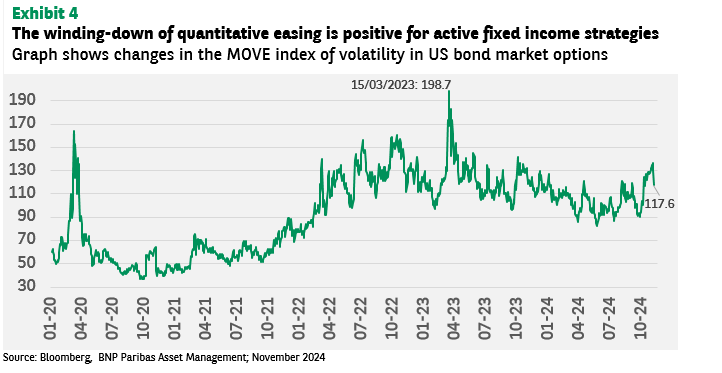
Economic dispersion is another area of opportunity. During the financial crisis and the pandemic, global central banks moved in lockstep, slashing rates at the same time for the same reasons and arriving quickly at the same destination. Now, we’re having very different conversations: who will go first, who will cut most, who’s ahead of or behind the curve, what might terminal rates be in which market?
One example is Canada versus the United Kingdom (UK) or versus Norway. Canada has sub-trend growth and below-target inflation, and is already well entrenched in its easing cycle. The UK has proceeded more cautiously, while Norway is yet to move. As the central banks plot different courses towards their respective targets, investors who get the sequencing right can benefit.
For investors not eager to make these decisions themselves, flexible funds targeting total and absolute return or income can take advantage of both attractive opportunities and useful places to hide out. When combined with their ability to navigate the ongoing uncertainties that might be giving investors pause, these strategies may be an attractive option for cash currently on the sidelines.


