
Investing in European small companies can offer investors attractive opportunities to diversify their portfolios and enhance returns, says Damien Kohler, head of small and mid caps at BNP Paribas Asset Management.
When European small caps underperform their larger counterparts, this is in part due to the cyclical nature of their business. Besides, they are often dependent on one product. This makes them sensitive to a significant economic slowdown. Large caps, on the other hand, tend to have strong market positions and suffer less in a downturn.
Having said that, European small caps tend to have stronger growth. This is often due to their ability to invest and expand in niche markets. Consequently, their organic growth often outpaces that of large caps. This has been the main source of their market outperformance over the longer term.
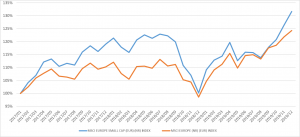
In seven out of the last 12 years – since 2008 – the MSCI Europe Small Cap (NR) index has outperformed the broad MSCI Europe (NR) (See Exhibit 1). In four out of these seven years, small caps were ahead by double-digit figures. In the five years of underperformance, the gap was a single-digit figure.
Exhibit 1: Small-cap stocks have outpaced large caps over the last three years, benefiting from strong growth in niche markets – graphs shows the 2017-2019 record of the European small-cap index relative to that of the large-cap barometer (Jan 2017 = 100)
Source: Bloomberg, BNPP AM
Risk management in combination with rigorous liquidity criteria
For many investors, the typically higher volatility of small caps is a concern. That is why investing in small caps requires a long-term view. This allows the worst shocks to be cushioned. The liquidity of the shares invested in is an important consideration in this respect.
Fund managers, in particular, those who pay little attention to that liquidity, can be burnt seriously when investor redemptions force funds to sell. That has a major impact on returns. Many funds then suffer. In our approach, strict risk management can then ensure that the benchmark and large caps are nonetheless beaten.
That is why we select stocks based on their market liquidity and the quality of the company’s balance sheet, among other things. We also regularly assess whether revenue growth is consistent over the next three years.
Better prospects
Since last December’s British election and the recent ‘phase one’ trade agreement between China and the US, two of the main issues that dogged markets in 2019 (i.e. Brexit and the Sino-US trade war) have receded. This has been helping investor confidence.
What is also supporting the European small cap segment is its relatively high dividend yield. The average dividend yield on European small caps is quite in line with that of large caps. Small caps offer 2.9%, large caps 3.5%. In the past, that difference was larger. This is another reason for investors to consider small caps.
A third point that should appeal to investors is that European small caps offer better diversification opportunities than large caps. The MSCI Europe Small Cap index contains about 1 000 companies, with the largest six countries making up 73% of the index; the large cap index includes about 450 companies, with four countries already accounting for 72%. This means that small caps can be used to add more to diversification to portfolios, both across countries, but also across sectors.
Strategy: Local or global
Small-cap companies can also give investors better exposure to an individual country, allowing them to really respond to cyclical differences across European countries.
With large caps, that is harder. These typically major international players are much more sensitive to global growth trends. In addition, it is possible to implement defensive and cyclical investment styles with small caps.
Sustainable
Sustainable investing in small caps can be a challenge. Large companies are typically much further along in this area. Smaller companies often do not have the same resources to implement specific environmental, social and governance policies. Nor do they communicate much about their ESG activities. Nevertheless, as a selection factor, ESG is integrated fully into our investment process for small caps, as it is with all other asset classes that BNP Paribas Asset Management funds invest in.
By the way, in our view, companies with the best ESG score do not always offer the best returns. A good guide would be to not necessarily buy the best ESG companies, but to avoid the worst. Which ESG criteria are relevant also varies from sector to sector.
This article appeared in The Intelligence Report. It is based on an interview published on fondsnieuws.nl

To discover our funds and select the ones that meet your requirements, click here > or visit your local country website


