
With the US Federal Reserve starting to cut interest rates, equities should remain supported in the short term. If our expectations of a soft landing for the economy are warranted, equities should gain further, even if the outcome of November’s US election looks uncertain. The mix of winners and losers might change depending on who will be in government.
Separately, China’s recent surprise stimulus package should lead to a continued tactical rebound in the market. Whether the medium-term outlook has fundamentally improved remains to be seen.
How asset classes perform in rate cutting cycles
The start of the cutting cycle in the US has boosted equities and raised hopes of a soft landing for the economy, especially as the 50bp cut was larger than the market had expected.
Such hopes to some degree fly in the face of history: In the last five cutting cycles, a recession occurred in four (see Exhibit 1). The exception was the cycle that began in 1984, when growth merely slowed to its trend rate. We believe the US economy will also see a soft landing this time.
After the Fed’s first rate cut, there has been much analysis of how different asset classes perform in cutting cycles. Simply taking the average returns of the previous five episodes, however, misses significant variation and ignores the crucial factor of the impact of economic growth on asset prices.
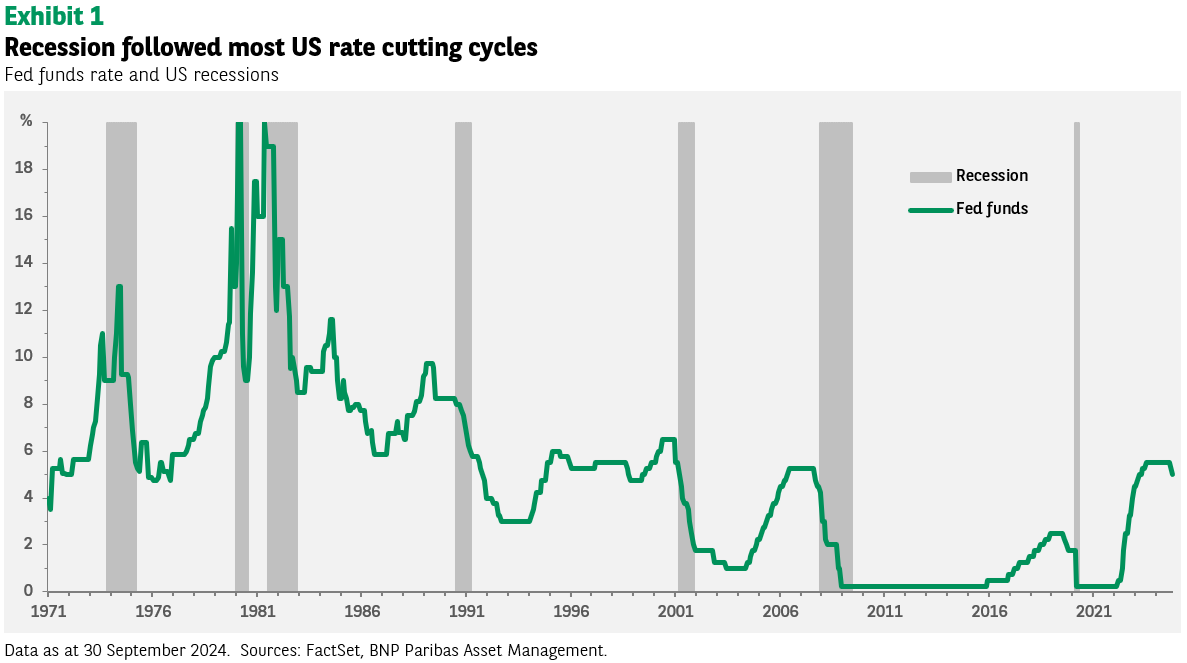
What is critical is not the fact that there was a recession in four out of the five previous cycles, but the timing. Asset returns in the 12 months after the first cut depended much more on whether the recession occurred sooner or later (if at all).
In other words, while all five episodes had falling policy rates in common, it is economic growth that primarily explains the differences in returns. One’s forecast for the outlook for GDP is thus more important than accurately predicting the number and timing of Fed cuts.
An environment where interest rates are falling and growth is slowing, or even negative, should be better for fixed income than equities, and for defensive stocks rather than cyclicals. On average over the five episodes, this is what occurred.
The US market tended to outperform the rest of the world, growth beat value, large caps outperformed small ones, and the top performing sectors were consumer staples, healthcare and materials (see Exhibit 2).
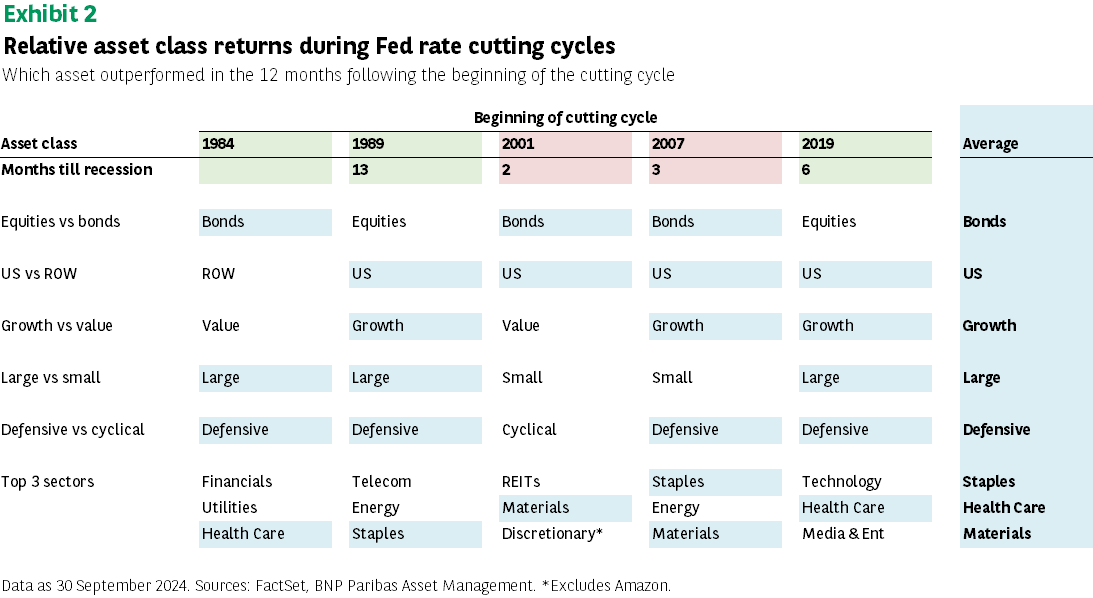
The relative returns between the two ‘near-term recession’ (NTR) cycles (2001 and 2007), and the ‘late or no recession’ (LNR) cycles (1984, 1989, 2019) were often quite different, however. In the LNR cycles, equities often bested bonds. The exception in 1984 may have had more to do with the starting point for Treasury yields at 14%, which subsequently dropped by almost 700bp.
We believe we are likely to see a rather smaller drop this time.
Growth outperformed value in two out of the three LNR cycles, while the NTR cycles were split. Perhaps surprisingly, small-cap stocks did best during the NTR cycles, though this more reflects the massive underperformance of technology stocks in 2001 and financial stocks in 2008 than the superior performance of small caps. Cyclicals outperformed defensives just once, in 2001. Sector returns were quite varied, with no single sector in the top three more than twice.
US outlook – Modestly overweight
With the US economy gradually slowing and, in our view, any near-term recession risks quite low, the environment is positive for US equity outperformance. The latest Atlanta Fed GDPNow forecast for the third quarter is 2.9% (seasonally-adjusted annual rate (SAAR)) after 3% in the second quarter; that is, growth is not really slowing.
Falling oil prices should provide a further boost to growth, reducing some of the previous drag on lower-end consumers from high inflation, and reducing input costs for companies (though developments in the Middle East could quickly reverse the fall).
The latest retail sales data suggests weakening growth, but that is not a worry; the economy must slow to hit the Fed’s forecast for 2% GDP growth – and its target for personal consumption expenditures (PCE) inflation. Worries will likely only arise if it appears that the deceleration is going further, either to a rate below 2%, or in the worst case, a contraction.
Our multi-asset team is modestly overweight US equities via the NASDAQ. This view is supported by steadily rising earnings expectations (see Exhibit 3). This pattern is notable, particularly for the NASDAQ (and Japan), given the market’s volatility over the summer. That volatility was primarily driven by technical factors such as the sudden unwinding of yen carry trades.

Earnings for S&P 500 companies are forecast to have risen by around 4% year-on-year in the third quarter, but there is a significant difference between the earnings for growth and value stocks.
The NASDAQ 100 index should see profit gains of just over 11%, while for the Russell Value index, earnings are expected to decline by about 1%. For value, expected strong gains for healthcare companies are offset by losses for energy companies.
The US election is the wild card in these forecasts. With polls showing the race as extremely close, markets are simply unable to price in either ‘Trump trades’ or ‘Harris trades’. Once the results are known – in particular, the configuration of Congress – will markets be able to assess the likely impact on the economy and different sectors. If there are to be tariffs, some sectors could take a hit.
Aside from election uncertainty, geopolitics is an ever-present risk as the world does not appear likely to become safer anytime soon.
Europe – Wanted: a catalyst to unlock valuations
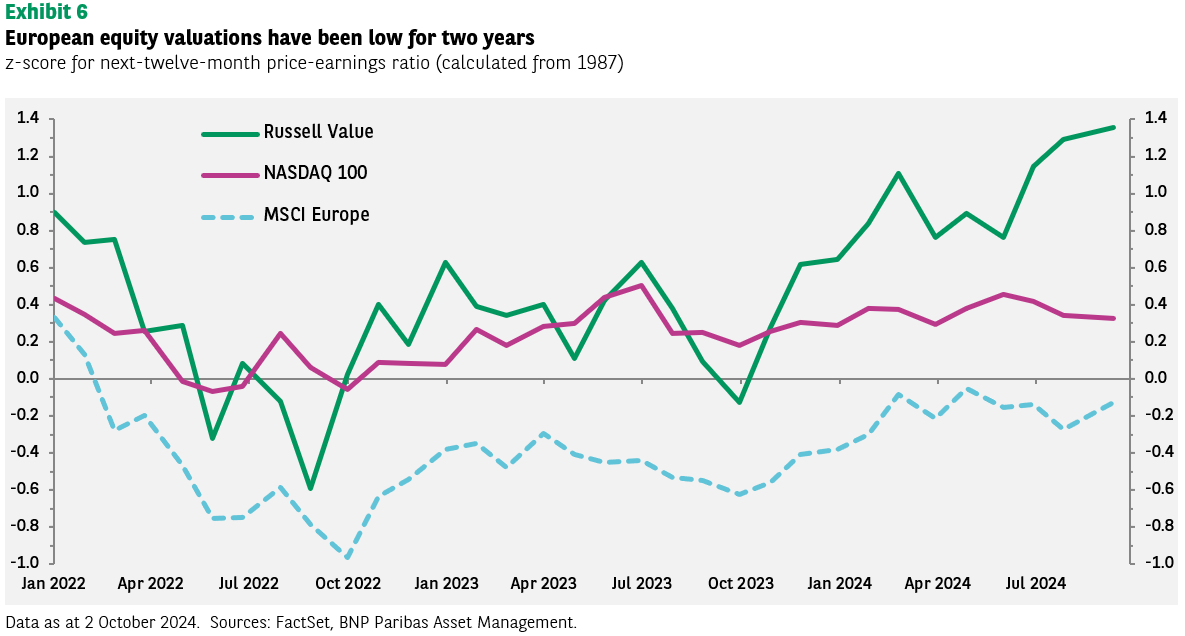
Along with most major indices, the MSCI Europe has made up all the losses from the summer sell-off, though it had never declined much in the first place (see Exhibit 4). So far this year, Europe has lagged most of major regional indices as growth has disappointed.
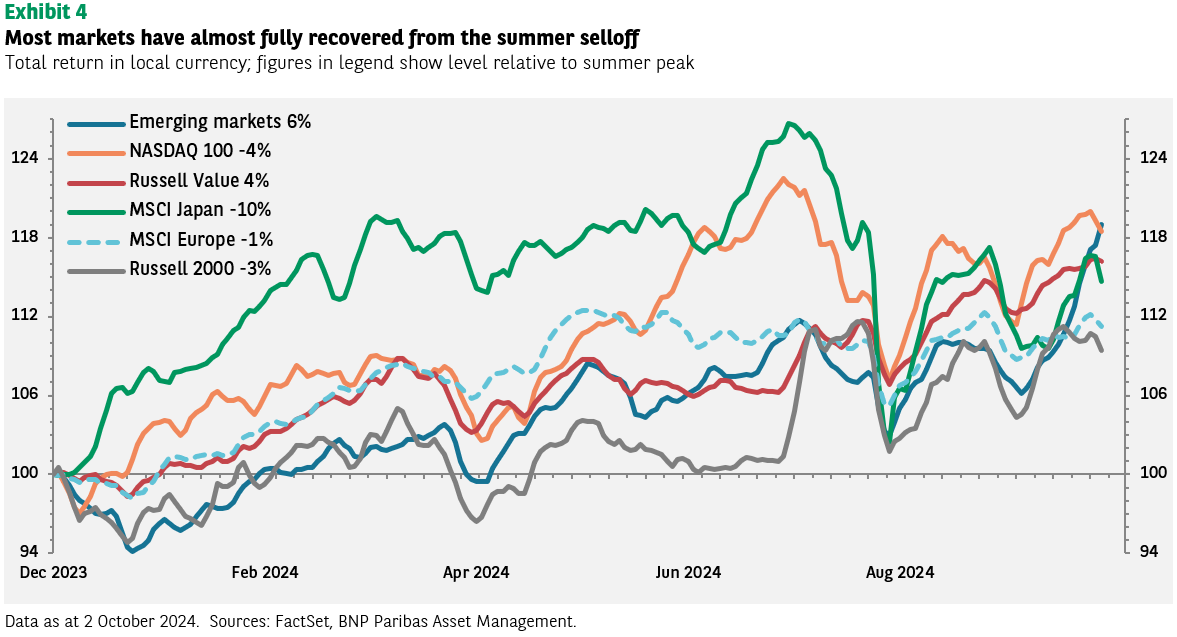
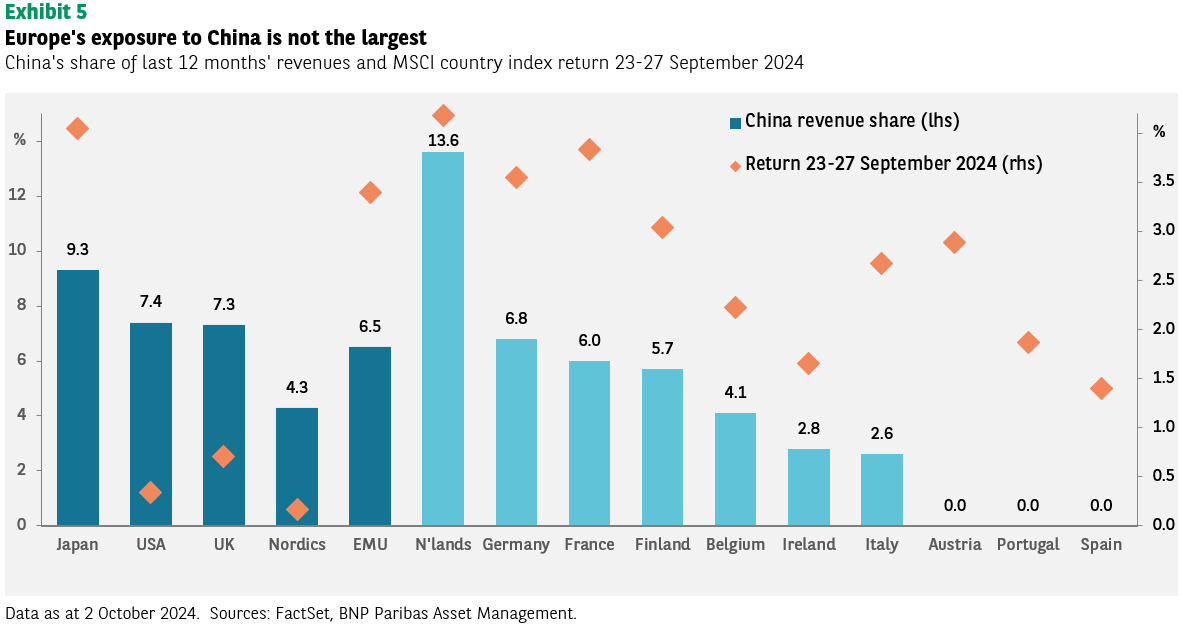
The market has received a boost from news of Beijing’s large stimulus package (see section on China). Many investors believe that continental Europe is more exposed to China than the US is, and the initial gains reflected that assumption: The MSCI EMU gained 3.4% vs. 0.3% for the S&P 500.
Reality is not entirely aligned with these returns. US companies sell more to China as a percentage of their sales. Sales to China account for 7.4% of large-cap US revenues versus 6.5% for companies in the MSCI EMU index. The UK share is also higher at 7.3%, as is the share for the Netherlands (13.6%).
Even for countries with a relatively large exposure (France, 6.8% and Germany, 6%), the volume is less than that for the US. The one major market with the largest exposure is Japan at 9.3%, and the returns over the last week for the MSCI Japan index have been commensurately greater at 4%.
While any marginal increase in sales to China resulting from the stimulus package should benefit European corporates, earnings will depend much more on sales within Europe and to the US, which represent over 24% of revenues.
Demand from the US should remain robust, but the outlook within Europe is challenging. Consumer sentiment is improving, but still depressed; economic data has disappointed; and the ECB has less scope to stimulate growth as policy rates are lower than in the US.
Consensus earnings estimates reflect this: In 2025, profits are expected to rise by just 9.3% compared to double-digit gains elsewhere (based on FactSet estimates).
The primary appeal of the market is valuations, but that has been the case for the last two years. Europe needs a catalyst to unlock this potential. Right now, it is difficult to see what that might be.
China – A real boost this time?
Markets have welcomed the latest stimulus for the economy. Not only has the MSCI China index gained 17% since 23 September, but markets linked to China such as Japan and Europe, have outperformed global benchmarks. Judging by previous rallies after big policy announcements, the period of Chinese equity outperformance could last many months (see Exhibit 7).
Part of the outperformance reflects previously poor foreign investor sentiment, underweight positions in many institutional portfolios and short positions in hedge funds.
In contrast to previous efforts, this move includes cash handouts to stimulate consumption and liquidity support for the stock market. There was more support for the property market, which is recognised as the country’s main near-term problem. Thanks to these measures, China’s leaders now at least have a chance of reaching their 5% growth target for the year.
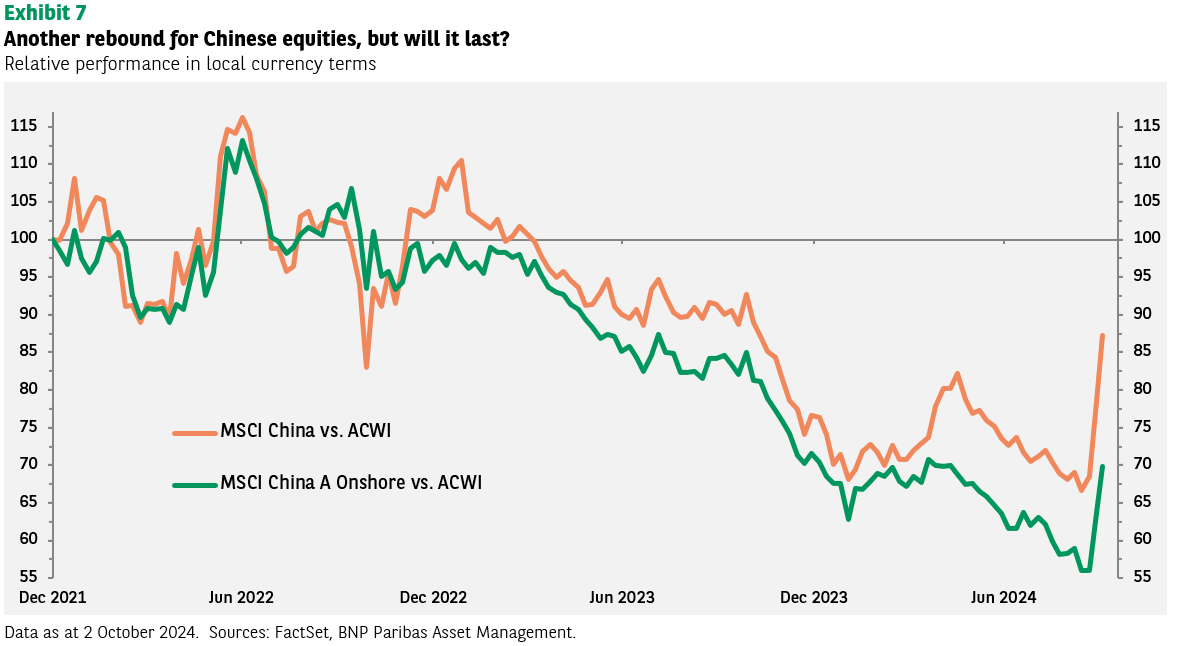
But what about in the longer term? Beijing also aims to double per capita income by 2035, which requires 5% growth every year over the next 10 years. We question whether this objective will be reached.
As our Asia strategist points out, some of the policies are contradictory. Being wants to boost growth, but also to re-industrialise as a high-tech economy. This means a retreat from old economy industries and less reliance on infrastructure and property investment. Such policies are slowing growth.
It is also not certain the areas chosen as part of ‘new quality productive forces’ can generate growth in the way infrastructure and property did in the past. Analysis by Goldman Sachs Global Investment Research suggests the share of GDP represented by new energy vehicles, wind/solar and battery (known as the ‘new three’), is only a fraction of property’s share.
Massive investment in the ‘new three’ might only generative (more) overcapacity. China’s exports of excess production in these and other sectors have driven growth over the last few quarters, but given the growing protectionist sentiment globally, this is unlikely to be sustainable.
Instead of exports or investments driving growth, China could focus on consumer demand, developing an economy more like that of the US or Europe. This would require improving the welfare and healthcare systems, so that people feel less of a need to accumulate savings to help them through times of trouble. Few measures over the years, however, have promoted such an evolution.
Even the cash handouts for those in extreme poverty are likely to have little impact on consumption, not just because they are directed towards a small share of the population.
Given the high share of household wealth represented by property, people understandably worry about the drop in real estate prices. Until they are convinced this market has turned the corner, they are unlikely to increase their spending. None of the recent measures suggests that turnaround is imminent.


