
Will the latest US tariffs on Chinese solar panel and electric vehicle (EV) imports – and the possibility of further tariffs after November’s US election – lift US inflation? Will they upset investor expectations of disinflationary growth and interest rate cuts, seen as a key support for equities?
Listen to the article
Rate cuts are here
The European Central Bank (ECB) and the Bank of Canada (BoC) led G7 central banks in cutting interest rates recently. However, mixed economic data have done nothing to move monetary authorities away from their data-dependent policy mode.
Financial markets saw the ECB’s 25bp rate cut as ‘hawkish’ because the central bank revised its growth and inflation forecasts upwards for this year and next, taking into account recent data surprises. The ECB did not pre-commit the future path of cuts and reiterated its ‘data-dependent’ stance.
The BoC was similarly cautious in what it told markets. It stressed that “interest rate decisions will be taken one meeting at a time”, depending on whether the economy evolves in line with its forecasts.
Other central banks – Sweden’s Riksbank and the Swiss National Bank – have also begun to take their foot off the brake. This could signal the start of a wider shift in monetary policy from tightening to slow inflation to easing as price pressures abate.
A different rate cut catalyst
The catalyst for interest rate cuts is different this time. In the past, an economic recession or a financial crisis often prompted monetary easing. Now, central banks are cutting rates in response to slowing inflation.
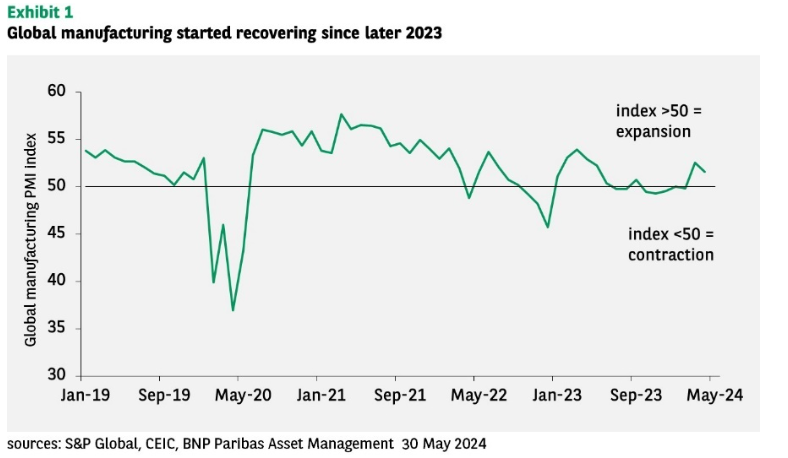
Disinflationary growth and policy easing are buoying the equity market. Global manufacturing is also recovering (see Exhibit 1). Growth and pricing momentum are returning to Japan, and China has made a policy U-turn by launching a large stimulus programme to stabilise the property market and bolster public confidence.
Adding in the effects of tariffs
But there are risks on the horizon. The US has again imposed tariffs on Chinese imports. Those levied by the Trump administration in 2018 boosted US inflation, though by less than was expected.
This was because:
1) A substantial proportion of the goods that were hit with tariffs were intermediary goods, not final consumer products.
2) Local US suppliers absorbed some of the impact on domestic prices by accepting lower margins.
3) The Chinese renminbi dropped by over 14% against the US dollar in 2018 and 2019, offsetting part of the tariff-induced import price inflation in the US.
There are significant differences, however, between the current round of tariffs and those seen in 2018. The US now imports virtually no EVs from China; only a few categories of Chinese solar panels and batteries are subject to the new Biden tariffs. Furthermore, US sectors that are vulnerable to any retaliation by China are receiving support from the Inflation Reduction Act and other fiscal measures.
The impact of the latest tariffs on US inflation and growth should thus be limited. The greatest risk may come after the presidential election if the trade conflict were to broaden significantly to include most or even all Chinese imports.
Another source of resurging inflation could be an energy or a supply-chain shock as geopolitical conflicts spread. This could force the Fed and other major central banks to raise rates again, which would hurt both stocks and bonds as the risk of stagflation mounts.
Productivity gains
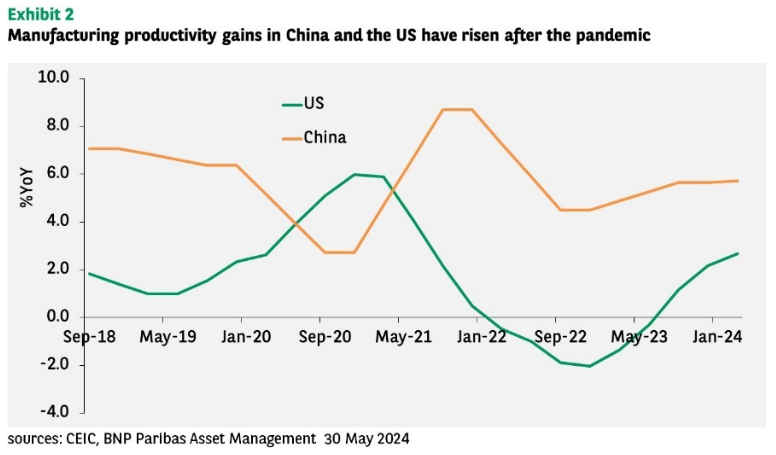
Over the medium term, inflation is more likely to fall than rise amid productivity gains, especially in the world’s two biggest economies, the US and China (see Exhibit 2). Even in the eurozone, which faces structural headwinds, productivity is expected to see a cyclical rebound.
The major economies are investing more in artificial intelligence (AI) and data centres. This should boost corporate efficiency, productivity and support the recovery of global manufacturing.
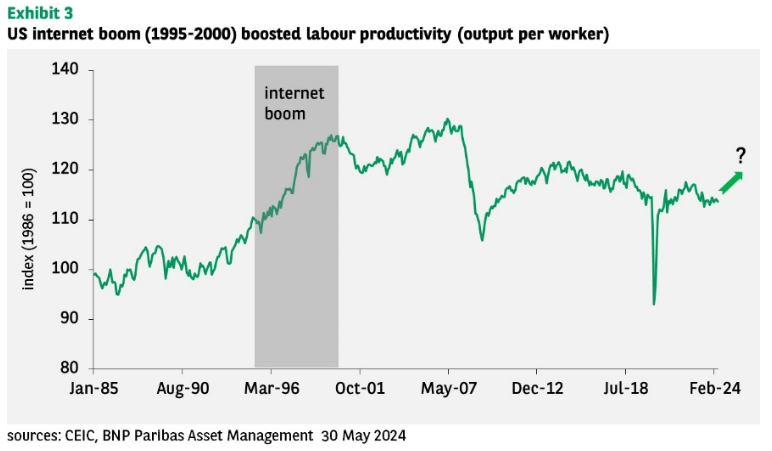
We have seen this pattern in the past. The US internet boom between the mid-1990s and early 2000s lifted labour productivity (see Exhibit 3), helping to keep the US consumer price inflation rate at 2.4% a year on average over that period. The ongoing AI revolution could similarly boost productivity and constrain inflation.
China’s story is different. Its economy has suffered from deficient demand since the pandemic, though GDP still grew by 5.3% year-on-year in 2023. A plausible explanation is that improved productivity boosted output growth amid a decline in the labour force.
Unless global inflation dynamics unexpectedly change for the worse, the rate cut scenario should remain intact. The AI boom and global manufacturing recovery bode well for risk assets in the medium term.


