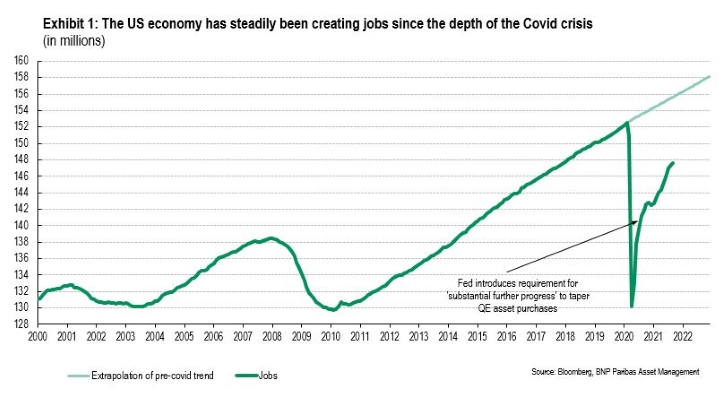
The US economy added just 194 000 jobs in September, falling well short of consensus expectations of around 500 000 and marking the weakest pace of job creation this year. August had seen 366 000 new jobs after more than one million in July.
Our view is that the latest jobs report reflects the disruption to the US economy caused by the Delta variant of Covid-19 over the summer. Data for September’s report was collected in mid-September when the Delta wave was near its peak.
This showed up in leisure and hospitality businesses, which had been a significant driver of job growth earlier this year. Here, fewer than 100 000 jobs were added in August and September. While Delta’s economic impact has been significant, the variant has nonetheless been contained. Construction companies and manufacturers reported strong job growth despite supply-chain difficulties, and retail hiring rebounded after two months of declines.
The biggest drag on employment was in the public sector. Government payrolls shrank by 123 000, with most of the losses in education. This decline appears to reflect the way the US Labor Department accounts for seasonal patterns, which the pandemic disrupted.
On an unadjusted basis, federal, state and local government employment actually grew by close to 900 000 in September. As that is fewer than in a typical September, the seasonal adjustment formula interprets it as a loss in jobs.
Overall, the September payrolls data was probably not the clear-cut report the US Federal Reserve might have had hoped for. Nonetheless, we think the job gains were sufficient to open the way for the central bank to announce a tapering of its asset purchases at its policy meeting in November.