
US core consumer prices jumped by 0.9% on the month in April. When combined with the big fall in prices 12 months ago dropping out of the annual calculation, year-on-year core consumer price index (CPI) inflation was pushed up to 3%, marking the highest rate since the mid-1990s.
Once again, distortions in activity tied to the evolution of the pandemic caused large moves in prices in certain categories: the three biggest surprises in the inflation data in several decades have all come in the last 12 months (highlighted in Exhibit 1).

As the economy reopened in April, a number of sectors badly hit by COVID-19 related shutdowns last year posted large price increases. Hotel prices and admissions to sports events rose by 8% on the month, airline fares and used car prices increased by 10% and vehicle rental rates jumped by a staggering 16%. Taken together, these key segments contributed about two-thirds to the overall increase in inflation in April despite only accounting for just over 10% of the inflation index (Exhibit 2).

Supply chain issues apparent
Digging further into the details of the report, the fingerprints of various supply chain issues can be seen. TV, electronics and toy prices all rose by around 3% for the biggest increase in many years – this is likely to be seen in upcoming purchasing price indices (PPI) too.
Interestingly, the big sectors in the services part of the CPI – housing and medical care, which make up around half of core inflation and typically have a lot of persistence – were muted. Rental prices are widely expected to pick up over the summer, but as yet, that has not been seen in the CPI data.
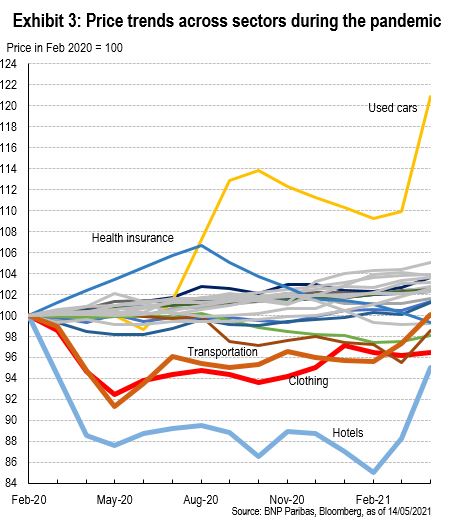
There is likely more near-term upward pressure in the transportation, entertainment and hotel categories (Exhibit 3) as the economy continues to normalise, while used car prices should level off and unwind, but that will require more new cars to be produced (this is being held up by the semiconductor shortage) and for that increase to feed through into a greater supply of used vehicles.
So far, as the Fed expected…
The magnitude of the surprise in this report was far greater than forecast, but the sectors in which it happened won’t have come as a great surprise to the Federal Reserve (the Fed). That makes it relatively straightforward for the central bank to continue to explain this increase as ‘transitory’.
The economy will not reopen multiple times and to the extent that much of the price pressures come through in one big surge it makes it easier for the Fed to pass that off as transitory, in much the same way as the instinctive reaction of some observers to recent surprising jobs data was to put it down to temporary factors.


