
After months of careful communication, the US Federal Reserve on 3 November announced that it would slow the rate at which it is buying bonds in the market. The monthly pace of purchases will decline by USD 15 billion a month, putting it on course to complete the taper process in June 2022.
Debate now about when rates will be raised
Now the policy debate will turn to when the Fed will decide that its three criteria on lift-off have been met and how fast policy rates might rise thereafter.
The three criteria to be met for the Fed to raise rates are:
- Maximum employment
- 2% inflation
- Inflation on track to moderately exceed 2% for some time.
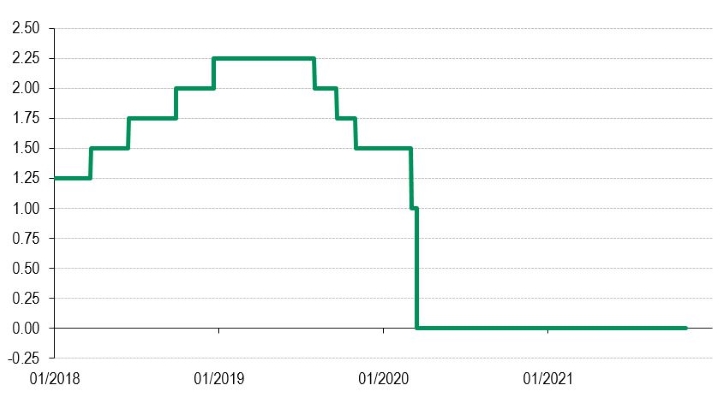
In his press conference, Chair Powell was clear that the Fed was approaching this discussion in a ‘risk management’ framework, balancing the fact that inflation is now well above the Fed’s 2% target despite the economy being well shy of full employment.
Waiting to see
Powell is clearly hoping that Covid will continue to abate over the winter, making more people comfortable or able to get back to old employment and consumption patterns. This would help relieve stress on the supply side of the economy. He expects those sorts of behavioural changes to begin pushing down inflation in the second or third quarter of 2022.
Depending on the extent that materialises, dovish policymakers on the Federal Open Markets Committee might be able to argue for delaying policy tightening, as they thought appropriate in September.
However, Powell was far less certain about the outlook, for either inflation or maximum employment than he was a few months ago.
Earlier in the year, he was adamant that, given time, the labour market would return to its pre-pandemic state.
Speaking after the meeting on 3 November, he had a much more nuanced take and said he would be watching the data to see how the job market evolved and what that might mean when it came to interpreting the Fed’s maximum employment goal.
Similarly, in September, the FOMC statement had described high inflation as largely being caused by transitory factors. The latest Fed statement described high inflation as being caused by factors that are expected to be transitory: confidence in their prior view has been eroded.
Room for change
If, ultimately, inflation pressures in the first half of 2022 were even more intense than the Fed currently expects, the taper process could be accelerated, ending bond buying earlier, implicitly clearing the ground for an earlier rate rise.
However, Powell also said that he wouldn’t want any decision to change the pace of the taper to surprise markets. That probably means preparing the ground for any change in the pace of the taper over a period of a month or two through Fed speeches and the minutes of FOMC meetings.


