
By Cedric Scholtes, Head of Investment Team, Global Sovereign Inflation and Rates and Elida Rhenals, Senior Portfolio Manager and Co-Head of Inflation
- Geopolitical and economic shocks have made inflation less predictable, strengthening the case for inflation-linked bonds
- Higher real yields can provide a stronger buffer and more attractive entry points for inflation-linked bonds than in previous years
- A diversified, active approach is essential to navigate changing inflation dynamics and managing interest-rate sensitivity across different markets
A series of inflationary shocks have buffeted the global economy in recent years – from pandemic-related shutdowns, followed by massive fiscal stimulus intended to protect firms and households, to wars in Ukraine and Iran, to tariffs, and most recently the artificial intelligence capex boom. Central banks have had the unenviable task of responding to these supply and demand shocks, having to judge their magnitude and persistence to calibrate policy rates.
Despite inflation having remained well above central bank targets for several years, investors have not seemed overly concerned about central banks’ willingness or ability to tackle inflation.
But geopolitical tensions, trade wars, energy insecurity, supply chain disruptions and rising investment in infrastructure and AI are reshaping the inflation outlook.
As we look to 2027, we believe that rather than assuming there will be a return to the relative price stability of the pre-pandemic decade, investors may need to prepare for a world in which inflation might be more elevated, but will also almost certainly be more volatile, less predictable, with a broader range of possible outcomes.
Inflation volatility: A structural shift?
For investors, a more volatile inflationary backdrop changes the way inflation protection should be considered. We believe it strengthens the case for inflation-linked bonds, especially now that real yields (returns adjusted for inflation) have normalised from pre-pandemic levels. Rather than a tactical response to the next inflation release, inflation-linked bonds can serve as a structural component of a fixed income or multi-asset portfolio.
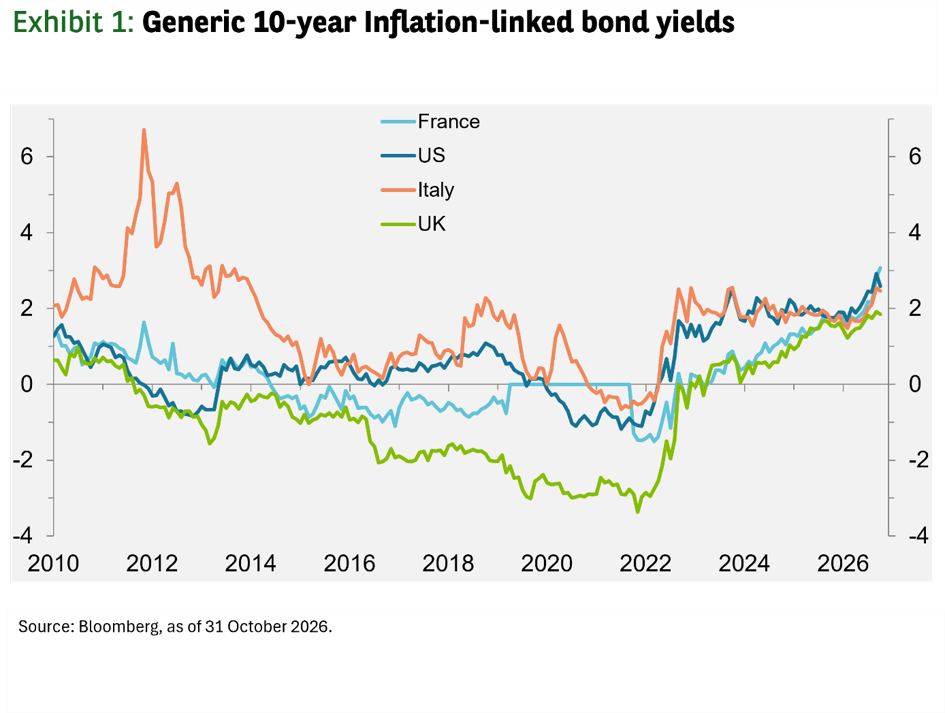
Importantly, valuations of inflation-linked bonds have also become more attractive. Real yields derived from inflation-linked bonds are now significantly higher than during much of the past two decades, providing a significant buffer in case central banks need to tighten policy further than is currently priced. Exhibit 1 shows developments in generic 10-year real yields for the key US, UK, France and Italian inflation-linked bond markets.
How do inflation-linked bonds work?
Unlike conventional bonds, inflation-linked bonds have cash flows that are adjusted in line with realised inflation, in order to protect the investor’s purchasing power. Their principal and coupon payments are linked to an inflation index, providing compensation for changes in prices over the life of the bond.
However, investors should be aware that inflation-linked bonds do not always rise in value whenever inflation increases. Their mark-to-market performance depends on three main drivers:
- Real coupon income: Like conventional bonds, inflation-linked bonds generate income through the periodic payout of (inflation-adjusted) coupons
- Inflation accretion: An inflation-linked bond’s principal payout moves in line with the underlying Consumer Price Index, and in most cases with a floor at the bond’s original face value. As a bond ages, it accrues inflation via a formulaic uprating of the principal paid out at maturity (but which increases the bond’s market value immediately)
- Duration impact: Like conventional bonds, inflation-linked bond prices are sensitive to fluctuations in yields. The magnitude of these movements depends on the bond’s duration, or sensitivity to yield changes. They tend to outperform conventional bonds when investors perceive inflation risk is rising, reflected in a widening of the spread between nominal and real yields on bonds of comparable maturity (the so-called breakeven inflation spread)
A common critique of inflation-linked bonds is that an investor who holds a 10-year bond through a period of elevated inflation may end up gaining less from inflation accretion than they lose on duration when the central bank tightens policy to combat the rise in inflation. This explains why investors looking for inflation protection have in recent years focused on short-dated inflation-linked bond funds.
Real yields and relative returns
However, the analysis is incomplete for a couple of reasons. First, starting yields matter. Today’s higher yields provide a much larger buffer against rising yields, especially if some monetary policy tightening is already priced in.
Second, most investors already own duration elsewhere in their fixed income allocations, but holding real yields could potentially be the better choice when faced with an inflation scare that initially pushes breakevens wider and then allows the investor to collect that inflation.
For some investors then, relative return, not absolute return, is the focus. By way of example, the Bloomberg one-to-30-year Treasury Inflation-Protected Securities (TIPS) index outperformed its maturity-matched comparator Treasury index by 12.6% in total return terms between 1 January 2020 and 12 December 2024, a period that covered the pandemic inflation, Ukraine war and a full Federal Reserve hiking cycle.1
This outperformance was achieved despite the rise in breakevens being temporary, and the central bank moving policy into restrictive territory, with inflation-linked bonds accreting the unanticipated rise in the CPI index.
So, for investors with a fixed duration allocation, the role of inflation-linked bonds in a portfolio is really to aim to provide diversification in the near term (when real yields diverge from nominal yields), and long-term insurance against inflation shocks (via the gradual process of inflation accretion).
Aiming for this insurance is most valuable when inflation episodes are likely to be more frequent than has been the case in the last three decades, and when the cost of the insurance (reflected in breakeven inflation rates) remains low.
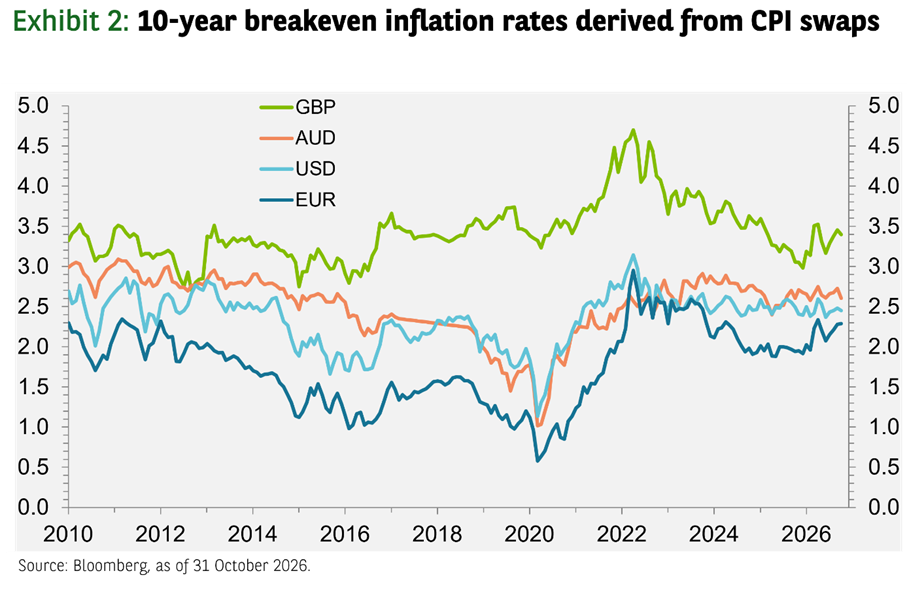
With breakeven inflation rates at around 2.0 to 2.4% in the eurozone and US, the hurdle will not be hard to clear if the global economy continues to be subjected to supply shocks.
Investors looking to gain protection against inflation surprises therefore need to ask themselves two questions: which markets should they focus on and how much interest rate sensitivity should they take on.
Taking a global approach
Inflation may be a global phenomenon, but it does not evolve uniformly across countries.
The US, eurozone and UK can experience different inflation dynamics and monetary policy cycles. As a result, opportunities in inflation-linked bonds can shift between markets over time.
For example, US TIPS were attractive during 2025’s ‘Liberation Day’ tariff announcements, while 2026’s Iran-related energy shock shifted attention towards Europe and UK inflation-linked bonds. A global investment universe therefore offers access to a broader range of opportunities and allows investors to diversify their sources of inflation exposure rather than relying on a single market.
Navigating inflation and interest-rate risks
Choosing the right market is only part of the challenge. Investors must also consider maturity, duration and the inflation expectations already reflected in bond prices.
Passive inflation-linked bond indices are typically weighted according to outstanding issuance or market capitalisation. This does not necessarily provide the most attractive investment exposure and can result in significant interest-rate sensitivity. UK inflation linked bonds, for example, make an outsized contribution, both in terms of weight and duration, to global inflation-linked indices.
The soaring inflation and sharp increase in interest rates witnessed in 2022 illustrates why duration matters. Investors seeking inflation protection may not want to assume substantial exposure to the interest rate risks associated with longer-maturity bonds during periods when central banks are aggressively tightening policy.
In these circumstances, investors may favour the shorter end of the yield curve, seeking to capture inflation exposure while limiting some of the volatility associated with longer-duration bonds.
An actively managed approach allows portfolio managers to adjust exposure across countries and maturities, manage real-yield sensitivity and assess whether market inflation expectations offer attractive value.
The objective is to identify where investors are being best compensated for the risks they assume, rather than simply replicating the composition of the inflation-linked bond market.
What does this mean for investors?
The case for inflation-linked bonds rests on three considerations:
- Inflation protection beyond short-term market movements: A more unpredictable inflation environment supports considering inflation-linked bonds as a structural portfolio allocation rather than a tactical trade
- More attractive real yields: Investors can now combine seeking inflation protection with positive real yields, unlike during much of the previous decade
- Greater scope for selective positioning: A global, actively managed approach can help investors navigate differences in inflation expectations, real yields and duration across markets
With inflation outcomes becoming less predictable, the question for investors is no longer simply when to seek inflation protection, but how best to incorporate it into their long-term allocation.
[1] Bloomberg.


