
By Arnaud Lebreton, Global Head of Insurance Coverage and Philippe Argou, Insurance CIO Coordinator
- Higher and volatile bond yields are presenting insurers with investment opportunities but also challenges with regards to liquidity and interest rates risk mismatch
- Tight credit spreads are prompting insurers to focus on shorter dated credit or to use the flexibility offered by derivatives
- More complex regulatory regimes and volatile market conditions mean insurers must strengthen their investment and risk management frameworks to manage balance sheet liquidity and performance
The macroeconomic and market backdrop for insurers has changed significantly over the past year, chiefly because of the Iran conflict.
Soaring energy prices have helped push up Eurozone annual inflation from 2.2% in September 2025 to 3.8% in September 2026. And in the US, inflation rose from 2.13% in September 2025 to 3.74%, 12 months later.
A year ago, the European Central Bank was considering a normalisation of monetary policy, pausing the 2024-2025 interest rate cuts which had quickly followed a phase of rapid hikes between 2022 and 2024, thanks to inflation moving towards its 2% target.
Meanwhile, the US Federal Reserve was looking to enter an easing cycle, with four cuts expected at the time.
One year on and both, albeit at a differing pace, have hiked twice – and markets are expecting more: two additional hikes until the end of 2027 for both the ECB and the Fed.1
As central banks raised their policy rates, bond yields also rose, but the expected steepening of the long end of the yield curve didn’t really happen. In 2026, US and euro term premia barely increased, especially when put into historical perspective:
We believe this leaves room for considerably more steepening going forward, especially as unaddressed deficits and fiscal concerns – in the US, several eurozone countries, and in Japan – are fuelling the rise in global yields.
For these reasons we believe that, when entering in 2027, insurers are likely to focus duration purchases more on the short-and-medium-term end of the curve.
Managing liquidity
If higher yields should be good news for insurers, then this also presents several challenges. First, after several years of increasing reinvestment,cash flowing into the market may be scarcer with investment plans having already been accelerated or short-term maturities already refinanced. Here, repurchase agreements (repos) could offer the resources to aim for the desired exposure to higher-yielding investments.
Second – and still liquidity related – continuously increasing rates are imposing a strain on balance sheets: the marked-to-market value of fixed-rate receiving derivatives becomes more and more negative, while at same time, the value of high-quality assets – used for collateral purposes – decreases.
This means that, more than ever, insurers need to have a strengthened liquidity management framework and the appropriate infrastructure to meet their financial obligations in a timely and efficient way.
They need to measure and monitor liquidity needs and resources on an ongoing basis and under different market conditions. In practice, liquidity needs and resources must be projected at different time horizons and the value of derivatives and eligible collateral stress tested.
Repurchase agreements, again, can potentially allow insurers to manage cash shortfalls and to minimise cash buffers, reducing the opportunity cost. Bond Credit Support Annexes2 can potentially make collateral management even more efficient provided enough eligible collateral sits against derivatives positions.
Asset and liability management perspectives
From an asset and liability management perspective, higher yields can create a mismatch due to convexity (the pace of change of duration as interest rates change). Liabilities duration could decrease faster than that of assets, which is not a desirable outcome for insurers in such a market dynamic.
Addressing this issue requires either dynamically rotating fixed-income portfolios to shorter dated bonds – which may be challenging without diluting the portfolio’s overall yield unless the insurer accepts higher credit risk by incorporating lower-rated bonds – or using the flexibility offered by derivatives.
Payer swaps, where an investor can pay a fixed interest rate but receive a floating rate, could allow insurers to adjust the asset duration without realising undesired accounting losses.
Alternatively, payer swaptions – which give the option, but not the obligation, of entering into an interest rate swap – could hedge the still higher interest rates scenario by stabilising asset duration without impacting the portfolio’s bond holdings.
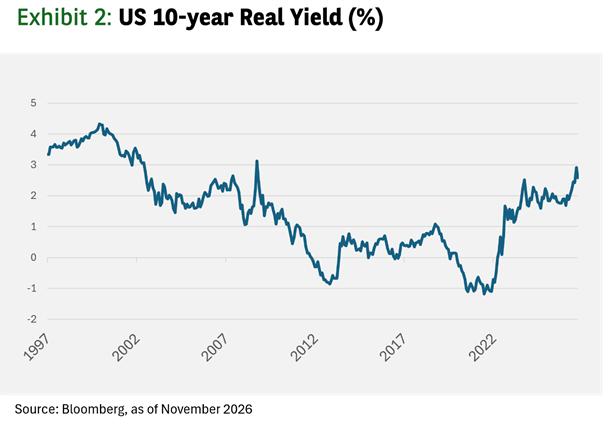
Also, persistent inflation can create a strain on liabilities for certain insurers (such as property and casualty insurers). In this context, real-yield assets that aim to generate returns above the rate of inflation, such as inflation-linked bonds, are relatively cheap and can act as valuable hedges to match these inflation-linked insurance obligations such as workers’ compensation.
Diversification and flexibility
The current environment highlights the importance of diversification within fixed income portfolios.
Huge investment in artificial intelligence infrastructure, rising equity markets driven by high earnings expectations and global quantitative tightening – reducing central banks’ holdings of long-dated government bonds – are exacerbating an unprecedent competition for capital.
This, together with fiscal deficits, is likely to drive swap spreads wider.
Liquid investment-grade corporate credit spreads have been relatively resilient over the year, and alongside a solid forecast for economic activity, the market is expected to stay range-bound even if hyperscalers’ issuance volumes remain very high.
Against this backdrop of relatively compressed credit spread,managers of portfolios with profit-sharing (designated as VFA3 under IFRS) are increasingly adopting total return strategies to seek performance.
Another approach to aim to generate credit returns while mitigating risk is to invest in short-duration high yield bonds. These assets are particularly attractive for insurers as they may offer higher all-in yields and lower volatility than long-duration alternatives.
Interest rates derivatives, namely swaps, can again offer the flexibility to manage the interest rates risk factor more independently from the credit spread risk factor – that is, to maintain the desired duration while getting exposure through cash investments to shorter dated high-yield bonds. This could potentially offer an attractive return on capital, resulting in an overall portfolio optimisation.
Navigating bumps in the road
Equity markets have enjoyed, overall, a remarkable performance over the last two years, but in today’s volatile environment insurers may aim to minimise any significant downside through appropriate hedging derivatives overlays.
These could potentially help mitigate downside risk and bring valuable cushioning against equity volatility at moderate cost, ultimately improving portfolios’ risk profile and return on capital.
This could be beneficial, especially at a time where risk-based solvency regimes are being deployed across more jurisdictions and increasingly recognise risk mitigation techniques such as derivative overlays, as a way to aim to reduce capital requirements.
These solvency frameworks exhibit a converging trend toward being more ‘economic’, i.e. with capital requirements based on assets and liabilities’ actual market risk, rather than on fixed rules.
This is evidenced by the adoption of the Hong Kong Risk-Based Capital regime in 2024 and the entry into force of the Japanese economic solvency ratio ICS in 2027. Solvency II itself will evolve in 2027 when its official review is implemented.
The Solvency II Review emphasises the importance of proper matching/hedging by buckets of sensitivity. The introduction of the Credit Spread Sensitivity Ratio in the new Volatility Adjustment formula will require insurers to pay attention – depending on their respective allocation starting point – to the impact on solvency and liquidity of the bonds/swaps balance when managing long-end duration.
Among other noticeable changes that could create potential opportunities for insurers are the reduced capital charges for non-Simple, Transparent and Standardised securitisations, making them potentially much more interesting for European insurers (especially for AAA tranches).
Another notable alteration is a higher flexibility for applying the reduced 22% capital charge for long-term equity investments, opening potential opportunities for larger implementation.
Bumps in the road may well lay ahead for insurers, due to the fast-moving macroeconomic and financial environment, geopolitical uncertainties and changing regulations. We believe that strengthened processes and infrastructure remain critical to manage balance sheet liquidity, asset diversification and performance generation.
Insurers who take these steps are, in our view, more likely to be able to maintain a steady yet flexible path towards their goals, no matter the bumps in the road.
[1] As of 11 November 2026
[2] Credit Support Annexes set out the collateral required by both parties in a derivatives transaction, as a way to manage counterparty risk
[3] Variable Fee Approach