
By Daniel Morris, Chief Market Strategist
- We expect the current divergence between technology and non-tech stocks, as well as between hardware and software companies, to continue into 2027
- While there is uncertainty over the long-term winners of AI development, earnings growth expectations are positive, offering potential opportunities for investors who can tolerate volatility
- We believe equity markets can generate a positive return in 2027, driven by a supportive economic environment and the impact of AI, despite likely short-term fluctuations
The great divides that characterised equity markets in 2026 – first, between tech and non-tech stocks, and second within the technology sector between semiconductor/hardware and software stocks (including hyperscalers) – is likely to persist into 2027.
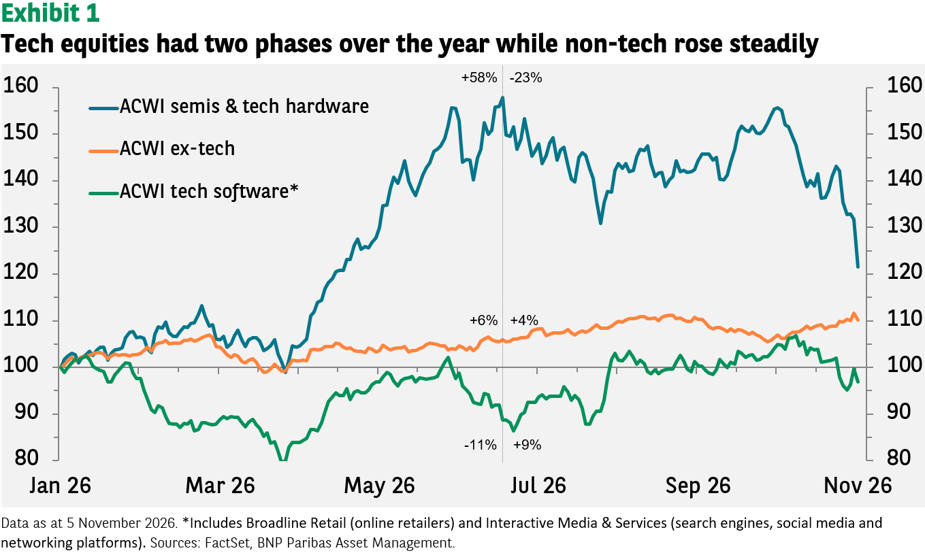
Returns for technology stocks fell into two phases in 2026: in the first half of the year, we saw a big rally in global semiconductor and hardware stocks, when they rose by 58% (local currency terms).1
This gain was partly mirrored by declines in software companies’ stocks including the hyperscalers, who were the principal customers of the semiconductor/hardware companies, or in those whose business models were themselves at risk from artificial intelligence technologies.
In the second half of the year, waning confidence in the capital expenditure outlook led to a reversal of performance, with semiconductor and hardware stocks declining 23%, while software stocks recovered their losses, rising 9%.2
Through all of this, non-tech stocks marched steadily higher (see Exhibit 1).
Growth despite earnings uncertainty
We expect these divides to persist, but the key question is, which pattern we will see?
Part of the high levels of volatility witnessed recently in tech stocks stems from the extreme uncertainty around how AI will develop, its impact on society, the economy and corporate profits. Views on who the winners and losers will be change almost daily with periodic ‘out of the blue’ surprises (like the launch of Chinese start-up DeepSeek’s AI model in January 2025) to shake things up even more.
This uncertainty can be seen in the big increase in the standard deviation of earnings estimates for tech stocks – showing how much analysts’ forecasts differ from one another. It has increased more than five times over the last two years, while for non-tech stocks it has been steady (see Exhibit 2).
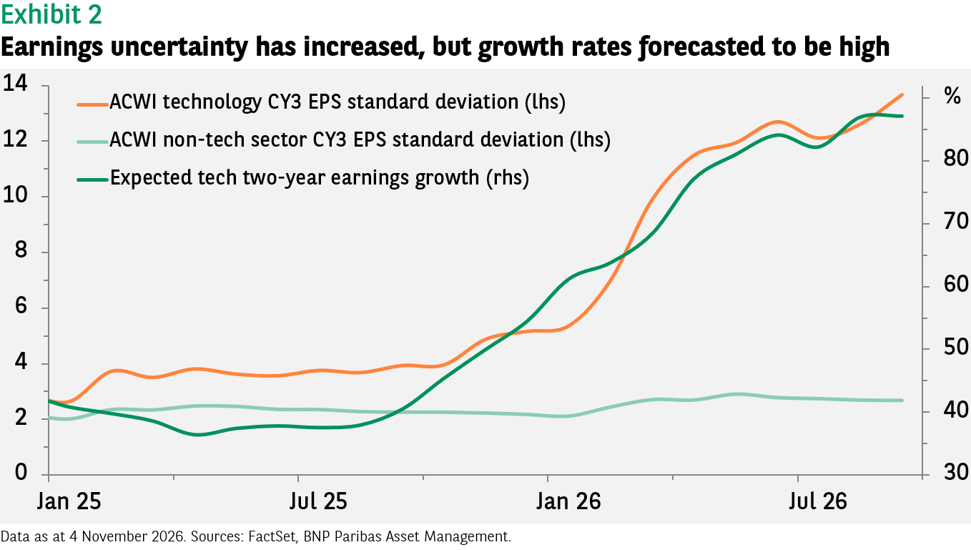
Given the wide range of forecasted profits, any marginal news can have a big impact on stock prices. This dynamic is likely to remain part of the AI investment universe.
As for the pattern we may see next year, we anticipate semiconductor and hardware stocks posting good returns given the still very high levels of planned capital expenditures.
The performance of software stocks, including the hyperscalers, is harder to predict. There is intense competition between them, and it is unlikely all the investments being made today will generate a sufficient and timely return on investment.
Revenue generation, however, is increasing as companies learn how to incorporate AI into their operations and see meaningful productivity gains. Consumers, too, may be willing to pay more in the future for the benefits AI tools can provide.
Looking beyond volatility
Investors should not lose sight of the medium-term opportunity. It is essentially a question of how fast technology sector earnings will grow. Consensus estimates are for nearly 90% earnings growth over the next two years.
Even if it turns out to be ‘only’ 70%, that would still imply strong stock appreciation, particularly as valuations are currently below average. The z-score of the forward price-to-earnings ratio – which indicates how far valuations sit below their historical average – is around -0.2 for the Nasdaq 100 index and -1.4 for emerging market technology stocks. For all the volatility over the last few months, the earnings trajectory remains positive.
This dynamic, though, of high potential returns alongside high volatility, presents a challenge to investors who want to participate in the gains but are concerned by the wide swings in stock prices.
The slices of the AI ‘pie’ will continue to expand and shrink (and in some cases disappear). Some of the challenges ahead include higher financing costs, increasing competition (notably from China), and energy supply constraints. Nonetheless, we believe the pie will continue to grow over time. An investor who can accept the volatility may find there is potential for returns above those of the broad market over the medium term.
At the same time, the high volatility offers significant potential opportunities to portfolio managers who are able to identify the winners and avoid the losers.
The wider market
Of course, few investors would dedicate their entire portfolio to AI; the technology sector still only represents about 40% of the MSCI All Country World Index by market capitalisation.
Returns for the other sectors have been steadily positive, as Exhibit 1 illustrates. This has been driven by strong growth in the US and lower, but still steady, growth in Europe. The most recent earnings season saw double digit gains across many of the major equity indices and forecasts for next year are also good (18% for MSCI ACWI). We foresee this supportive economic environment continuing, even with interest rates likely to be higher on average in 2027 than in 2026, in our view.
The opportunity, however, may be in identifying those companies which are able to incorporate AI into their operations and accelerate profit growth. This is where the US may have an advantage.
To the degree that AI allows companies to reduce labour costs, US companies are among the quickest to adjust the size of their workforce, in contrast to those in Europe and Japan. This dynamic has its own implications for consumer demand depending on how quickly displaced workers move into new roles, but currently the US adult unemployment rate remains low and steady.
From a market perspective, the superior returns of the Russell Value index compared to other indices with a similar sector composition is perhaps evidence already of this phenomenon.
The potential for European companies may be best among those who are able to monetise the significant amount of funds behind the European strategic autonomy initiative in sectors such as defence and infrastructure.
The positive global macroeconomic outlook bodes well for equity returns in 2027. AI is likely to continue to play an outsized role in equity returns, with different dynamics between software companies and hyperscalers relative to semiconductor and hardware manufacturers. The medium-term outlook is positive, but it is unlikely to be a smooth path. Meanwhile, we expect non-tech sectors to see steady growth, with upside potential in those companies who are best able to leverage the AI revolution.
[1] Source: FactSet, BNP Asset Management.
[2] As of 5 November 2026.


