
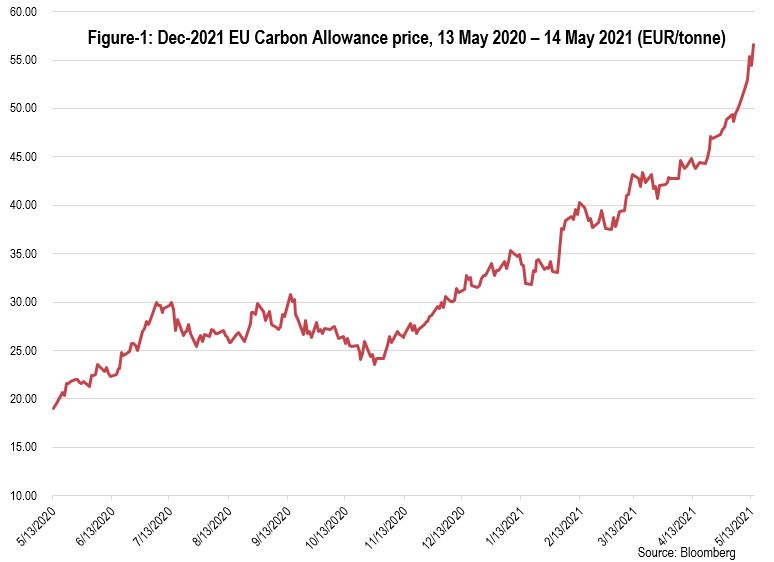
The EU Emissions Trading Scheme (EU-ETS) is among the hottest commodity markets in the world so far this year with European carbon allowances (EUAs) having broken above EUR 56 per tonne last week for a new all-time high, trading up by 70% since 1 January and by 195% over the last 12 months (see Exhibit 1). Against this backdrop, all eyes are now on the imminent launch of the UK’s ETS and the first auction of UK allowances (UKAs) on 19 May.
The EU-ETS is by far the largest carbon market globally by volume, with a 2021 cap of 1.4 gigatonnes (Gt). Next on this metric is South Korea at 590 megatonnes (Mt,), California (320Mt). and then the UK (155Mt.)
Yet despite being only one tenth the size of the EU-ETS by primary volume, and one third and one half respectively of South Korea’s and California’s, the UK forward power curve tells us that the UK-ETS is primed to emerge as the world’s second largest by value. This is because UKAs look set to trade in line with EUAs, and hence at a significant premium to Korean Allowance Units (KAUs), currently trading at 18 000 won (EUR 13.3/t), and California Carbon Allowances (CCAs), currently at USD 19.4/t (EUR16/t).
Indeed, on the basis of what the UK forward power curve is currently telling us, we think the Dec-2021 UKA contract – which will start trading on the ICE exchange on 19 May in tandem with the first UKA auction – is likely to open more or less in line with the equivalent Dec-21 EUA contract.
At the moment, the Dec-21 UK baseload power price is GBP 85 per megawatt-hour (MWh), with 50% thermally efficient combined-cycle-gas-turbine (CCGT) plants assumed to be setting the price. After stripping out the Dec-21 gas price of 76 pence per therm (GBP 26/MWh) — which gives an input cost of GBP 52/MWh for our 50%-efficient CCGT — the so-called dirty spark spread comes to GBP 33/MWh. Next, we need to strip out the cost of the UK carbon-price-support (CPS) levy, which is fixed at GBP 18 for every tonne of carbon-dioxide emitted in 2021/22. Our 50%-efficient CCGT will emit 0.4 tonnes of CO2 for every MWh generated, giving us a CPS charge of GBP 7/MWh.
This leaves us with a spark spread of GBP 26/MWh, way above the kind of single-digit number we would expect the marginal-price setting plant to print. Accordingly, if we assume that as a proxy for UKAs, the Dec-21 UK baseload-power contract is embedding the Dec-21 EUA price – GBP 49/t at today’s exchange rate – the implied cost burden for our price-setting CCGT is GBP 20/MWh (i.e. GBP 49/t multiplied by 0.4).
This would leave us with a clean spark spread of GBP 5/MWh, much more in line with what a price-setting generator could expect to make, suggesting that the first UK-ETS auction should clear around GBP 49/t, and that Dec-21 UKAs should also start trading at or close to that level.
THE MORE IMPORTANT QUESTION, THOUGH, IS WHERE PRICES WILL GO AFTER THAT
On the one hand, given the current UK-ETS cap over 2021-30, the market looks significantly over-supplied: UK-ETS installations had provisional emissions in 2020 of 105Mt, compared with a 2021 cap of 155Mt.
On the other hand, the UK recently declared an extremely aggressive emissions-reduction target for 2035 of -78% from 1990 levels. Given that the UK’s current target for 2030 is only -57%, this implies a cliff-edge reduction over 2031-35 of 21 percentage points. Accordingly, the UK Government is already committed to revising the UK-ETS cap for 2030 to make it compatible with a 2050 net-zero trajectory. [1]
Based on how EUAs have re-rated over the last 12 months despite similar near-term over-supply issues, we think that on balance, the market will look through the short-term surplus of UKAs and focus instead on the need for revised legislation to ensure that the UK meets its new 2035 target and hits net zero by 2050.
And with the EU set to announce a raft of new legislation in July confirming a much more ambitious 2030 EU-ETS cap to align with its own 2050 net-zero target, we see EUAs remaining strong over the second half of the year and UKAs tracking EUAs higher in the first instance. [2]
HOW HIGH CAN EUAS GO OVER THE SECOND HALF OF THE YEAR?
Our pricing framework indicates that fundamentals would justify up to EUR 59/t for the Dec-21 contract, but other factors – most notably positive sentiment in the face of the pending legislation to tighten the 2030 EU-ETS cap – could always push the price above this level over the summer.
Even at EUR 59/t, though, the UK-ETS primary market would be worth EUR 83bn in 2021, and at the equivalent price for UKAs (GBP 51/t), the UK-ETS primary market would be worth EUR 9.2bn. This would put the UK market ahead of both the Korean ETS (with a 2021 primary market value of EUR 7.9bn at current prices and exchange rates), and the California ETS (EUR 5.1bn at current prices and exchange rates).
In short, the chances are we are about to witness the launch of what could soon be the world’s second-largest carbon market.
THERE COULD BE A NEAR-TERM TWIST
The UK-ETS includes a cost-containment mechanism (CCM) that kicks in if the price of UKAs averages double the average level of the previous two years for three months in a row. Under the CCM, auction volumes can be brought forward from later the same year and/or from the following year, with 25% of the new-entrant reserve also available for this purpose.
In the absence of a two-year track record for UKAs at the market’s inception, the average EUA price of the last two years will initially be the benchmark price used to assess whether to trigger the CCM, and the UK authorities have already indicated that on this basis, the initial price level at which the CCM could be triggered is GBP 44.74/t.
With the UK power curve currently implying that Dec-21 UKAs will start trading above this level, the UK-ETS is going to be a key market to watch over the summer for carbon aficionados.
If the CCM is indeed triggered, the question will be whether prices then disconnect from EUAs, or whether, on the contrary, the market looks through the extra short-term volumes made available under the CCM and continues to bid the UKA price up to parity with EUAs.
[1] The UK government states that the required tightening of the cap to 2030 will be implemented by 2024 at the latest.
[2] The wild card in how UKAs will trade over the second half of the year is whether the so-called Cost Containment Mechanism (CCM) available under the UK-ETS legislation will be invoked.
This material is issued and has been prepared by a representative of BNP PARIBAS ASSET MANAGEMENT Australia Limited (“BNPP AMAU”) AFSL 223418 ABN 78 008 576 449.
This material is produced for information purposes only and does not constitute:
- an offer to buy nor a solicitation to sell, nor shall it form the basis of or be relied upon in connection with any contract or commitment whatsoever or
- investment advice.
Opinions included in this material constitute the judgement of BNPP AMAU at the time specified and may be subject to change without notice. BNPP AMAU is not obliged to update or alter the information or opinions contained within this material. Investors should consult their own legal and tax advisors in respect of legal, accounting, domicile and tax advice prior to investing in the financial instrument(s) in order to make an independent determination of the suitability and consequences of an investment therein, if permitted. Please note that different types of investments, if contained within this material, involve varying degrees of risk and there can be no assurance that any specific investment may either be suitable, appropriate or profitable for an investor’s investment portfolio.
Given the economic and market risks, there can be no assurance that the financial instrument(s) will achieve its/their investment objectives. Returns may be affected by, amongst other things, investment strategies or objectives of the financial instrument(s) and material market and economic conditions, including interest rates, market terms and general market conditions. The different strategies applied to the financial instruments may have a significant effect on the results portrayed in this material.
All information referred to in the present document is available on www.bnpparibas-am.com


