
Sustainability
Explore our approach to sustainability

Climate change, social inequality and environmental degradation can have a material impact on the performance of companies in which asset management companies invest. Accordingly, at BNP Paribas Asset Management, we place sustainability at the heart of our strategy and investment philosophy.
Concretely, we analyse financial and non-financial information to identify investment opportunities and risks, seek to minimise the adverse impacts of our investments, use our influence to help shape a better future, and allocate capital towards companies that are contributing to positive change.
“Our investment philosophy reflects our belief that a sustainable approach is key when making investment decisions. As a major financial organisation, we are a firm believer in good governance, transparency and extensive reporting: both from the companies we invest in and from how we operate as a firm.”
Jane Ambachtsheer
Global Head of Sustainability
Our journey
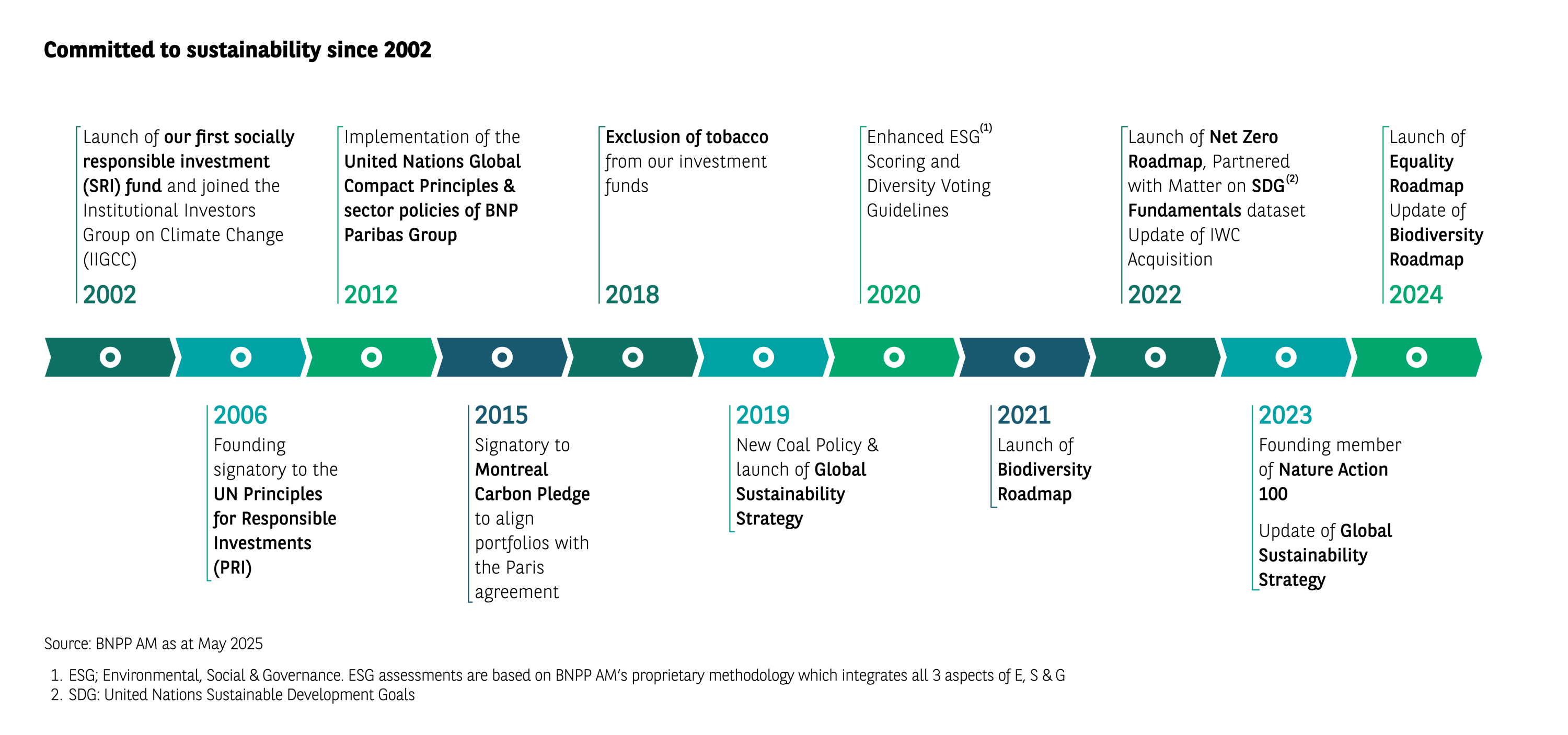
Our sustainability journey began in 2002 with the launch of our first socially responsible investment fund and the creation of our dedicated environmental, social and governance (ESG) research team – the precursor to our global Sustainability Centre.
This long-established commitment to sustainability has given us the strength and expertise to navigate an increasingly challenging investment environment and deliver on our ambition to generate long-term sustainable returns for our clients.
Our approach to sustainability
Our approach to sustainability is built on six pillars. It provides a broad and robust framework, recognising that systemic risks, such as climate change or biodiversity loss, cannot be addressed through exclusions or the integration of ESG factors alone.
1. A forward-looking perspective (“3Es”)
We believe the optimal economic model can be built on a successful Energy transition, healthy Ecosystems, and greater Equality in our societies – our 3Es. Taken together, these form a pathway to economic sustainability that will enable us, as investors, to safeguard long-term returns. These themes guide our strategic research, stewardship, responsible business conduct, sustainable thematic investing and CSR approach. They are also reflected in the other pillars of our approach to sustainability, and our roadmaps describe our detailed strategy and targets.
2. Responsible Business Conduct (RBC)
Wherever they operate, we expect companies to meet their fundamental obligations in the areas of human and labour rights, protecting the environment and ensuring anti-corruption safeguards, in line with the UN Global Compact Principles, the OECD Guidelines for Multinational Enterprises (OECD MNE Guidelines) and UN Guiding Principles on Business and Human Rights (UNGPs). We aim to engage with companies where they fall short and exclude the worst offenders. We also have a series of sector policies that govern the conditions for investing in sensitive sectors and guide our screening requirements and stewardship activities.
3. ESG integration
We believe that analysing investments using ESG criteria helps us account for a wider set of risks and opportunities and better understand the role of companies in driving systemic risks and addressing the challenges of the transition towards a more sustainable and inclusive economy. This helps us make better-informed investment decisions in line with our fiduciary duty. We accomplish this through the application of our ESG Integration Principles & Guidelines, and the development of proprietary sustainability research and tools.
4. Stewardship
We are committed to contributing to a successful energy transition, healthy ecosystems, and greater equality in our societies. We combine voting, issuer engagement and policy advocacy to realise this ambition. Learn more.
5. Sustainability in our product range
We aim to meet different sustainability objectives across a broad range of asset classes. Accordingly, we provide distributors with solutions to meet end clients’ ESG preferences and offer products to invest directly in sustainability, e.g., thematic and impact funds. In addition, our Solutions and Client Advisory team works with clients to build bespoke sustainable portfolios.
6. “Walking the talk”: CSR*
Walking the talk is critical to achieving excellence. As a sustainable asset manager, our corporate practices and disclosures should match or exceed the standards we expect from the entities in which we invest. Over the last five years, we have focused on immersing our employees in a sustainable workplace, one where they can have positive impact through their work, and we encourage them to carry this through to their personal lives.
*CSR: Corporate Social Responsibility
Important information
The content of this page on BNP Paribas Asset Management’s approach and corporate philosophy is only for information purposes and does not constitute an offer to buy or sell any services, products or investments. These statements apply differently to each BNP Paribas Asset Management product, the characteristics of which, including those relating to sustainability, are described in the legal documentation of the funds, available here according to your country of residence and investor profile.
“The sustainable investor for a changing world” reflects the objective of BNP PARIBAS ASSET MANAGEMENT Europe to integrate sustainable development into its activities, although not all funds managed by BNP PARIBAS ASSET MANAGEMENT Europe fulfil the requirement of either Article 8, for a minimum proportion of sustainable investments, or those of Article 9 under the European Regulation 2019/2088 on sustainability-related disclosures in the financial services sector (SFDR). For more information, please see staging.bnpparibas-am.co.uk/en/sustainability.
Environmental, social and governance (ESG) investment risk: The lack of common or harmonised definitions and labels integrating ESG and sustainability criteria at EU level may result in different approaches by managers when setting ESG objectives. This also means that it may be difficult to compare strategies integrating ESG and sustainability criteria to the extent that the selection and weightings applied to select investments may be based on metrics that may share the same name but have different underlying meanings. In evaluating a security based on the ESG and sustainability criteria, the Investment Manager may also use data sources provided by external ESG research providers. Given the evolving nature of ESG, these data sources may for the time being be incomplete, inaccurate or unavailable. Applying responsible business conduct standards in the investment process may lead to the exclusion of securities of certain issuers. Consequently, performance may at times be better or worse than the performance of relatable strategies that do not apply such standards.