
Our latest paper “Multi-Asset Portfolios with Active and Passive Funds: A Robust Portfolio Optimization Framework” introduces a practical and scalable approach for constructing multi-asset portfolios that blends both active and passive funds. The framework is designed to help asset managers, institutional investors, distributors and robo-advisors implement investment views efficiently, while managing real-world constraints and uncertainties.
Addressing the shortfall in traditional portfolio construction
Traditional approaches to portfolio construction such as mean–variance optimisation fall short in today’s environment of mass customisation, digitalisation, and the proliferation of both active and passive investment vehicles.
Our research addresses the gap by:
- Explicitly incorporating tactical and thematic investment views
- Managing uncertainty in expected returns and fund alphas
- Accounting for fund charges and tracking error constraints
- Reconciling differences between indices used for expressing views, strategic allocation and fund benchmarks.
The main points of our methodology
Our robust optimisation framework builds on state-of-the-art portfolio construction and adapts it for the practical realities of multi-asset portfolios:
- Layered mapping: Lasso regressions1 are used to map the risk exposures of funds to their benchmarks, and of their benchmarks to the core indices used to express tactical and thematic views, ensuring alignment between implementation and investment views
- Risk model: A statistical risk model based on principal components analysis (PCA)2 captures systematic and idiosyncratic risks, including currency exposures, to establish the individual independent sources of risk in the universe of available core indices
- Robust optimisation: Explicitly taken into account is the uncertainty of investment views in rendering portfolios less sensitive to estimation errors, so that they can be directly used without the need for additional investment constraints beyond those strictly necessary, e.g., no leverage and no short positions
- Active vs. passive allocation: A key innovation is the ability to use the investor’s confidence in the expected net alpha (i.e., beyond ongoing costs) from actively managed funds and set this against the uncertainty in tactical or thematic investment views as the parameters for finding the portfolio’s most adequate tilt towards active versus passive funds.
Practical implications
With no tactical or thematic views, the robust optimisation framework balances two objectives:
- To minimise tracking error relative to the strategic asset allocation (SAA) using available active and passive funds
- To maximise expected net alphas from active funds based on the investor’s confidence in those alphas.
Passive funds are favoured for closely tracking the SAA, though they have negative alpha due to ongoing charges. Active funds are included not only for their expected positive net alpha, but also when their unique risk exposures can help further reduce tracking error, even if their expected alpha is zero or negative.
The optimiser determines the optimal mix of active and passive funds, subject to constraints (no shorting, no leverage, and full investment in the selected funds).
As confidence in active fund alpha increases, the portfolio tilts more towards the active funds with the highest expected net alphas (see Exhibit 1):
- With maximum confidence in active alpha: the portfolio may invest almost entirely in those active funds
- With no confidence in active alpha: the optimiser selects the combination of active and passive funds that best tracks the SAA, regardless of alpha.

The portfolio can invest in a selection of 35 equity, fixed income, commodity and listed real estate funds, some active and others passive. Actively managed funds are assumed to generate a risk-adjusted alpha of 0.5 before ongoing charges – see our paper for details. Source: BNP Paribas Asset Management.
With directional tactical views on an asset class (e.g., US equities), portfolios react by increasing or decreasing allocations to passive funds of that asset class (see Exhibit 2):
- The optimiser prefers passive funds for expressing strong directional views because they provide purer exposure (lower tracking error) to the targeted asset class
- Active funds in the same asset class tend to maintain a relatively stable allocation unless the tactical view is very negative, in which case both passive and active allocations to that asset class are reduced
- Tracking error increases as tactical views become more extreme, reflecting the portfolio’s deviation from the SAA.
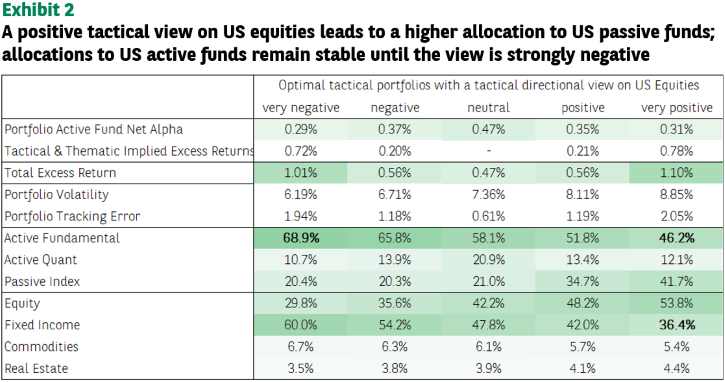
Based on the same list of selected funds as for exhibit 1 and with medium level of confidence in fund net active alphas; source: BNP Paribas Asset Management.
With thematic views, preferences for themes (e.g., disruptive technology) are implemented by reallocating from broad passive exposures (e.g., global or US equity passive funds) to specialised active funds that capture the theme (see Exhibit 3):
- As conviction in the thematic view strengthens, the allocation to the corresponding active thematic fund increases. At the same time, allocations to passive funds within the same asset class, as well as to other active funds in the same asset class that are unrelated to the theme, decrease
- The optimiser ensures that thematic tilts do not compromise the overall diversification and risk profile of the portfolio.

Based on the same list of selected funds as for exhibit 1 and with medium level of confidence in fund net active alphas; source: BNP Paribas Asset Management.
More transparency from analytical demos
In the paper’s appendix, we provide detailed analytical demonstrations underpinning the results discussed above. This added layer of transparency shows how the robust portfolio optimisation framework works, both with and without tactical or thematic views, and as confidence in expected net fund alphas changes.
By making the mathematical foundations explicit, we ensure the results from applying this framework are predictable and fully understood, leaving no room for surprises in portfolio behaviour and giving investors the required confidence in the robustness and reliability of the approach.
Why adopt this framework?
The main strengths of the proposed framework are:
- Transparency: The decomposition of risk into systematic and idiosyncratic components allows for precise attribution and better communication with stakeholders
- Flexibility: Investors can balance strategic exposures, active alpha and tactical convictions, adapting allocations as market conditions or preferences change
- Scalability: The approach is suitable for large-scale, automated portfolio customisation, supporting the needs of both institutional and digital advisory platforms.
[1] LASSO regressions, also known as Least Absolute Shrinkage and Selection Operator (LASSO), is a type of linear regression that includes a penalty term to prevent overfitting and improve the accuracy of statistical models.
[2] Principal Component Analysis (PCA) is a technique used in data analysis and machine learning that helps in reducing the number of features in a dataset while retaining the most important information


