
Dynamic Allocation. Absolute Flexibility
In a year full of surprises, absolute return fixed income strategies have provided a much-needed portfolio cushion. With uncertainty set to continue, we look at how this approach can help investors stay on track with their goals.

2026: Anything but simple
While we continue to weigh the impact of evolving tariffs on the global economy, market volatility is likely to remain heightened. The recent de-escalation in the trade war between China and the US has provided some relief; however, even the lower levels of tariffs look unlikely to alleviate slowing US growth this year. Moreover, tariffs have added complications to the policy environment by boosting US inflation, leaving the US Federal Reserve between a rock and a hard place. Add geopolitical tensions to the picture and 2026 is looking like to be a continuation of last year.
1. Flexible & dynamic approach
BNP Paribas Global Absolute Return Bond dynamically allocates across different regions, sectors, securities, tenors, yield curves and currencies in accordance with the investment team’s views. This can help to improve diversification, limit drawdowns and deliver positive returns regardless of market conditions.
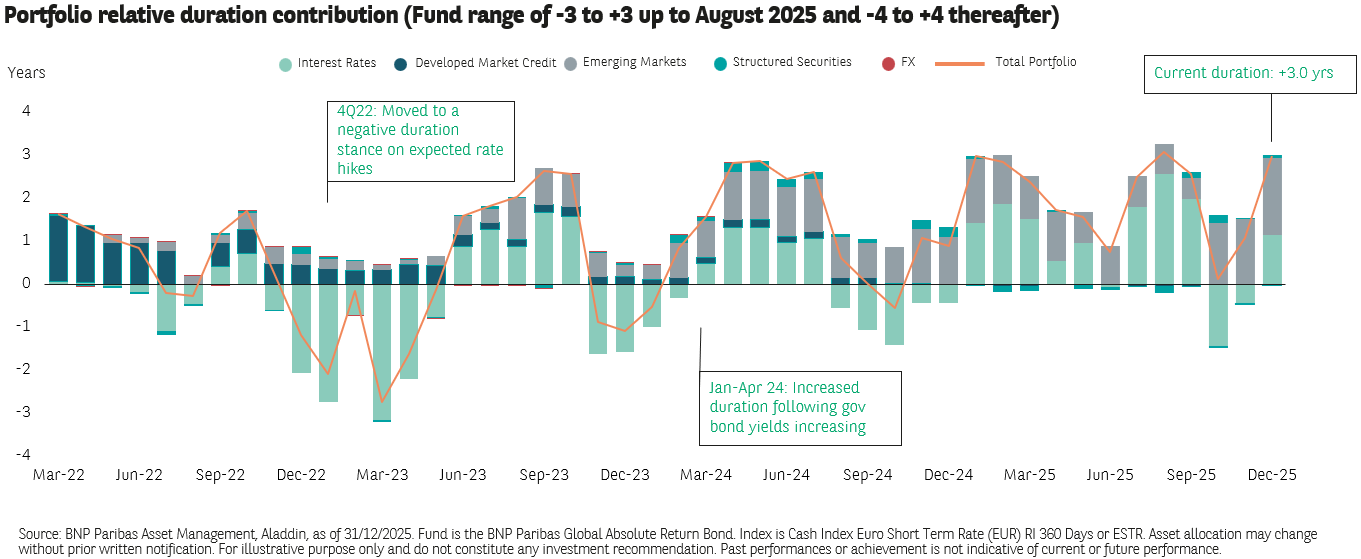
2. Focus on capital preservation*
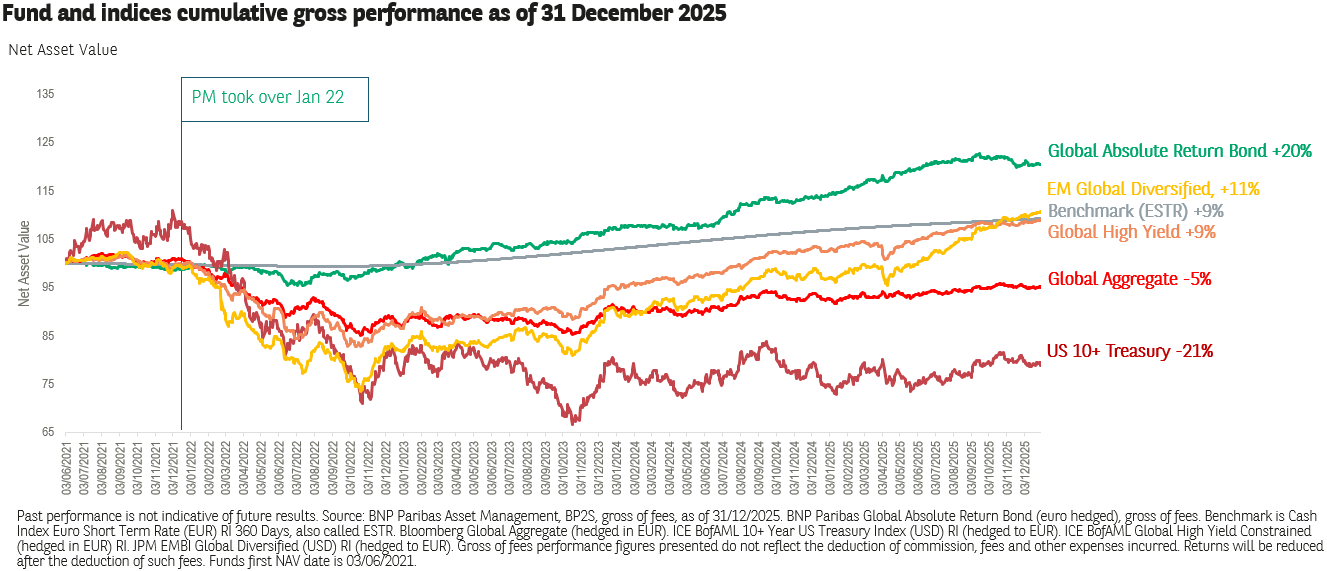
In support of capital preservation, the team places considerable emphasis on portfolio construction and works closely with their dedicated front office risk analyst. The result is a globally diversified portfolio with multiple return streams that seeks to perform well across the team’s base case as well as a range of other scenarios.
Please note that the performance results illustrated in the chart below are gross of fees and would not reflect the real returns of the BNP Paribas Global Absolute Return Bond Trust had it been active at the time.
3. Enhanced risk-return profile
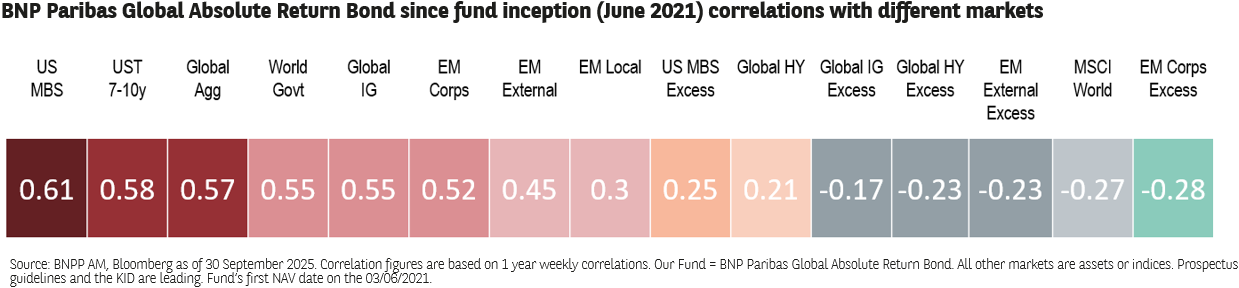
With its flexible approach and ability to invest in relative value positions, typically delivers low correlations to traditional fixed income segments such as global high yield. The strategy may, therefore, help to improve the risk-return profile of a diversified portfolio.
Meet the team
BNP Paribas Global Absolute Return Bond is actively managed by James McAlevey, Head of Global Aggregate and Absolute Return. Based in London, James has more than 26 years investment experience across multi-strategy fixed income and interest rates portfolios.
James and the Absolute Return team are part of BNP Paribas’ Global Fixed Income investment group. They collaborate with the investment group’s various teams to generate the best ideas across an unconstrained multi-sector fixed income universe. They also benefit from access to firmwide resources including our dedicated Sustainability Centre, Quantitative Research Group and Macro Research team
-
James McAlevey

Head of Global Aggregate and Absolute Return
-
Jayesh Mistry

Senior Portfolio Manager
-
Gaetan Fenerol

Portfolio Manager
-
Heyuan Qian

Junior Portfolio Manager
-
Vicky Browne

Investment Specialist, Global Aggregate & Absolute Return
-
Jamie Irvine

Portfolio Manager
View Fund Documents



Insights
Access the team’s latest views and ideas

Talking Heads – Flexibility in global bonds with absolute return


BNPP AM Webinar -Global Economic Outlook and Navigating Todays Market Volatility – James McAlevey | May 2025

Insights Video Update – BNP Paribas Global Absolute Return Bond Strategy


Why today’s markets favour absolute return bond strategies
*BNP Paribas Asset Management doesn’t provide any formal capital guarantee or protection of the funds. No information given or any term used herein shall be interpreted to provide such a guarantee or protection.
Get in touch
Got a question? Our team is happy to help
Important information
Marketing communication. For Wholesale Investors only.
This information is distributed to wholesale clients only in Australia by BNP PARIBAS ASSET MANAGEMENT Australia Limited ABN 78 008 576 449, AFSL 223418. None of the funds referred to in this material, besides the BNP Paribas Global Absolute Return Bond Trust, are available in Australia & New Zealand, and so this material is provided to wholesale clients for information purposes only.
Past performance or achievement is not indicative of current or future performance. Performance is calculated net of fees unless otherwise stated.
Any views expressed here are those of the author as of the date of publication, based on available information, and subject to change without notice. This material does not constitute investment advice.
Investments are subject to market fluctuations and the risks inherent in investments in securities. The value of investments and the income they generate may go down as well as up and it is possible that investors will not recover their initial investment. There is no guarantee that the performance objective will be achieved.
Environmental, social and governance (ESG) investment risk: The lack of common or harmonised definitions and labels integrating ESG and sustainability criteria at EU level may result in different approaches by managers when setting ESG objectives. This also means that it may be difficult to compare strategies integrating ESG and sustainability criteria to the extent that the selection and weightings applied to select investments may be based on metrics that may share the same name but have different underlying meanings. In evaluating a security based on the ESG and sustainability criteria, the Investment Manager may also use data sources provided by external ESG research providers. Given the evolving nature of ESG, these data sources may for the time being be incomplete, inaccurate or unavailable. Applying responsible business conduct standards in the investment process may lead to the exclusion of securities of certain issuers. Consequently, (the Sub-Fund’s) performance may at times be better or worse than the performance of relatable funds that do not apply such standards.
The sub-fund may be exposed to other risks defined below.
Capital loss risk: The investments are subject to market fluctuations and the risks inherent in investments in securities. The value of investments and the income they generate may go down as well as up and it is possible that investors will not recover their initial outlay.
Interest rate risk: The value of an investment may be affected by interest rate fluctuations. Interest rates may be influenced by several elements or events, such as monetary policy, the discount rate, inflation, etc.
Credit risk: This is the risk that may derive from the rating downgrade of a bond issuer to which the sub-funds are exposed, which may therefore cause the value of the investments to go down. Sub-funds investing in high-yield bonds present a higher-than-average risk due to the greater fluctuation of their currency or the quality of the issuer.
Liquidity risk: There is a risk that investments made in sub-funds may become illiquid due to an over-restricted market (often reflected by a very broad bid-ask spread or by substantial price movements), or if their rating declines or their economic situation deteriorates.
Derivatives risks: Risks include the lack of secondary market liquidity, valuation risks, the lack of standardisation and regulation, the risk of leverage, the risk of the counterparty.
Counterparty risk: This risk relates to the quality of the counterparty with whom the funds do business or enter into various transactions. This risk reflects the counterparty s ability to honour its commitments (payment, delivery, repayment, etc).
Operational and Custody Risk: Some markets are less regulated than most of the international markets; hence, the services related to custody and liquidation for the subfund on such markets could be more risky
For a complete description and definition of risks, please consult a client relationship manager or the global BNP Paribas Asset Management website: staging.bnpparibas-am.co.uk.
Equity Trustees Limited (“Equity Trustees”) ABN 46 004 031 298 | AFSL 240975 is the Responsible Entity for the BNP Paribas Global Absolute Return Bond Trust (“the Trust”) (ARSN 686 205 121). Equity Trustees is a subsidiary of EQT Holdings Limited ABN 22 607 797 615, a publicly listed company on the Australian Securities Exchange (ASX: EQT). BNP Paribas Asset Management Australia Ltd (“BNPP AMAU”) ABN 78 008 576 449 | AFSL 223418 is the investment manager of the Trust. This material has been prepared by BNPP AMAU to provide you with general information only. In preparing this information, we did not take into account the investment objectives, financial situation or particular needs of any particular person. It is not intended to take the place of professional advice and you should not take action on specific issues in reliance on this information. Neither BNPP AMAU, Equity Trustees nor any of their related parties, their employees or directors, provide any warranty of accuracy or reliability in relation to such information or accept any liability to any person who relies on it. Past performance should not be taken as an indicator of future performance. You should obtain a copy of the Product Disclosure Statement (PDS) before making a decision about whether to invest in this product. The PDS can be obtained from staging.bnpparibas-am.co.uk/en-au or from your adviser.
BNP Paribas Global Absolute Return Bond Trust Target Market Determination is available here staging.bnpparibas-am.co.uk/en-au. A Target Market Determination is a document which describes who these financial products are likely to be appropriate for (i.e. the target market), and any conditions around how the product can be distributed to investors. It also describes the events or circumstances where the Target Market Determination for these financial products may need to be reviewed.
The rating published on 07/2025 for the BNP Paribas Global Absolute Return Bond Trust is issued by Lonsec Research Pty Ltd ABN 11 151 658 561 AFSL 421 445 (Lonsec Research). Ratings are general advice only and have been prepared without taking account of investors’ objectives, financial situation or needs. Consider your personal circumstances, read the product disclosure statement and seek independent financial advice before investing. The rating is not a recommendation to purchase, sell or hold any product. Past performance information is not indicative of future performance. Ratings are subject to change without notice and Lonsec Research assumes no obligation to update. Lonsec Research uses objective criteria and receives a fee from the Fund Manager. Visit lonsec.com.au for ratings information and to access the full report. © 2025 Lonsec. All rights reserved.