
The US Federal Reserve opted for the status quo at its monetary policy meeting on 11/12 June. What grabbed more attention – at least in eurozone financial markets – was the shock decision by Emmanuel Macron on 10 June to dissolve the French National Assembly and call for snap legislative elections. The subsequent volatility in eurozone equity, bond and currency markets is probably not just due to the effect of surprise.
Listen to the article
The outcome is tough to call
The European elections held few surprises as polls had anticipated the results well – in France and elsewhere – and the shape of the new European Parliament will likely be little changed from its predecessor.
The real surprise was the announcement by the French president of the dissolution of the National Assembly and a snap election set for 30 June (first round) and 7 July (second and final round).
With the final lists of candidates now published, polling organisations have more elements to make initial projections, at least for the first round of voting.
Still, it will likely be tough to anticipate the outcome given the method of voting in France, so it will be interesting to see how the coming polls will be analysed by the international financial community.
For the moment, it seems the risk of political instability in France is troubling equity investors. The 6.2% fall by the CAC 40 over the last week was deeper than that seen in other European markets (-4.2% for the EUROSTOXX 50 index, with implied volatility rising to its highest since October 2023, at nearly 20%).
The euro suffered to a limited extent over the week from 7 to 14 June, losing 0.9% against the US dollar at 1.07, 0.5% against the Japanese yen and 1.6% against the Swiss franc.
The yield of the 10-year German Bund benefited from a flight-to-safety effect, ending at 2.36% on 14 June, a sharp weekly fall of 26bp that brought it to its lowest level since the first half of April. The yield of the German 2-year bond fell by 32bp to 2.76% on 14 June.
The yield of the French 10-year OAT rose from 3.10% on 7 June to 3.23% on 10 June, ending the week at 3.13%. As a result, the OAT-Bund yield spread rose from 48bp to 76bp in just one week. We have to go back to April 2017 (before Emmanuel Macron’s first election) to see the spread at such a level.
The spread between the 10-year Italian BTP and German Bund widened to 157bp at the end of last week, the highest since February. Spanish and Portuguese 10-year bond yields, on the other hand, eased by 6bp over the week, suggesting that investors are starting to worry about government debt levels in an environment in which campaign promises may raise fears of less fiscal prudence.
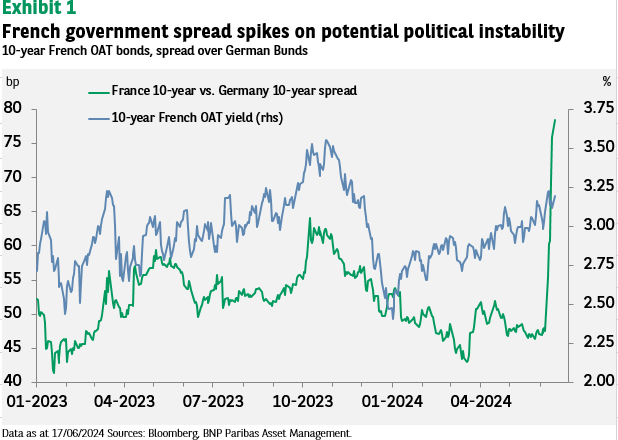
On 19 June, in a move unrelated to the political situation in France, the European Commission is expected to launch excessive deficit procedures against several member states, including France and Italy. This was on the cards for France, but it is not likely to calm investors’ concerns.
Meanwhile, at the Fed…
The Federal Open Market Committee (FOMC) unsurprisingly opted for the status quo at its monetary policy meeting on 11-12 June. In his press conference, Fed Chair Jerome Powell reiterated the Fed remains ‘highly attentive to inflation risk’ and will need to see more data before taking any action.
The FOMC’s press release pointed out that ‘inflation eased over the last year, but remained elevated. In recent months, there has been modest further progress towards the committee’s 2% inflation objective’.
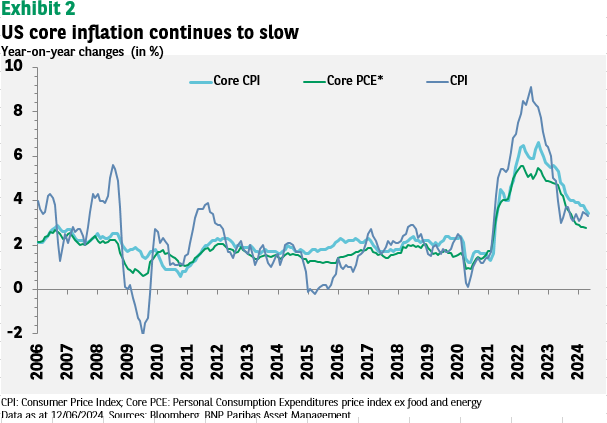
US consumer price indices were released on the morning of 12 June, so the FOMC had plenty of opportunity to discuss them, although whether the latest data was included in the updated forecasts is unclear.
After surprising to the upside in January through March and being roughly in line with expectations in April, inflation was lower than expected in May. Core inflation fell from 3.6% to 3.4% year-on-year, its lowest since April 2021 (3.0%).
What is the Fed trying to tell us?
Investors are focused on the Fed’s growth forecasts – still 2.1% at the end of 2024, 2.0% at the end of 2025 and 2026, and above the long-term growth estimated at 1.8% – and on inflation. The Fed has revised its inflation forecast up slightly for 2024 and 2025 and back to 2% in 2026 for headline and core inflation as measured by personal consumption expenditures deflators.
The ‘dot plot’ of the level of policy rates each FOMC member deems ‘appropriate’ at the end of each year (here meaning 2024, 2025 and 2026), appeared at first reading more hawkish than in March.
The median point for the federal funds rate is now 5.125%, which corresponds to just one 25bp rate cut this year (the current 5.25-5.50% range corresponds to a median level of 5.375%), whereas three cuts totalling 75bp had been considered appropriate in December 2023 and March 2024.
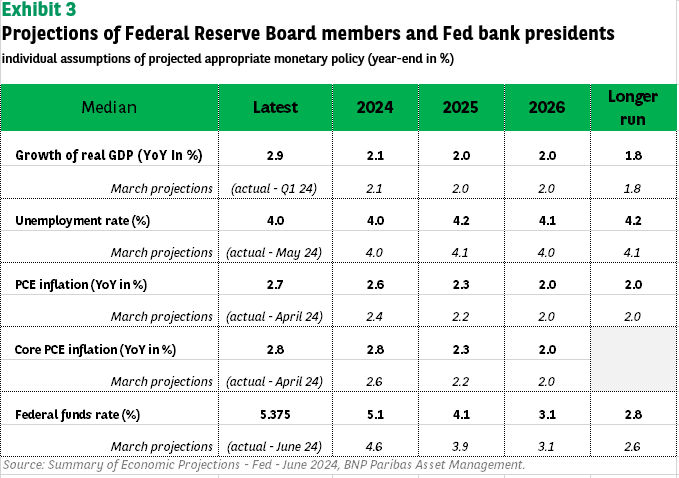
Looking at the ‘dot plot’ more closely, we see that four FOMC members are contemplating a status quo until the end of the year, seven favour one cut and eight two cuts. The overall message could be seen as one of caution rather than fundamental doubts over the direction of US inflation.
The same ‘dot plot’ indicates policy rates are expected to drop by 100bp in 2025 and 2026, which corresponds to an easing cycle that should reassure investors. On 12 June, the S&P 500 equity index closed at a record high, above 5 400 points. It has continued to rise since.
As Jerome Powell reiterated, he needs to have more confidence in the path of inflation before taking any decision. He clearly believes that, given still solid growth, time is on his side.
In his press conference, he noted that ‘if you look back in five or 10 years’ time and try to make a case for the significance to the US economy of one 25 base point rate cut, you’d have quite a job on your hands’. His appeared to be trying to make clear that monetary policy is not about one cut or one hike: ‘The whole rate path matters’.
Powell concluded by saying, ‘I do continue to think that when we do start to loosen policy, that will show up in significant loosening.’
Could this be the ‘central bank’ form of the Zambian proverb that – in pointing out that you need to consider different people’s perspectives – says ‘when you show a child the moon, he sees only your finger’? Whether or not that’s the case, this is a good way to encourage investors to take a step back and stop being childish, which could be good advice.
Disclaimer
This material is issued and has been prepared by a representative of BNP PARIBAS ASSET MANAGEMENT Australia Limited (“BNPP AMAU”) AFSL 223418 ABN 78 008 576 449.
This material is produced for information purposes only and does not constitute:
1. An offer to buy nor a solicitation to sell, nor shall it form the basis of or be relied upon in connection with any contract or commitment whatsoever or
2. Investment advice.
Opinions included in this material constitute the judgement of BNPP AMAU at the time specified and may be subject to change without notice. BNPP AMAU is not obliged to update or alter the information or opinions contained within this material. Investors should consult their own legal and tax advisors in respect of legal, accounting, domicile and tax advice prior to investing in the financial instrument(s) in order to make an independent determination of the suitability and consequences of an investment therein, if permitted. Please note that different types of investments, if contained within this material, involve varying degrees of risk and there can be no assurance that any specific investment may either be suitable, appropriate or profitable for an investor’s investment portfolio.
Given the economic and market risks, there can be no assurance that the financial instrument(s) will achieve its/their investment objectives. Returns may be affected by, amongst other things, investment strategies or objectives of the financial instrument(s) and material market and economic conditions, including interest rates, market terms and general market conditions. The different strategies applied to the financial instruments may have a significant effect on the results portrayed in this material.
All information referred to in the present document is available on www.bnpparibas-am.com.


