
Market concerns about the risk of a budget-related government shutdown in the US that punctuated the last week of September have materialised. In the absence of a last-minute deal in Congress on a spending bill (or ‘continuation’ budget law), the US’s non-essential federal services were closed on 1 October. Market reaction has, so far, been muted.
Listen to the audio
First of all, while a shutdown is fairly rare, it is not exceptional.
The macroeconomic effects of shuttering government services are usually limited: federal workers are not paid, and spending is held back, for only a few days or at most weeks. Indeed, the longest shutdown occurred during Donald Trump’s first term (lasting 35 days from 22 December 2018 to 25 January 2019).
According to estimates by the Congressional Budget Office made at that time, this situation reduced the level of GDP in the fourth quarter 2018 by a modest 0.1% and a slightly higher 0.2% in the first quarter of 2019. This effect was partly offset later.
In a response to a senator’s question on September 30, the CBO said, ‘the effects of a shutdown depend on its duration and on an administration’s decisions about how to proceed’.
Given President Trump’s comments on the shutdown, his next steps could be a decisive factor this time. He has indicated the suspension of government services could be used to reshape the federal workforce, threatening mass firings, and suggested ‘irreversible’ cuts to programmes important to the opposition Democrats. The administration put on hold some $18 billion of infrastructure funds for projects in the hometown of Democratic leaders.
For markets and economists, the shutdown means the publication of economic data (especially the crucial inflation and employment reports) will likely be delayed. This could affect the Federal Reserve’s ability to accurately assess the state of the economy and cause the market to reconsider its expectations for the near-term interest rate outlook.
Life goes on
For the time being, financial markets have shrugged off the shutdown, even though it adds to the existing risks and concerns (such as uncertainties over the Fed’s independence, the legality of the trade policy, the outlook for a weakening labour market, and firm geopolitical tensions).
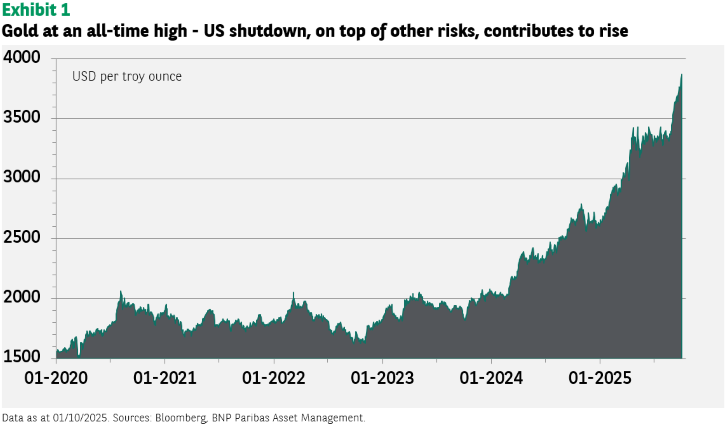
Gridlock in the US budget debate has driven the price of gold to record highs. From us, this evolution reflects not just the safe haven nature of gold as an asset, but also fundamental elements such as its growing use in the reserves of central banks in emerging countries.
In addition, expectations of the Fed’s easing of monetary policy further and a weakening of the US dollar provide strong support for gold.
The shutdown: the canary in the mine of this cycle?
Equities rose further in September, allowing the MSCI AC World index to post a 7.3% rise (in USD) in Q3. However, market nervousness could (re)emerge if investors start to worry again about the consequences of President Trump’s ‘reciprocal’ tariffs on imports.
So far, investors have been reassured by the economy’s continued buoyancy – its resilience in the first half of the year defied forecasts. The prospect of the Fed resuming its monetary easing in a non-recessionary environment reinforced the positive momentum for risky assets.
What’s next?
Forecasts for US GDP growth have been revised up for 2025 due to the positive trends in activity so far, but a slowdown has now been taking hold and concerns over the outlook for US employment remain. Inflation is still likely to rise further, even if only temporarily.
In late September, President Trump announced more tariffs – now on branded pharmaceuticals, heavy trucks, some home equipment, timber, lumber and derivate products. This reminded investors that he is committed to his trade policy, even if the Supreme Court is to rule in early November on its legality. In August, an appeals court had judged most of the tariffs to be illegal.
Uncertainty also lingers over the Fed’s status as an independent central bank. Political pressure (together with the President seeking to reshuffle the Fed’s policy-setting Federal Open Market Committee) could upset monetary policy decision-making.
In this regard, the Supreme Court’s decision to allow Fed Governor Lisa Cook to remain in her post is reassuring. It does not end the arm-wrestling. The administration will be able to put its arguments before the court next January. This latest decision does echo the ruling in May which underlined the Fed’s special legal status.
At the end of September, former Fed Chairs, former Treasury Secretaries and several economists (a total of 18 top economic personalities) solemnly reminded the Supreme Court of the importance of the central bank’s independence and asked ‘to keep Governor Cook in her position while the legality of her removal is adjudicated’. It appears that message was received.
Why Fed independence matters for all markets
We do not aim to review the economic literature on the topic; Fed Chair Ben Bernanke did this succinctly in a speech in May 2010. One could still wonder why a loss of Fed independence matters.
The assumption is that a less independent Fed will adjust its reaction function in a direction that aligns with President Trump’s call for much lower interest rates. In the short term, that should be positive for equities. In the longer term, the risk of the economy overheating could increase as a looser Fed policy risks un-anchoring inflationary expectations.
If you instead assume an unchanged Fed reaction function, forecasting a series of aggressive rate cuts should mean that a recession is in sight.
So, what of the US economy?
Second-quarter GDP growth was revised up to 3.8% annualised, with private consumer spending rising by 2.5%. Data on household income (+0.4% in nominal terms) and household spending in August (+0.4% in real terms after +0.3% in July) confirmed the solid momentum has lasted into the third quarter.
The running estimate of third-quarter growth provided by the Atlanta Fed’s GDPNow tracker (based on data as of 1 October) stands at a robust 3.8% – this is on the back of strong household consumption, supported by resilient incomes.
At the September FOMC meeting, the Fed chose to focus on (weak) employment rather than (in-line) inflation. For now, investors appear not to see this as a decision dictated by pressure from the White House, especially because job creation has softened since July. Various measures of inflation have marched market expectations, reassuring investors (and perhaps even the Fed).
For the time being, Stephen Miran, chair of the White House Council of Economic Advisers and newly appointed to the FOMC, appears still isolated. He voted for a 50bp cut at the September FOMC and claimed a few days later that policy rates should be around 2% at a time when Fed Chair Jerome Powell stressed that “uncertainty around the path of inflation remains elevated”. His caution appears to be shared by a majority on the FOMC.
Economy or politics?
When economic data are not released, market economists become (more) interested in politics.
Bill Clinton’s 1992 campaign slogan “It’s the economy, stupid” highlighted the importance of the shape of the economy and its consequences for voters’ personal finances. Employment will likely be the focus of the midterm elections in a year’s time.
Despite disappointing job creation, the unemployment rate has risen only slightly – to 4.3%, breaking out of the 4.0%-4.2% range it had been in since July 2024.
The ‘unemployment halo’ (regular unemployment, plus people marginally attached to the labour force, plus those working part-time for economic reasons) stood at 8.1% in August after 7.8% a year earlier. This has added to evidence of a less dynamic labour market, which is starting to weigh on household confidence.
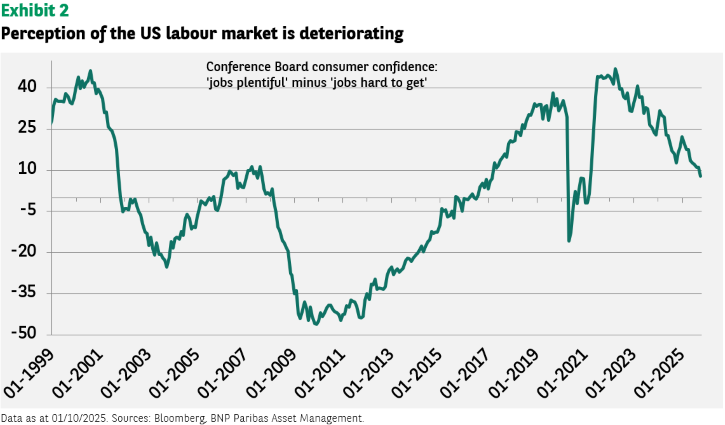
The Conference Board’s confidence index fell in September to its lowest since April and the perception of the labour market is deteriorating. The difference in survey responses between ‘Jobs easy to get’ and ‘Jobs hard to get’ fell to 7.8% in September (a new low for this cycle) from 19.4% in January.
So, the economy does matter.


