
After the ‘Liberation Day’ turmoil, US President Donald Trump last week adjusted his ‘reciprocal’ tariffs, reviving risk-on trades, with US stocks having their best day since 2008. The rally ended quickly when China retaliated against the high US levies. Such market swings reflect uncertainty over global growth, inflation, monetary policy… What do economic fundamentals tell us about what is next?
Listen to the article
Trump’s latest plan sets a 10% across-the-board tariff on imports into the US, but postpones selected country-specific tariffs for 90 days, namely for those countries that have not retaliated.
That did not include China. It hit back with higher tariffs on exports from the US. It also restricted sales of rare earth and other minerals to the US (crucial for car, semiconductor and aerospace industries) as well as imports of US movies. Beijing has warned that other restrictive measures on trade would follow.
Tariffs – The damage is done
It is unclear what president Trump will do after the 90-day pause. The uncertainty will likely keep market confidence low, hindering investment and hiring decisions, and thus (eventually) hurting economic growth.
More importantly, market optimism that Trump’s new approach will involve less-damaging tariffs now appears overblown. The combination of 145% tariffs on Chinese goods and reduced tariffs on much of the rest of the world will likely reduce the tariffs’ impact on US prices only slightly.
A recent study estimated that1 the originally announced US import tariffs could add about 170bp to US Personal Consumption Expenditures inflation. The current Trump plan would reduce the inflationary impact by only 40bp to 130bp. From the same 2024 month, the PCE index for February rose by 2.5%. Excluding volatile food and energy prices, the index increased by 2.8% from one year ago.
What is important is that China plays a key role in driving US inflation. The study estimated that 68bp (or 52%) of the 130bp boost on the PCE would come from the punitive tariff rate imposed on Chinese goods.
Since about two-thirds of US imports from China are capital or intermediate goods, high tariffs act as a tax on US domestic capital expenditure and manufacturing, crimping growth and lifting prices.
Broadly softer-than-expected US inflation data released last week showed headline and core consumer price (CPI) inflation easing to 2.4% and 2.8% year-on-year, respectively. This did not boost market sentiment as these numbers will likely rise due to the tariff hikes.
Signs of economic weakness in the US were emerging even before the tariffs. For example, in February, retail sales rose by only 0.2% month-on-month after contracting by 1.2% in January. The March ISM manufacturing purchasing managers’ index fell by 1.3 points MoM to 49, a level indicating contraction; and total industry job openings fell by 194,000 in February.
While Trump’s plans for expansionary fiscal policy will likely add marginally to GDP growth, according to our research team, government job cuts by the Department of Government Efficiency stand to worsen the short-term outlook for employment and consumption.
The cross-currents of tariffs boosting short-term inflation and hurting growth once the inflationary effects work through the system have given US Federal Reserve (Fed) a stagflationary dilemma.
What do the fundamentals tell us?
At this point, risks to growth appear larger than those to inflation. Tariffs can eventually give way to deflationary pressures because they are a tax on both consumption and production. Without a commensurate increase in nominal incomes, these levies act as a drag on aggregate demand, reducing disposable incomes, pushing up business costs, and crimping consumption and production.
Over time, such a spiral would inevitably turn out to be deflationary. Evidence from the 1920s and 1930s has shown that the tariff hikes during the inter-war years did lead to price deflation (see Exhibit 1).

Economic weakness will likely dampen price pressures. The recent Atlanta Fed’s GDPNow estimate of real GDP growth based on high-frequency data is projecting a 1.4% contraction of the US economy in the first quarter of 2025, even before the full force of the Trump tariffs.
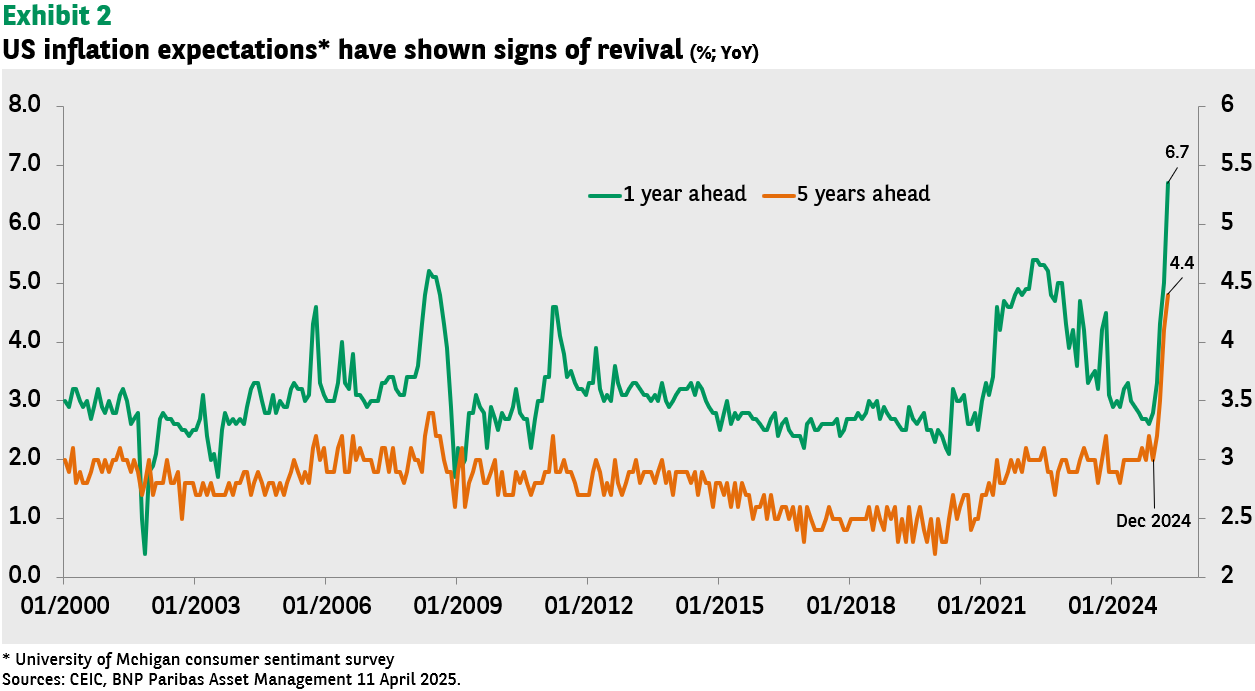
A weaker economy begets a weaker labour market, which tends to suppress wage – and inflationary – pressures. The key to whether the Fed can see beyond a temporary rise in inflation from the tariffs is that inflation expectations must remain anchored. On this, the recent signals are not clear.
US consumer expectations of inflation appear to be showing signs of rising (see Exhibit 2). The University of Michigan inflation expectations measure reached 6.7% and 4.4% in April for the 1-year and 5-year periods ahead, respectively. If confirmed, the tariffs could risk un-anchoring inflation expectations. That would affect the trajectory of the Fed’s monetary policy (read, no further interest rate cuts).
What is next?
Against this backdrop, investors should not expect the Fed to change its policy anytime soon. The problem is knowing when the impact of the tariffs will hit. The new levies will likely boost inflation a few months after implementation (we still do not know how the implementation will play out). They will put the brakes on growth after the inflationary effects have played out.
The exact timing of these dynamics is blurry. The Fed will need to be convinced that growth has become a bigger problem than inflation for it to cut interest rates again. We are not there yet.
The US central bank is stuck between a rock and a hard place. Ultimately, the tariff-led trade conflict could push the Fed to cut rates to counter the tightening effects of higher tariffs and rising trade policy uncertainty. The effect of the tariffs on US incomes will likely dwarf that on inflation, inflicting greater damage on employment and growth than any potential boost to (core PCE) inflation.
All this means that Fed rate cuts have not yet fallen by the wayside. They are just being delayed.
As for China, the escalation of the tariff war could push Beijing to take more aggressive measures to counter this external shock. As the world’s second largest economy, China would have ample fiscal ammunition to shield the economy from the impact of the tariffs. Beijing has the fiscal will to put in a significant expansion of the budget deficit to support the economy and uphold consumption.
[1] See “Rotating Tariffs: More China Less Global”, UBS Global Research, 9 April 2025.


