The US federal government shutdown, which began on 1 October, continues with little sign of any imminent settlement between Democratic and Republican lawmakers. As a result, at a critical juncture with the US labour market clearly weakening but growth holding up, interpreting what’s going on in the US economy has become even trickier.
Listen to the article
US data desert
The shutdown has stopped official data releases, which will leave investors in a data desert without major economic reports from the Bureau of Labor Statistics (BLS, responsible for the non-farm payroll report, consumer and producer price inflation data), the Census Bureau (retail sales report and some housing data) or the Labor Department (employment claims).
US inflation data for September inflation had been scheduled for publication on 15 October.
The consensus view was that the consumer price index from the Bureau of Labor Statistics would show an increase in inflationary pressures. On 10 October, the BLS said it planned to release its consumer price index (CPI) report on 24 October. While more than a week late, the report will still come in time for the US Federal Reserve’s (Fed) rate-setters, which next meet on 28-29 October, to factor it into their policy decision.
At their last meeting, Fed policymakers signalled a greater focus on the risks from a slowing labour market than from rising inflation. The ‘dot plot’, the Fed’s survey of its own members’ forecasts, suggests that policymakers expect inflation to be running at 3% by year-end, slightly above the current rate. We expect, contrary to market expectations, that US inflation will remain above 3% in 2026.
Although the non-farm payroll report for September has not been released, the basic picture of a low-hiring, low-firing US economy remains unchanged. We anticipate that growth in the US economy will slow this year to a sub-trend pace as the combined effect of tariffs and immigration restrictions hurt both demand and supply. Economic activity is expected to accelerate in 2026 year as easier monetary and fiscal policies lift demand.
We continue to expect gradual key rate cuts from Fed policymakers to around 2.5-2.75% by mid-2027. This is similar in nominal terms to current market pricing but much lower in real terms as we expect inflation to prove more persistent and that the Fed will likely downplay that, choosing to focus squarely on the employment side of its dual mandate.
Markets roiled by new tariffs
European stocks and US futures rose on 13 October after Donald Trump appeared to take a more conciliatory tone towards China. This followed the US President’s threat on 10 October of additional 100% tariffs on China starting on 1 November. President Trump also hinted he might cancel a planned summit with President Xi Jinping later this month.
This new threat from Trump, which came in response to a package of export controls on rare earths that Beijing had previously unveiled, sent the S&P 500 down by 2.7%, its steepest one-day drop since early April. The US Treasury yield curve steepened, and the US dollar fell versus major currencies.
Previously, US markets endured a largely quiet week in the absence of key data releases.
Political uncertainty in Japan
Following her victory, on 4 October, in the Liberal Democratic party’s leadership race, Sanae Takaichi seemed poised to become Japan’s first-ever female prime minister.
However, the abrupt collapse on 10 October of the 26-year-old coalition between the Liberal Democratic party and its junior partner, Komeito, complicates Takaichi’s route to becoming prime minister — a goal that depends upon a vote in parliament later this month.
Takaichi’s path to the premiership now depends on her securing the support of the Japan Innovation Party — the third-largest party in the lower house. Under Japan’s parliamentary system, in which MPs vote for a prime minister by name, and victory is secured via a simple majority, opposition parties could jointly propel an alternative candidate into office.
As a political veteran who has held many cabinet positions, Takaichi is seen as a big supporter of the late Shinzo Abe’s ‘Abenomics’ policies. These aimed at jumpstarting Japan’s economy out of two decades of stagnation through a mix of easy monetary policy, fiscal stimulus and structural reforms.
The prospect of weeks of political upheaval and the potential for a shift in the power balance of Japanese politics is likely to weigh on Japanese stock markets this week.
In the wake of Takaichi’s victory in the LDP’s leadership race, markets had anticipated easier monetary policy and greater fiscal stimulus. The result was a steeper yield curve and an all-time high last week for the Nikkei 225 index.
France: Second time lucky?
On 10 October, President Emmanuel Macron re-appointed Sebastien Lecornu as prime minister, five days after Lecornu had resigned.
A new cabinet list was unveiled on 12 October with the mission of passing a budget before the end of the year to keep deficit below 5%.
In addition to the centre-left Socialists, the centre-right Republicans seem sceptical about this latest development. Having supported both previous governments, the Republicans have now decided to stay outside the ruling coalition and will vote on each proposed law independently.
Prime Minister Lecornu needs both the Socialists and the Republicans to abstain in no-confidence votes against him later this week. A compromise does still seem achievable as Lecornu has reportedly made some progress in talks with the other parties whose support he needs.
Nonetheless, it will remain an uphill struggle to get a budget for 2026 through the divided parliament by the end of the year. If a compromise is found, markets could well see it as a short-term positive.
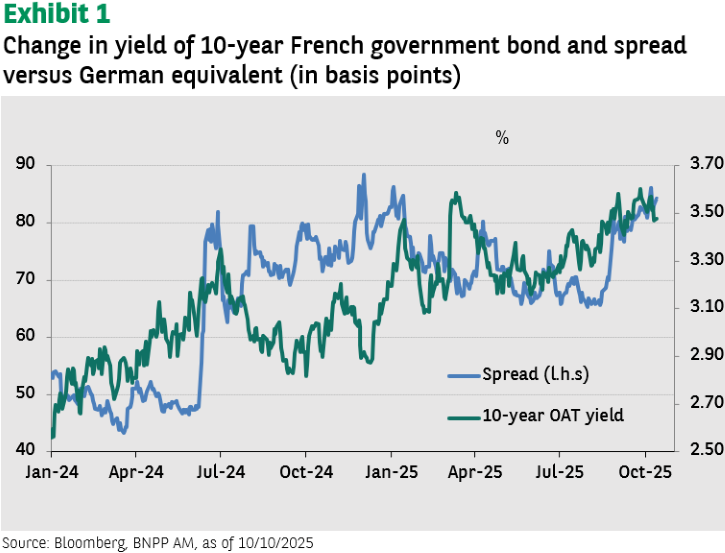
This was the theme markets played last week, with investors apparently reassured by developments (no imminent dissolution of the parliament and a willingness to set a 2026 budget before the end of the year). The 10-year interest yield spread between France and Germany has narrowed (see Exhibit 1).
While modest, the proposed budgetary effort is in line with the trajectory to reach the 3% target in 2029, validated by the European Commission in November 2024 during the evaluation of the budgets of the European Union’s member states.