
Investors expected prior to the US election that 2025 would see a soft landing of the US economy, entailing a slowdown both in consumer demand and payroll growth. That is exactly what seems to be happening, with the inevitable worries that the slowdown will go further than expected and a recession ensues.
Listen to the article
The disappointing US private non-farm payrolls figure (38,000 seasonally adjusted for August versus a consensus estimate of 78,000 and 77,000 in July) has renewed worries of an impending recession in the US, even though other economic data points to still steady growth (the AtlantaFed GDPNow estimate for real GDP growth in the third quarter is currently 3% as at 4 September). At a minimum, the odds that the US Federal Reserve will cut the fed funds rate at least 25bp at its next meeting have risen significantly, with either a 50bp cut, or additional 25bp cuts between now and the end of the year also somewhat more likely.
The firing of the BLS head last month highlighted the decreasing reliability of these figures, however. Falling response rates are a key reason for large revisions subsequently as better data is collected. Markets (and the Fed) will nonetheless take this data as a sign that the labour market is not as robust as they might wish.
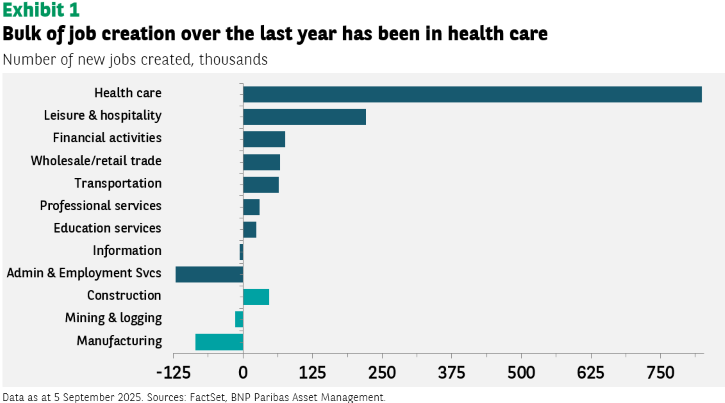
Another concern is the dependence of the labour market on the health care and social assistance sector for the bulk of what job creation there has been over the last year (see Exhibit 1). Over 70% of new jobs have been here, while the rest of the market is notably less dynamic. Leisure and hospitality is the partial exception as it builds back after Covid lockdown devastation. Notable also are job losses in temporary employment agencies, a pattern often seen as economic growth slows and companies are able to meet demand with staff on hand. Finally, manufacturing has certainly not yet seen any benefit from Trump’s tariffs, though anecdotal evidence suggests this should improve in the quarters ahead.
Chinese equities on a tear
Chinese purchasing managers’ indices data released recently do not fundamentally change the picture of an economy struggling with a moribund property market, weak consumer confidence and demand, and US tariffs.
This constellation has not prevented a sharp outperformance of the domestic A-share index versus the MSCI All Country World by 10 percentage points over the last few weeks before faltering a bit recently. Unusually, this outperformance has not been matched by the performance of the H-share MSCI China index (see Exhibit 2).
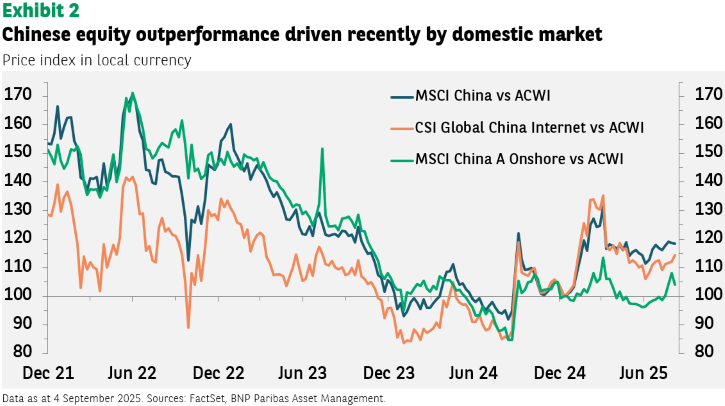
The recent decline came as after news reports surfaced of government regulators considering steps to cool the market. Longer term, without a broader recovery in the economy, we wonder if this spike might not follow the same pattern as the one from July to August 2023, when the A-share market outpaced the H-scare, but then quickly reversed. For more sustainable gains, we look to the Chinese technology sector, which enjoys fundamental support from AI-developments, similar to the sector in the US.
NASDAQ wobbles
That support has not prevented the NASDAQ 100 index from itself underperforming the non-tech parts of the market recently. One of the triggers for the lag was a report questioning the profitability of AI investments. This is a perfectly reasonable question for investors to be asking given the substantial sums being spent.
The companies making up the NASDAQ index have certainly accelerated their capex spending, to a point that the increase is outpacing the expected increase in earnings (see Exhibit 3). For the index’ price gains to be sustainable, one would think the EPS line in the chart will soon need to turn up in the same way.
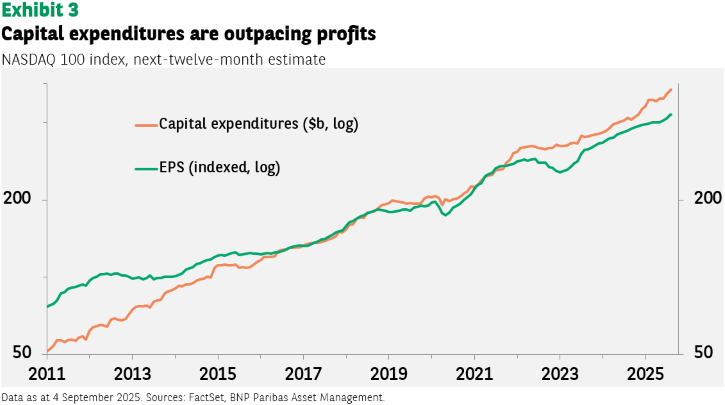
The fact that it has not, however, is oddly a reason to still prefer US technology shares. One of the criticisms of the tech sector is that valuations are excessive. We do not entirely share that view: forward price-earnings (P/E) ratios are certainly above average (currently 27.1x compared to a long-run average of 21.2x), but they are less so than for the Russell Value index.
The response from the naysayers is that the “P” in the P/E ratio is not the problem, it’s the “E”. The P/E ratio is not extremely elevated only because earnings expectations are too high. If you believe future earnings will turn out to be far lower, than the P/E is even higher. The steady slope of the EPS line in the chart above shows that in fact expectations are not rising at a faster-than-normal rate.
Long-bond woes
Long-term interest rates are rising around the world (see Exhibit 4), both for systemic and idiosyncratic reasons. Concern in the US has centred on wavering faith in the credibility of the US government driving a rise in term premium. There are also doubts about the sustainability of government finances, though this is a factor for France and the UK, too. The rise in Japan partly reflects the normalisation of the bond market now that the country has returned to inflation and the Bank of Japan is raising rates.
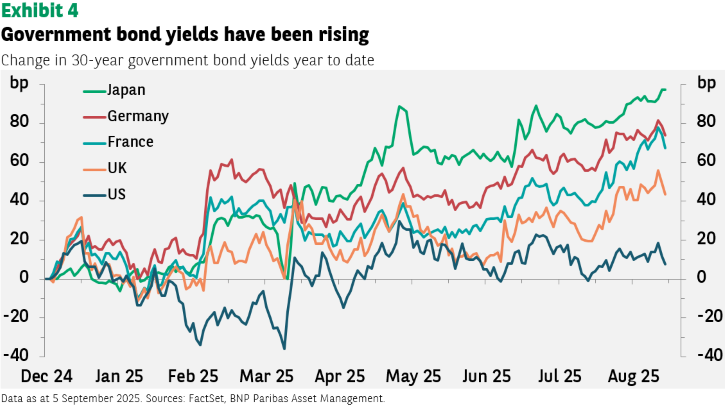
Perhaps the most surprising aspect of the moves is that they are comparatively limited for the US, whose government shows little interest in reigning in budget deficits, while countries in Europe are at least making the attempt.


