
What began as a rotation between different sectors in US stock markets degenerated in the last week of July into a full-scale sell-off with equity markets across the globe correcting sharply.
Listen to the article
The risk-off move in US equity markets really took hold on 1 August with all regional stock markets affected (see Exhibit 1). The tech-heavy NASDAQ Composite index fell by 3.4 % in the last week of July. Since its all-time high on 11 July, the NASDAQ has declined by more than 10% — the common definition of a market correction. Over the same period, the S&P 500 index is down by 6%.
The sell-off on Monday 5 August was broad-based, but large tech companies that had driven much of this year’s market rally were among the worst hit. This was despite a generally positive earnings season. It would seem quite simply that market expectations for tech stocks had been so high that it was difficult for them to be achieved.
Conditions have improved into Tuesday 6 August. The VIX index of expected US stock market turbulence has fallen back, though it remains well above recent levels and its long-term average of around 20, but far below the four-year high of 65 it hit on 5 August (see Exhibit 2).


What triggered the risk-off move in equity markets?
Among the proximate causes for the sell-off were:
- The decision on 31 July by the US Federal Reserve to not cut its key fed funds rate from the level of 5.25-5.50% where it has stood since July 2023. The Fed preferred to stand pat and prepare the way for a first rate cut in this cycle at its next policy meeting in September.
Although this had been expected, in the post-meeting press conference, Chair Jerome Powell made it clear that unemployment was now as much of a concern as inflation. He said the jobs market was merely ‘normalising’ rather than moving steadily toward recession.
Not all analysts agree with him. Some former FOMC member have suggested the Fed is falling behind the curve in maintaining policy rates at the current level for so long.
Chair Powell went so far as to tempt providence by saying that he “would not like to see material further cooling in the labour market.”
The next day providence duly delivered, firstly via a monthly ISM manufacturing survey which was much weaker than expected at 46.8 versus 48.5 prior. Markets took particularly note of the diffusion index on manufacturers’ plans for employment. It fell to its lowest since the beginning of the pandemic; it is over 20 years since it last dropped to such a level outside of a recession.
The same day saw the publication of the headline manufacturing purchasing managers’ index, along with the new orders reading that is taken as a good leading indicator of the economic outlook. Both slipped ominously into negative territory; a rise in jobless claims only served to exacerbate market angst that the Fed was making a policy error.
With the market fully focused on the risks to the US labour market, mitigating factors such as the fact that the ISM has been a poor guide to real US GDP growth since the pandemic, or the possible distortion of jobless claims by idiosyncratic factors (e.g., the effects of hurricane Beryl or retooling in Michigan’s auto plants) were ignored. Investors latched on to the idea that exactly what the FOMC did not want, i.e., a significant deterioration in the US labour market, was in fact underway.
The ‘coup de grace’ came on Friday 2 August when July’s non-farm payrolls report revealed lower-than-expected job creation of 114 000 (versus 175 000 expected and an average of 215 000 over the last 12 months). There were also modest downward revisions to prior months’ data, while July’s unemployment rate rose to 4.3%.
The signs in recent weeks of slowing momentum in the labour market first stoked optimism about imminent rate cuts from the Fed. Last week’s data triggered concerns over recession, as historically ahead of downturns unemployment tends to rise slowly at first, and then tips swiftly into a recession.
That’s the basis for the so-called Sahm rule: Once the unemployment rate rises 0.5% above its low for the previous 12 months, there will likely be a recession. That threshold was triggered by the increase in the US unemployment rate in last week’s data.
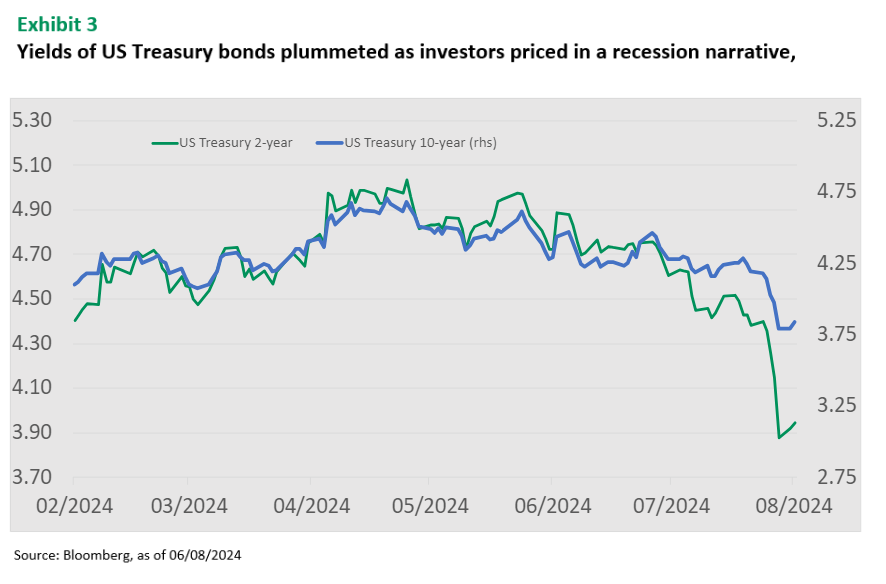
The previous market consensus for a soft landing of the US economy was jettisoned to be replaced with a narrative of an impending recession. Yields of US Treasuries plummeted (see Exhibit 3 below) and the market moved to pricing four rate cuts this year, with at least two of 50bp. There was even talk of the Fed having to undertake an emergency cut before September’s next meeting of the FOMC, though we see this as unwarranted.
- The decision on 31 July by the Bank of Japan (BoJ) to significantly tighten monetary policy by lifting its benchmark interest rate to 0.25 % from 0.10 % previously and halving its monthly bond purchases.
Prior to the policy decision, analysts were split evenly on the prospect of the BoJ lifting short-term interest rates, with some economists cautioning against a move after a string of weak economic data.
It may be that the BoJ’s tightening was partly due to pressure from the Japanese government for the BoJ to unwind its ultra-loose monetary policy and act to stop the yen’s decline (intervention in currency markets having failed to prevent the yen from making a 38-year low against the US dollar in June – see Exhibit 4 below). Recent data had already been on the soft side, so it is possible that the BoJ chose to ignore economic weakness and moved to counter the fall in the yen.
This more hawkish stance in Japan contrasts with expectations for a dovish shift in US monetary policy. The result has been an unwinding of carry trades in which international investors have borrowed the yen as a funding currency to sell and invest in a currency with higher rates.
Previously, the weaker yen had enhanced the foreign earnings of Japanese firms and enticed foreign investors into Japanese stock markets, which had seen a strong rally in the first half of 2024 (see Exhibit 4).
Over the past 18 months, the yen depreciated as the Fed raised interest rates and the BoJ stood still. This allowed the carry trade – where investors borrow cheaply in yen to invest in higher-yielding assets denominated in US dollars, euros (particularly eurozone ‘peripheral’ government bonds) or in currencies such as the Mexican peso – to flourish. This sent the Japanese currency lower still.

The relative shift in market expectations (higher rates now in Japan, lower rates in the US) likely triggered the unwinding of carry trades, causing the previously profitable trades to become loss making. The unwinding sets in motion a series of amplifying effects. Investors buying the yen to close out loss-making positions drive the yen higher. This worsens the pressure on those still holding the position, be they engaged in carry trades or speculating on further yen depreciation.
An appreciating yen menaces the profitability of Japanese exporters who sell, for example, in US dollars and repatriate their profits in yen. The subsequent fall in stock market valuations unleashes a negative spiral.
Every stage of this unwinding is driven to a certain extent by leverage, which investors may employ either in the carry trades or in margin positions on Japanese stocks. Such margin positions are reported to have reached the highest level since 2006 before the sell-off began.
By the close on 5 August, the TOPIX stock market index lost 12%, its worst performance since 1987. It had erased all its gains for the year after having reached an all-time high on 11 July.
Japanese stocks surged, though, on Tuesday 6 August, leading markets higher across Asia in a striking reversal of the previous day’s global sell-off. The TOPIX closed up 9.3 % and the yen stabilised at about 145.7 to the US dollar.
As fundamentally nothing significant has changed in the Japanese economy it is likely the abrupt unwinding of the carry trade drove much of the momentum selling on 5 August.
- An environment that is favourable for a perfect storm of events reversing consensus/momentum trades.
Many equity markets had a strong run in the first half of 2024, leaving valuations in some markets stretched and ripe for a fall.
In many markets positions were concentrated (e.g., tech stocks in the US) and investors were perhaps too complacent. This created the environment for a volatility spike with a sudden move to risk-off and an unwinding of crowded carry trades during a period of limited summer liquidity.
- The situation in the Middle East is understandably raising investor concerns and adds to nervousness in markets.
Is there a fundamental justification for the moves?
The unwinding of leveraged trades in markets with poor summer liquidity can, as we are seeing, be brutal. Events in Japan may reflect the start of an unwinding of a basic discrepancy in interest rate differentials, which can be traced back to the long-standing divergence between US and Japanese monetary policy.
Given the length of time that low interest rates facilitated carry trades financed in yen, the process of unwinding may have further to run.
The speed and strength of the moves in Japan’s stock markets point to a re-evaluation of the factors behind this year’s rally . It now seems clear that the rally was primarily fuelled by a weak yen rather than fundamental improvements in corporate Japan.
It will take time before the full consequences of the unwinding of the Japan carry trade (cheap funding in Japan and the search for yield among Japanese investors buoying the prices of risky assets around the world), become apparent.
It seems unlikely that the BoJ can push key Japanese interest rates higher from here in the short term. The question is more whether the Japanese economy can cope with last week’s tightening of monetary policy.
Our view on the US now
- US recession fears are not justified
- US payrolls data paint a picture of a labour market that is rebalancing amid a growth slowdown. July’s relatively weak report may be partially explained by idiosyncratic factors. It is likely that the Fed will require more information on the labour market before drawing any conclusions
- Corporate earnings are holding up well (meaning large-scale redundancies seem unlikely)
- The Atlanta Fed’s GDP Nowcast estimates indicate growth will still be at 2.5% in third quarter of 2024
- There do not appear to be any major financial imbalances (except for the US government’s debt position)
- US commercial real estate problems appear manageable, and there do not appear be any systemic financial risks in play.
In the absence of a major external growth shock or an internal financial stability shock, the probability of a US recession does not look that elevated to us, assuming the Fed delivers on rate cuts.
It looks more like we are seeing a messy unwind of market exuberance rather than any sudden realisation that a US recession has already begun. Calls for an emergency Fed cut do not appear at all justified at the moment, in our view.
The sell-off so far has been confined largely to equities. Apart from a general shift to risk-off, it has not spread significantly to credit (loans, corporate bonds, etc.). Sovereign bond markets are functioning as a hedge. If any of this were to change, it would indicate a deterioration in the situation.
Disclaimer
This material is issued and has been prepared by a representative of BNP PARIBAS ASSET MANAGEMENT Australia Limited (“BNPP AMAU”) AFSL 223418 ABN 78 008 576 449.
This material is produced for information purposes only and does not constitute:
1. An offer to buy nor a solicitation to sell, nor shall it form the basis of or be relied upon in connection with any contract or commitment whatsoever or
2. Investment advice.
Opinions included in this material constitute the judgement of BNPP AMAU at the time specified and may be subject to change without notice. BNPP AMAU is not obliged to update or alter the information or opinions contained within this material. Investors should consult their own legal and tax advisors in respect of legal, accounting, domicile and tax advice prior to investing in the financial instrument(s) in order to make an independent determination of the suitability and consequences of an investment therein, if permitted. Please note that different types of investments, if contained within this material, involve varying degrees of risk and there can be no assurance that any specific investment may either be suitable, appropriate or profitable for an investor’s investment portfolio.
Given the economic and market risks, there can be no assurance that the financial instrument(s) will achieve its/their investment objectives. Returns may be affected by, amongst other things, investment strategies or objectives of the financial instrument(s) and material market and economic conditions, including interest rates, market terms and general market conditions. The different strategies applied to the financial instruments may have a significant effect on the results portrayed in this material.
All information referred to in the present document is available on www.bnpparibas-am.com.


