
Fed Chair Jerome Powell’s speech on Friday 22 August at the Jackson Hole economic conference was supposed to be the event of the week and, indeed, it had consequences for financial markets. By focusing on the downside risks on employment, Powell paved the way for a cut in key rates on 17 September.
Listen to the article
Powell’s comments could be seen as bringing some ‘summer relief’ as he spoke of resilient US economic activity, a strong earnings season with positive forward guidance, a cooling of trade tensions, and hopes on the geopolitical front.
As is often the case, economists responded with differing views. Some saw Powell’s speech as dovish, justifying a rebound in equities – with the Dow Jones index hitting a new record high – and a decline in US bond yields. Others believed his tone appeared hawkish. The assessment of various available artificial intelligence tools was that the tone was neutral.
Fears about employment
Powell confirmed that US monetary policy is moderately restrictive and that an adjustment could be considered given the baseline outlook and the shifting balance of risks. It was the change in his tone on the labour market that attracted the most attention.
At the end of July, Powell had commented on the stability of the unemployment rate, linking it with a ‘balanced’ labour market. At Jackson Hole, he suggested this was a ‘curious kind of balance’ resulting from a marked slowdown in both the supply of and demand for workers.
His conclusion was that ‘this unusual situation suggests downside risks to employment are rising’. He went further, saying that ‘if those risks materialise, they could do so quickly in the form of sharply higher layoffs and rising unemployment’.
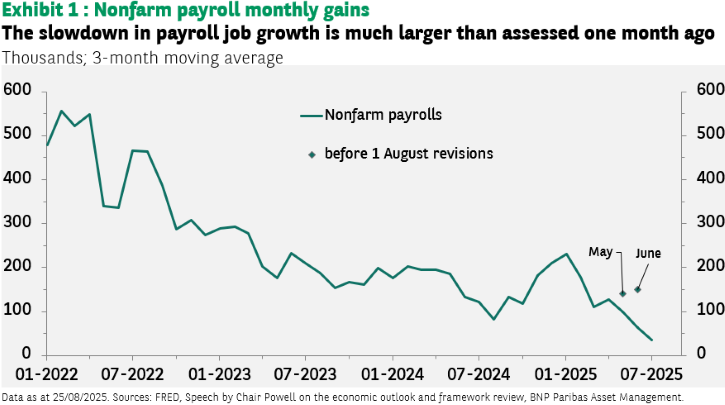
At Jackson Hole, Powell presented a graph (see Exhibit 1) showing the revisions to the number of jobs created that had worried investors at the beginning of August. On 9 September, the Bureau of Labor Statistics will release the preliminary estimate of the upcoming annual benchmark revision. The period under consideration is April 2024 to May 2025. A lot of attention will be focused on this highly technical aspect of the job report.
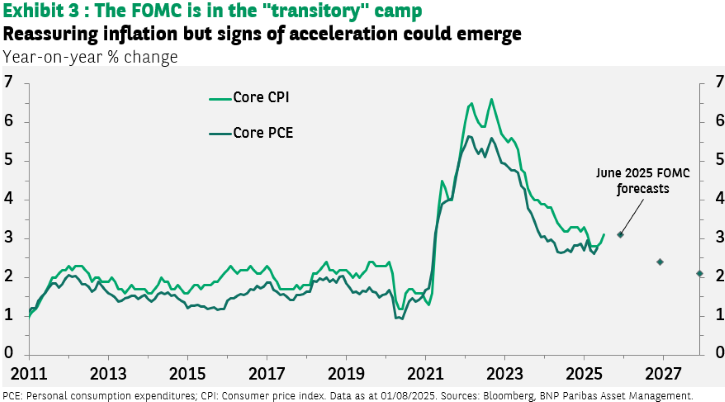
In our view, the Fed chairman’s intention was to announce a rate cut in September but not to endorse the series of cuts reflected in futures markets. Recalling that he now shares the notion of a ‘transitory’ increase in inflation linked to US import tariffs, he said there are still numerous less favourable possibilities such as a longer-lasting inflation dynamic or the de-anchoring of inflationary expectations.
He concluded that the concurrence of short-term upside risks to inflation and downside risks to employment is a complex situation for monetary policy, ‘which is [thus] not on a preset course’.
By announcing what looks like a fine-tuning of the Fed’s monetary policy – and thus breaking from the wait-and-see stance adopted since the beginning of the year – Jerome Powell succeeded in his last appearance as Fed chair at Jackson Hole. He arguably managed to reassure investors without further annoying the White House just when Donald Trump said he was ready to fire a Fed governor (Lisa Cook) suspected of mortgage fraud.
President Trump is seeking to alter the composition of the Federal Open Market Committee (FOMC). It is possible that Jerome Powell adjusted his speech and suggested a possible rate cut at the next meeting to avoid a recurrence of FOMC members voting against such a decision in September, as Christopher Waller and Michelle Bowman did in July.
Where does the US economy stand?
The flash estimates of the August purchasing managers’ indices (PMIs) confirmed the resilience of the US economy. The composite PMI rose to an 8-month high of 55.4, a level in line with GDP growth of 2.5% (annualised), consistent with the pace estimated by the Atlanta Fed’s indicator (GDPNow) based on data available as of mid-August.
When they are back from their summer break, investors will work to determine how the US economy is responding to Washington’s economic policies.
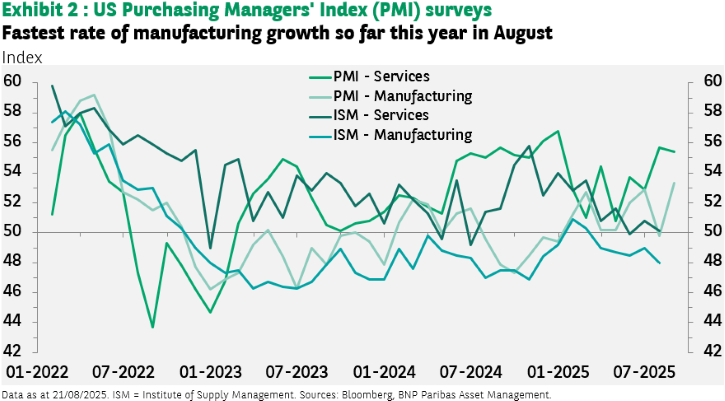
While the latest inflation figures perhaps reassured investors, the PMI data showed that price inflation had hit a three-year high. In this context, the revisions to inflation forecasts that will accompany the next FOMC meeting will indicate policymakers’ view of the risk.
Jerome Powell concluded his Jackson Hole speech by reaffirming that ‘FOMC members will make these decisions based solely on their assessment of the data and its implications for the economic outlook and the balance of risks. We will never deviate from that approach’.
It was his way of reaffirming the importance of central bank independence, as did other central bankers at Jackson Hole.
On the other side of the Atlantic
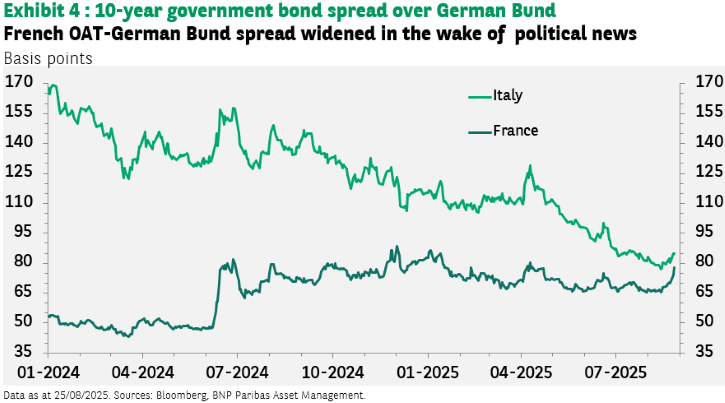
The interest rate differential between France and Germany has widened, approaching that of Italy, since François Bayrou’s announcement to seek a vote of confidence in the French National Assembly. It is still too early to say whether the French Prime Minister’s unexpected decision is likely to change the European Central Bank’s (ECB’s) next monetary policy decisions.
If the question were asked of Christine Lagarde today, there is no doubt the ECB president would answer — as she always does when politics rock financial markets — that the ECB is an independent central bank and that means the governors will deliver on the mandate, no matter the political situation.
Should Bayrou’s government not survive the vote of confidence, President Macron’s options would be either to appoint a new Prime Minister or dissolve the National Assembly and trigger a snap general election.
It is unclear which outcome is priced in the current OAT-Bund spread level, but the reaction has been more muted than in June 2024, when Macron last announced an unexpected dissolution of the assembly. Around the date of the confidence vote, certain factors will be worth watching:
- How the auction of long-term OAT (French government bonds) goes on 4 September
- What rating agency Fitch concludes on 12 September; it currently accords France a AA- rating alongside a negative outlook
Could the ECB step in?
In an interview on 28 October 2024, ECB President Christine Lagarde came straight to the point in answering a question about ECB intervention to calm markets:
Q: “The spread between France and Germany has increased from 0.5% to 0.8% since the French National Assembly was dissolved. The ECB has an instrument [The Transmission Protection Instrument] that it can use to intervene and calm the markets. Are you ready to use it?
A: “We have clearly outlined the conditions under which we will use this instrument. And that is not an issue today”.
It seems that, so far, nothing much has changed — the OAT spread is widening but with no contagion to other European bond markets. The week before François Bayrou’s announcement, long-term investors saw the level of yield at the long end of the French curve and still bought French debt. So it appears there is no reason (yet) for the ECB to jump in with a mechanism such as the TPI.
Back-to-school season will be busy
The ECB and the Fed’s September monetary policy decisions should be in line with financial markets’ (and investors’) expectations. That may change if there are any surprises between now and then from the raft of upcoming events and reports.
These include the labour market (US employment report on 5 September), inflation (eurozone estimate on 2 September, US producer and consumer prices on 10/11 September), and press conferences with Christine Lagarde and Jerome Powell.


