The Federal Reserve’s dual policy mandate, requiring the US central bank to ensure both stable prices and maximum employment, raises the question of the relative importance Fed policymakers attach to each objective. Both the US unemployment rate and the inflation rate have been rising recently, so which matters more?
During the press conference after the Fed’s policy meeting on 17 September, Chair Jerome Powell increased the weight the Fed gives to employment relative to inflation in its decisions on the course of US interest rates.
Currently, he said, the risks are on the side of employment, justifying the Fed’s decision to cut rates by 25bp. Powell again explained that the Fed’s base case is that currently higher inflation is down to US import tariff-driven goods inflation, which will probably prove to be a one-time event.
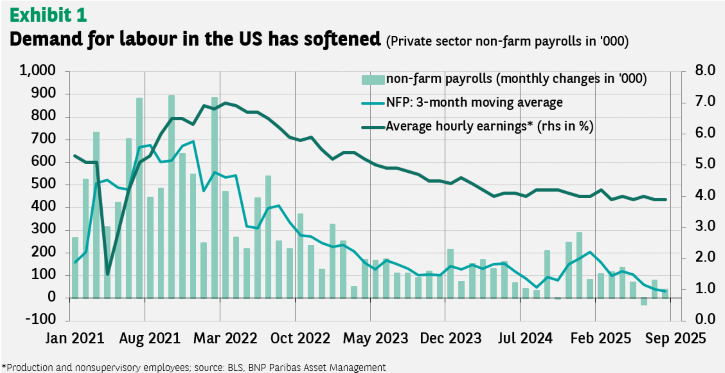
As our graph of the week shows, demand for labour has clearly been softening with creation of new jobs running at around 29,000 over the last three months relative to levels as high as 150-200,000 last year.
However, the supply of labour is also falling in the wake of the Trump administration’s efforts to restrict immigration, so the breakeven rate of new monthly jobs needed to hold the unemployment rate constant could be as low as somewhere between 20-50,000.
Our bond team’s view is that the US labour market is weakening significantly with demand falling faster than constrained supply. To counter this trend, we expect two more cuts of 25bp in the benchmark federal funds rate in 2025, and at least 75bp more in 2026, taking the terminal fed funds rate to 2.75-3.00% or below for this cycle.