
Target date funds – often the default investment choice in retirement plans – promise a simple solution: start with a high allocation to equities and gradually shift to safer assets such as bonds and cash as retirement nears. Beneath this simplicity lies a complex challenge: how should the ‘glide path’ – the schedule for shifting asset allocations – actually be designed? Romain Perchet, Mehdi-Vincent Hacini, Thomas Heckel and Koye Somefun explain.
Despite decades of academic research, most industry practices rely on rules of thumb as academic models typically do not scale well to real-world, multi-asset portfolios.
In our recently published paper, “Practical and Robust Glide Path Design for Multi-Asset Target Date Funds”1 in The Journal of Retirement, we explore a new, practitioner-focused framework that aims to bridge the gap between theory and practice.
In this note, we discuss some of the key ideas in the paper.
Why glide paths matter
Glide paths are central to the success of target date funds. They determine how much risk investors take at each stage of their working life, balancing the potential for wealth growth with the need for capital preservation as retirement draws closer.
Traditional approaches often lack a solid theoretical foundation, are highly sensitive to input assumptions, or simply do not work when more than two asset classes are involved.
Regulatory changes and the growing scale of retirement assets – over $4 trillion globally at the end of 2024 – make a robust, transparent design of the glide path more important than ever.
The human capital perspective and its limits
Academic models often justify glide paths by considering ‘human capital’ – the present value of future earnings – which is typically bond-like.
Early in a career, most wealth is in human capital, so financial investments can be riskier. As retirement nears and human capital declines, portfolios should become more conservative.
However, these models are complex, sensitive to assumptions, and hard to implement for multi-asset portfolios.
A two-step, robust approach
The paper proposes a practical, two-step framework:
- Build a robust efficient frontier1: Use robust portfolio optimisation2 to generate a set of one-period optimal portfolios for different risk levels. This approach, unlike classic mean-variance optimisation, is less sensitive to small changes in expected returns and produces more diversified portfolios.
- Recursively construct the glide path: Starting from one year before retirement, select the optimal portfolio from the efficient frontier for each period, working backward. The goal is to maximize expected wealth and control downside risk (using Value-at-Risk3) at retirement.
To illustrate, start by selecting the portfolio one year before retirement that optimises final wealth while balancing the impact of downside risk using Value-at-Risk. Next, two years prior to retirement, pick a portfolio from the efficient frontier that, together with the previously chosen one-year portfolio, yields the best possible final wealth over those last two years, again factoring in Value-at-Risk for downside protection. This process continues by working backward year by year, determining allocations for each period until all pre-retirement years have been addressed.
In the recursive process described above, the glide path depends only on risk appetite – not on personal circumstances or accumulated wealth – making it easy to publish and communicate.
Scalability and flexibility
The glide path design focuses on the long-term allocation to the multi-asset portfolio by assuming an independent one-period efficient frontier, which significantly simplifies the framework, but could be adapted to take tactical short-term opportunities into account.
It allows us to break down the glide path design process into two independent steps. Consequently, the approach works for portfolios with many asset classes, whereas traditional approaches only look at the allocation between equity and bonds. In other words, the approach is by design scalable to multiple assets.
Exhibit 1 shows an example of an efficient frontier with volatility on the x-axis and expected return on the y-axis. Exhibit 2 gives examples of allocations on the efficient frontier with increasing volatility.
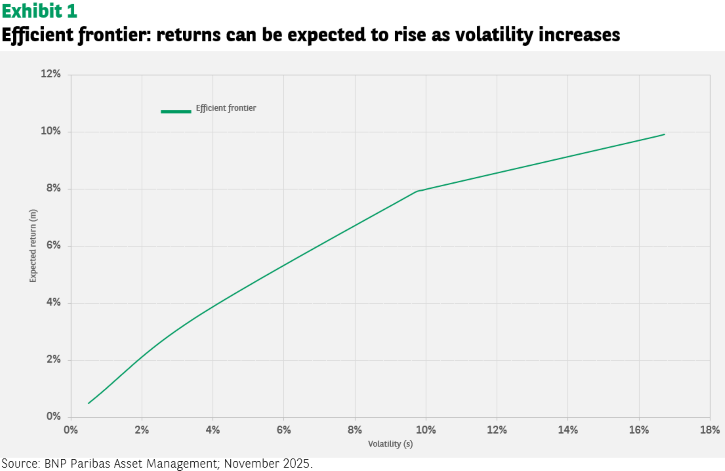

In the paper, we use the above efficient frontier irrespective of the years to retirement (as the underlying risk and return assumption do not depend on the years before retirement).
However, an easy extension, and something we do in practice, is to work with different efficient frontiers depending on the years before retirement due to, for example, regulatory restrictions such as a minimum level of cash two years before retirement.
This will not fundamentally change the problem: i.e., it does not (exponentially) increase the computational complexity of the problem and still results in glide paths that are known upfront, which is often a design requirement for practitioners.
The approach is flexible, facilitating a range of modifications that do not fundamentally change the approach. Currently, cash represents the risk-free asset at retirement. This can be adapted straightforwardly to accommodate alternatives to cash such as annuities as the risk-free asset at retirement.
Moreover, it is easy and intuitive to generate more defensive glide paths by simply varying the Value-at-Risk’s confidence level. Additionally, it is straightforward to replace a Value-at-Risk constraint with a constraint on other risk measures, e.g., Expected Shortfall.
Numerical insights
In line with economic intuition, the resulting glide path reduces the allocation to risky assets as the investor approaches retirement.
Exhibit 3 illustrates the approach with an eight-asset universe, showing how the glide path gradually shifts from equities to bonds and cash as retirement nears. The method is robust to changes in expected returns and can be tailored to different risk preferences or regulatory requirements.

Conclusion
This new framework offers a practical and flexible way to design glide paths for multi-asset target date funds.
By focusing on investment decisions and risk appetite – rather than hard-to-measure personal factors – it provides a scalable solution that meets both regulatory and investor needs in a rapidly evolving retirement landscape.
Read our paper Practical and Robust Glide Path Design for Multi-Asset Target Date Funds in the Journal of Retirement.
[1] The efficient frontier graph helps investors understand risk versus return, plotting portfolios with the highest expected return for a given level of risk. It emphasises diversification to optimise returns while minimising risk, highlighting the trade-off between risk and reward.
[2] Portfolio optimisation involves selecting the best mix of assets, aiming, for example, to achieve maximum return at a chosen level of risk. By analysing the performance of asset combinations under different scenarios, investors can identify the allocation that best aligns with their investment goals and risk tolerance.
[3] This involves assessing potential losses and the probability they will occur over a specified period. For example, as a result of the analysis, higher-than-acceptable risks may lead to sales of concentrated holdings.