Artificial intelligence is a pivotal theme driving the digital transformation across all sectors of the global economy. As the technology continues to proliferate into new applications, 2024 is already shaping up to be a crucial year in the development of the investment opportunities that AI offers, write Pamela Hegarty and Vincent Nichols.
The launch of ChatGPT in November 2022 marked an inflection point in the evolution of AI. It took the use of so-called large language models – a branch of generative AI that extends the capability of deep learning algorithms from analysing existing information to generating new content – to a higher level.
In addition, ChatGTP developers democratised access to AI models through cloud services and mobile apps, making it much easier for other developers, companies, and individuals to use the technology.
The release of ChatGPT set off a race among cloud service providers and other tech companies to expand their datacentre infrastructure, software stacks, foundation models and applications. Several leaders in the field published outsized positive revisions to their earnings and saw remarkable stock returns in 2023 and the first months of 2024.

Source: 5 Types of Artificial Intelligence That Bring Value to Business (scnsoft.com)
Where do we go from here? Nine developments in 2024
Over the course of 2024,we expect:
Continued growth of the infrastructure for training AI models – Capital spending by cloud service providers and large businesses stands to benefit semiconductor companies and the providers of servers, storage, and networking gear
The emergence of a credible competitor to the leading provider of graphics processing units (GPUs) as it ramps up its MI300 chip, which it expects to be competitive for AI model training workloads. A potential industry shift towards software that can fit with different hardware could begin to work in its favour as it continues to collaborate with the open-source software ecosystem
We expect GPUs to power most AI workloads given their performance and flexibility even as a wide range of leading tech companies looks set to continue to use application-specific integrated circuits (ASICs) in select high volume applications.
AI will likely be a major driver of semiconductor demand for the remainder of the decade. Logic and memory chip companies, foundries and semiconductor capital equipment and materials providers should benefit. AI inference (whereby a trained model is deployed into a production environment) will migrate from the cloud to edge computing and into devices over time
There is an emerging opportunity for the back-end networking of AI supercomputers, with Ethernet adoption outpacing InfiniBand growth, due to its ability to support multi-tenant cloud infrastructure
Providers of servers, data storage equipment, optical networking gear and cyber security platforms will likely see incremental revenue opportunities. It is critical to ensure high bandwidth for AI supercomputers to keep GPUs busy, as well as to make systems energy-efficient and minimise their environmental impact
Cloud service providers could develop larger, more powerful AI systems as they increase the number of parameters in the models and make use of larger datasets. Software companies will likely continue to embed AI functionality to improve their products. Investors should be sure to monitor the ability of technology providers to monetise the new capabilities

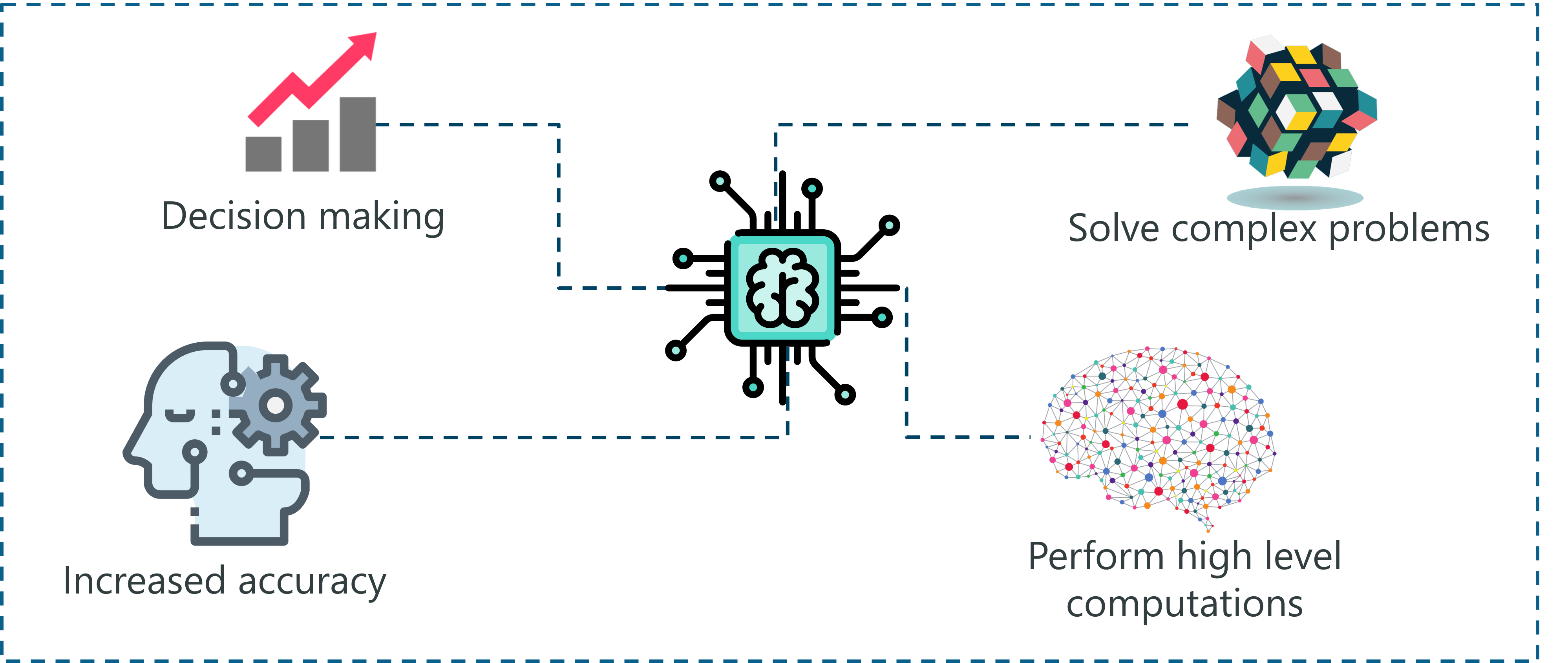
Uses for AI; source: What-Is-AI-Types-Of-Artificial-Intelligence-Edureka.png (3994×1689) (d1jnx9ba8s6j9r.cloudfront.net)
Use cases for AI will likely proliferate. UK newspaper The Economist has pointed out several interesting scientific applications, including pattern recognition (for drug discovery and materials science), predictive engines (folding proteins), complex computer simulations (weather models and simulating processes) and the use of generative AI to design new chemicals.
Companies are using generative AI for a broad range of activities including software development, chat bots for customer service, writing contracts and automating the production of marketing content.
In the industrial sector, manufacturers and equipment providers are implementing AI systems to enhance process controls and virtual digital twin models. In healthcare, the journal Nature published a scientific study in the Netherlands that describes the use of AI for medical image analysis to classify tumours, which could improve the decision-making of surgeons during brain procedures.
We believe bottom-up fundamental research will be critical to identifying the best stocks to play this theme, while avoiding companies that are unable to adapt.
AI as a key growth driver
As AI adoption proliferates, there are several risk factors to monitor with respect to fundamental analysis, environmental, social and governance (ESG) factors and investor sentiment.
A growth perspective – the speed and duration of infrastructure development are uncertain, and there could be pauses for ‘digestion’ during the process. AI expenditure could crowd out budgets for other information technology projects.
In late 2023, the US tightened its restrictions on semiconductor exports to China. While the goal was to limit their use for military applications, there could be as-yet unseen consequences; there is also potential for further escalation.
ESG – irresponsible users could abuse AI for surveillance, hacking and the creation of deep fake news. Biased datasets may result in incorrect output from AI models. Data privacy and security are issues, as well as the significant energy requirements for powering the datacentres that run AI models.
Investor sentiment – we may see valuations fluctuate as the technology moves through the adoption cycle. Some pundits have highlighted the existential risks of using AI for warfare and other nefarious applications.
On balance, we are optimistic about the pervasive adoption of artificial intelligence and its positive impact on
- cloud service providers
- software companies
- owners of large databases
- the semiconductor supply chain
- companies that are using AI to improve business processes.
We see AI as a key enabler of
- recommendation engines
- automated customer service systems
- manufacturing automation
- drug discovery
- document production
- educational tools.
To learn more about how we target opportunities in AI and other tech innovations, view our Disruptive Technology Fund
With such diverse potential, we believe AI will be a key growth driver in 2024 and beyond.
More articles on how new technologies are disrupting conventional business models:
Disclaimer
This material is issued by BNP Paribas Asset Management USA, Inc. (“BNPPAM USA”)*. In Australia, BNPPAM USA is exempt from the requirement to hold an Australian financial services license under the Corporations Act 2001 in respect of the financial services. BNPPAM USA is regulated by the SEC under US laws, which differ from Australian laws. This material is distributed in Australia by BNP PARIBAS ASSET MANAGEMENT Australia Limited ABN 78 008 576 449, AFSL 223418 .
This material is produced for information purposes only for the exclusive use of wholesale clients and does not constitute:
1. an offer to buy nor a solicitation to sell, nor shall it form the basis of or be relied upon in connection with any contract or commitment whatsoever or
2. investment advice.
Opinions expressed are current as of the date appearing in this document only. This document is not to be construed as an offer to buy or sell any financial instrument. It is presented only to provide information on investment strategies and current financial market trends. The analyses and opinions contained in this document are those of BNPPAM USA, and are based upon information obtained by BNP PARIBAS ASSET MANAGEMENT USA, Inc. from sources which are believed to be reliable. BNPPAM USA provides no assurance as to the completeness or accuracy of the information contained in this document. Statements concerning financial market trends are based on current market conditions, which will fluctuate. Investment strategies which utilize foreign exchange may entail increased risk due to political and economic uncertainties. The views expressed in this document may change at any time. Information is provided as of the date indicated and BNPPAM USA assumes no duty to update such information. There is no guarantee, either express or implied, that these investment strategies work under all market conditions. Readers should independently evaluate the information presented and reliance upon such information is at their sole discretion.
The information contained herein (and any calculation of targeted/expected returns) includes estimates and assumptions and involves significant elements of subjective judgment and analysis. No representations are made as to the accuracy of such estimates and assumptions, and there can be no assurance that actual events will not differ materially from those estimated or assumed. In the event that any of the estimates or assumptions used in this presentation prove to be untrue, results are likely to vary from those discussed herein. Past performance is not indicative of future results. The value of investments and the income derived from those investments may fluctuate over time such that the value of a portfolio at any given point in time may be more or less than its original value.
*BNP PARIBAS ASSET MANAGEMENT USA, Inc. is registered with the US Securities and Exchange Commission as an investment adviser under the Investment Advisers Act of 1940, as amended.