
Perspectives meet conviction
Europe edges its way into the heart of global portfolios

Introduction
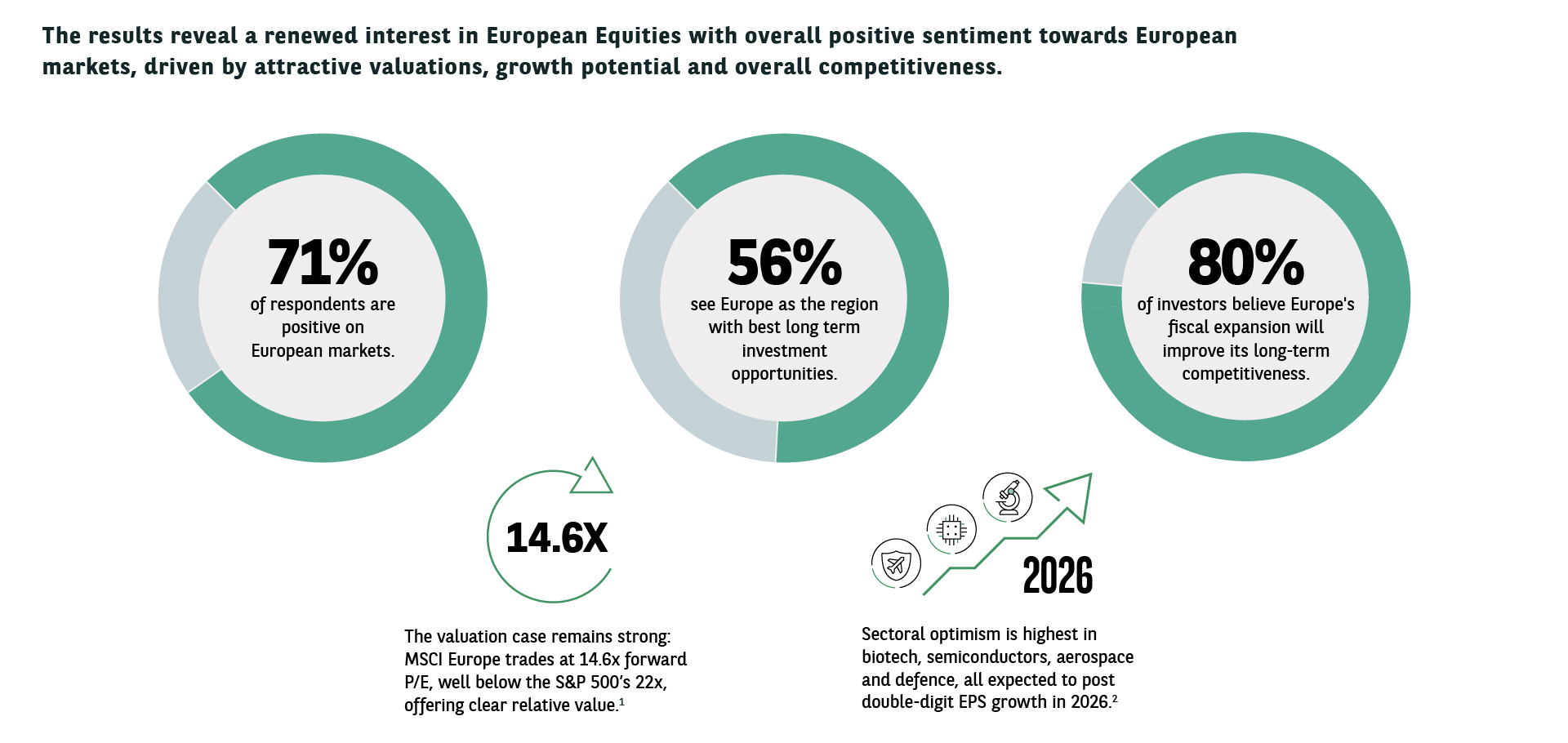
Europe is re-emerging as a strategic long-term investment for global portfolios, driven by a valuation gap that is one of the widest in decades. The S&P 500’s 22x forward P/E compared to Europe’s 14.6x1 offers value, income, and diversification. Structural reforms, fiscal ambition like Germany’s €500 billion fund, and EU initiatives such as REPowerEU and Readiness 2030 are boosting sectors like biotech, semiconductors, aerospace, and digital infrastructure. With stable ECB guidance and governance, Europe presents a credible alternative to the concentrated US market and some volatile emerging markets, reducing single-market and sector risks for investors.
Purpose of the Survey
After a decade of US market dominance, Asia Pacific investors are reassessing strategies as Europe re-emerges as a compelling opportunity. A BNP Paribas Asset Management survey of 300 institutional investors across Australia, Hong Kong, Japan, and Singapore shows a clear shift in sentiment and allocations toward Europe, driven by attractive valuations, solid earnings potential, and a more stable macro and policy outlook.
Spotlight 1: Attractive Valuation and Growth Potential – Reasons for Pivoting towards European Equities
From Tactical Exposure to Strategic Conviction
European equities are gaining renewed attention from APAC investors, and that’s further proven through the Europe Rising: 2025 APAC Investor Pulse survey. This shows a renewed interest in Europe that is being driven not by short-term sentiment, but by a confluence of valuation advantage, earnings recovery, and a wave of fiscal transformation unfolding across the region.
Interpretation: Structural Tailwinds Support Sustained Allocations
Investors are responding to structural tailwinds—fiscal reform, innovation-led sector growth, and monetary policy clarity. Europe is now viewed not as a tactical trade, but as a region capable of delivering competitive returns and anchoring diversified portfolios.
Spotlight 2: European Fixed Income: Resilient Yields, Reinforced by Policy Clarity
Stability, Income, and Policy Credibility
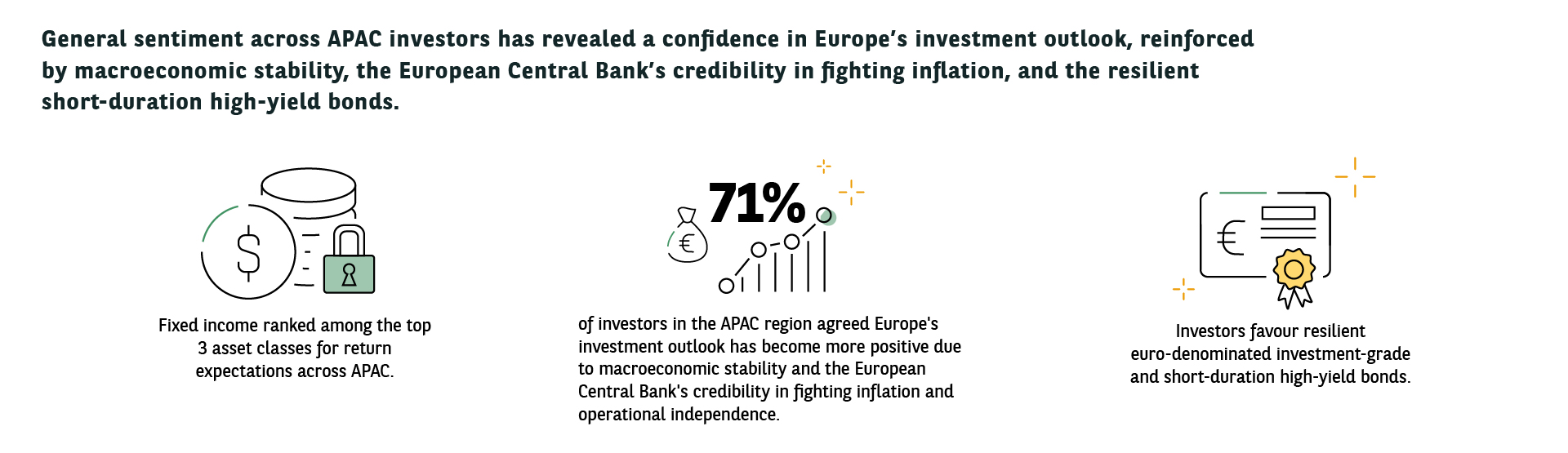
As global rate cycles diverge and volatility endures, European fixed income is becoming a dependable source of yield and stability for APAC investors in a shifting rate environment.
Interpretation: Stability and Income Anchor Returns as Rates Reprice
European fixed income has evolved from a yield play to a strategic allocation, offering stability, income, and downside protection in a shifting rate environment. Private credit is increasingly favored for its yield premium and low correlation to traditional assets.
Spotlight 3: Active Allocation and Alternatives Strengthen the Modern Portfolio
Beyond 60/40: Building Portfolios for Resilience and Growth
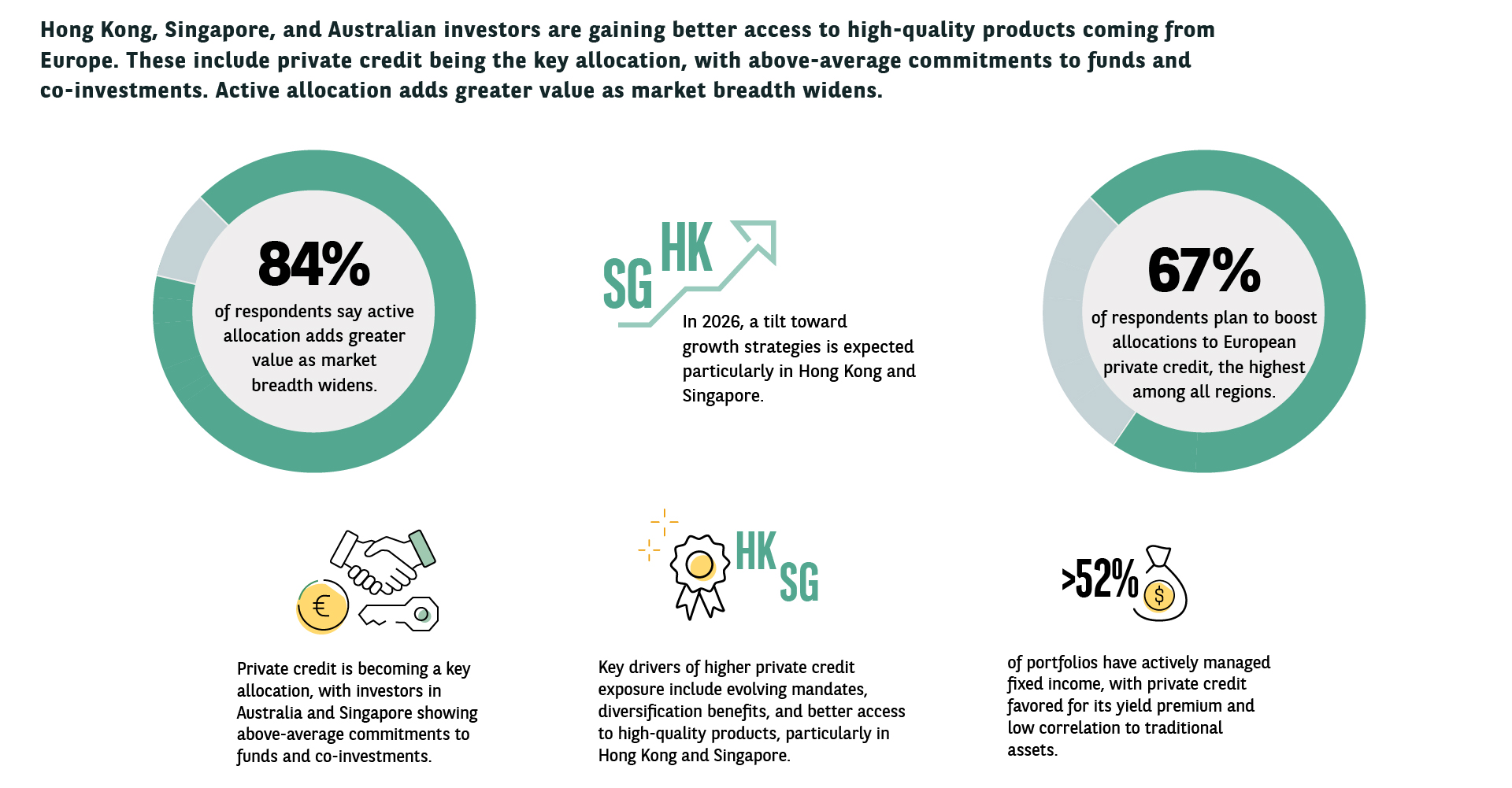
As the 60/40 model evolves, APAC investors are adopting dynamic allocations that incorporate alternatives, active allocation, and new sources of risk and return.
Interpretation: Dynamic Construction Improves Resilience
Modern portfolios have moved beyond static allocation, adopting multi-dimensional strategies that blend active and passive, public and private, growth and resilience. Active allocation is key to navigating complexity and seizing new opportunities.
Europe Rising Survey Report
Discover our European investment capabilities
Fixed income
A diverse range of Euro fixed income strategies, including Euro high yield bonds which pursue equity-like returns and offer a reliable source of income.
Equity
Growth-driven thematic ideas which seize opportunities in areas from defence, energy, digital infrastructure to critical supply chains.
Private assets
Co-investment is another growth market, providing a wider set of opportunities beyond public equities.
Related funds
-
BNP Paribas Global Absolute Return Bond Trust
Target consistent returns through a broad spectrum of fixed income opportunities
-
BNP Paribas Diversified Private Credit Trust
Unlock the potential of the private credit markets
-
BNP Paribas Green Bond Trust
Active green bond strategy, supporting climate-related and environmental projects
Related insights





[1] Data as of 8 September 2025. Sources: IBES, FactSet, BNP Paribas Asset Management.
[2] Data as of 8 September 2025. Sources: Factset, BNP Paribas Asset Management.
Get in touch
Got a question? Our team is happy to help
Important information
Marketing communication. For Wholesale Investors only.
This information is distributed to wholesale clients only in Australia by BNP PARIBAS ASSET MANAGEMENT Australia Limited ABN 78 008 576 449, AFSL 223418. None of the funds referred to in this material, besides the BNP Paribas Global Absolute Return Bond Trust, are available in Australia & New Zealand, and so this material is provided to wholesale clients for information purposes only.
Past performance or achievement is not indicative of current or future performance. Performance is calculated net of fees unless otherwise stated.
Any views expressed here are those of the author as of the date of publication, based on available information, and subject to change without notice. This material does not constitute investment advice.
Investments are subject to market fluctuations and the risks inherent in investments in securities. The value of investments and the income they generate may go down as well as up and it is possible that investors will not recover their initial investment. There is no guarantee that the performance objective will be achieved.
Environmental, social and governance (ESG) investment risk: The lack of common or harmonised definitions and labels integrating ESG and sustainability criteria at EU level may result in different approaches by managers when setting ESG objectives. This also means that it may be difficult to compare strategies integrating ESG and sustainability criteria to the extent that the selection and weightings applied to select investments may be based on metrics that may share the same name but have different underlying meanings. In evaluating a security based on the ESG and sustainability criteria, the Investment Manager may also use data sources provided by external ESG research providers. Given the evolving nature of ESG, these data sources may for the time being be incomplete, inaccurate or unavailable. Applying responsible business conduct standards in the investment process may lead to the exclusion of securities of certain issuers. Consequently, (the Sub-Fund’s) performance may at times be better or worse than the performance of relatable funds that do not apply such standards.
The sub-fund may be exposed to other risks defined below.
Capital loss risk: The investments are subject to market fluctuations and the risks inherent in investments in securities. The value of investments and the income they generate may go down as well as up and it is possible that investors will not recover their initial outlay.
Interest rate risk: The value of an investment may be affected by interest rate fluctuations. Interest rates may be influenced by several elements or events, such as monetary policy, the discount rate, inflation, etc.
Credit risk: This is the risk that may derive from the rating downgrade of a bond issuer to which the sub-funds are exposed, which may therefore cause the value of the investments to go down. Sub-funds investing in high-yield bonds present a higher-than-average risk due to the greater fluctuation of their currency or the quality of the issuer.
Liquidity risk: There is a risk that investments made in sub-funds may become illiquid due to an over-restricted market (often reflected by a very broad bid-ask spread or by substantial price movements), or if their rating declines or their economic situation deteriorates.
Derivatives risks: Risks include the lack of secondary market liquidity, valuation risks, the lack of standardisation and regulation, the risk of leverage, the risk of the counterparty.
Counterparty risk: This risk relates to the quality of the counterparty with whom the funds do business or enter into various transactions. This risk reflects the counterparty s ability to honour its commitments (payment, delivery, repayment, etc).
Operational and Custody Risk: Some markets are less regulated than most of the international markets; hence, the services related to custody and liquidation for the subfund on such markets could be more risky
For a complete description and definition of risks, please consult a client relationship manager or the global BNP Paribas Asset Management website: staging.bnpparibas-am.co.uk.
BNP Paribas Global Absolute Return Bond Trust Target Market Determination is available here staging.bnpparibas-am.co.uk/en-au.A Target Market Determination is a document which describes who these financial products are likely to be appropriate for (i.e. the target market), and any conditions around how the product can be distributed to investors. It also describes the events or circumstances where the Target Market Determination for these financial products may need to be reviewed.
Environmental, social and governance (ESG) investment risk: The lack of common or harmonised definitions and labels integrating ESG and sustainability criteria at EU level may result in different approaches by managers when setting ESG objectives. This also means that it may be difficult to compare strategies integrating ESG and sustainability criteria to the extent that the selection and weightings applied to select investments may be based on metrics that may share the same name but have different underlying meanings. In evaluating a security based on the ESG and sustainability criteria, the Investment Manager may also use data sources provided by external ESG research providers. Given the evolving nature of ESG, these data sources may for the time being be incomplete, inaccurate or unavailable. Applying responsible business conduct standards in the investment process may lead to the exclusion of securities of certain issuers. Consequently, (the Sub-Fund’s) performance may at times be better or worse than the performance of relatable funds that do not apply such standards.