
Surging inflation brought an end to the decade-long era of low bond yields. In the decade ahead, we believe bond yields will not return to the near-zero levels of the recent past or see the steady capital appreciation which marked the prior 30 years. Instead, our view is that inflation and real yields are more likely to remain closer to their long-term averages, supported by central bank policy, changing supply/demand dynamics, and the risk that inflation could spike again. Higher nominal and real yields should provide simpler and more secure solutions to investor’s fixed income needs, ushering in a new era of opportunities in the asset class.
In the summer of 2020, 10-year US government bonds offered yields of around 0.5%. By the autumn of 2023, they had surged to just under 5.0%.[1] In just three years, a decade’s worth of investor concern over cheap money, paltry yields, negative interest rates, and the inability of central banks to generate inflation had evaporated. Investor appetite for additional yield and thus the push to add increasing levels of credit or illiquidity risk to their portfolios also evaporated. The decade-long era of low bond yields was suddenly over.
Much has been written about the attractiveness of current bond yields and the potential for strong absolute returns as monetary policy becomes more accommodative. But relatively little has been written about the longer-term implications of the sudden lurch out of the low yield era.
Today’s US government bonds pay a positive real (inflation-adjusted) interest rate, have a more symmetric risk profile, and can play a wider range of roles and offer more opportunities in a diversified portfolio. Bonds are back, not just as a tactical investment in the coming quarters, but as a strategic opportunity for investors generally and – for the first time in a decade – with renewed purpose for a wide range of institutional investors needing income, duration, and diversity.
In the coming months, we will be taking a closer look at the implications of a new era for bonds through a series of in-depth articles. Here, we start by placing the end of the age of low yields in an historical context and providing broad guidance for managing bond exposure in the years ahead.
Bonds from 1981 to 2021: A tale of two eras
From 1981 to 2011, a period when actively managed bond investment began and the modern idea of holding a diversified portfolio of stocks & bonds became consensus, bond yields rose and fell with each economic cycle, but steadily trended lower.
It was effectively a thirty-year bull market, driven by the elimination of the ‘great inflation’ of the 1970s, and encouraged by a range of deflationary trends. The creation of the European Union, for example, or the emergence of China as an economic powerhouse and the economic integration of emerging market countries more broadly, were all symptoms of globalisation. This phenomenon was seen as a way to increase efficiency and productivity. In such an environment, steadily declining inflation was a natural consequence. Meanwhile, increasingly more efficient financial markets (including the advent of bond trading) and rapid technology gains helped push inflation lower around the world. Bond yields, rationally, followed with 10-year Treasury yields slowly falling from around 16% in 1981 to just under 2% in 2011 as can be seen in Exhibit 1.
These three decades were, despite short-term rallies and collapses, the golden era for bonds. Yields remained relatively high, so income was high, and the march to ever lower yields added a compelling dose of capital appreciation throughout each economic cycle. Holding lots of bonds in a diversified portfolio became common sense.
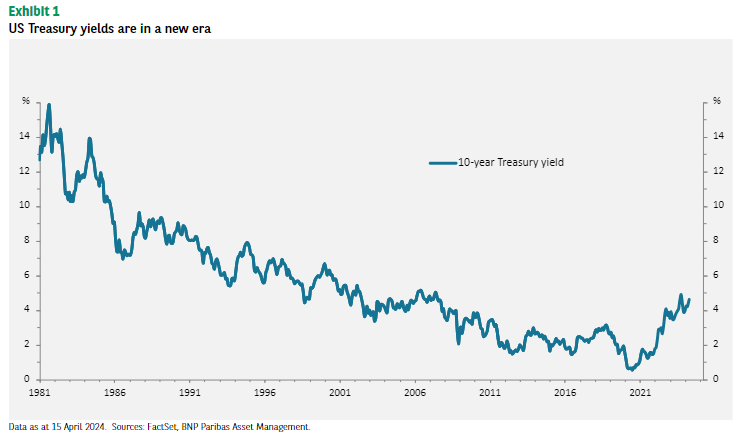
But between 2011 and 2021, both inflation and bond yields began to run out of room to fall. Japan was the first economy to reach zero yields, and most economists and market strategists (rightly) blamed local factors, especially the country’s deteriorating demographics. Then low inflation and lower yields spread across the globe. Numerous theories emerged to explain why, with most settling on the idea that we were in a ‘new normal’ and bond yields would stay low for the foreseeable future because global deflationary trends were too vast and too powerful. A consensus began to emerge that central banks lacked the power to create inflation despite them pivoting from lowering interest rates (to below zero if needed) to directly injecting more cash into the financial system through ‘quantitative easing’.
The challenge for central banks was amplified by the fallout from the 2007-2008 Global Financial Crisis. Consumer and corporate sectors were reeling, with both needing to focus more on improving their balance sheets than spending or investing. Governments on their own balance sheets, looking to reduce deficits and debt levels at the expense of stimulus spending. As such, central banks had to carry the burden of maintaining growth and inflation. Perhaps, in hindsight, investors did not give central banks enough credit while giving the global deflationary trends too much.
Throughout this era, investors’ need for income from investments remained unchanged. While few contested the idea that bonds still offered diversification benefits – that duration could be (and often was) an effective hedge against weak equity markets – the dearth of income resulting from low government bond yields became a problem. A furious search for more yield drove investors and companies into increasingly riskier fixed income assets, complex structured products, or some combination of the two.
While our description of the last 40 years is a simplification, we believe it is helpful to see the current environment in the context of two distinct eras in the modern history of bonds: The 1981-2011 bull market, which we call the golden era, and the low yielding ‘lost decade’ from 2011 to 2021. As investors consider where bonds go from here, we caution against regarding either of these periods as ‘normal’, with bonds necessarily fated to return to one or the other in the decade ahead.
The pandemic proved that inflation is still possible
Today’s higher bond yields are the direct result of inflation rapidly reaching levels unthinkable just five years ago and central banks responding with the fastest and most aggressive rate hikes in decades. But at the risk of stating the obvious, nothing else has changed.
Globalisation did not suddenly revert in 2021, the EU didn’t dissolve, technology did not abruptly become inefficient or start hindering productivity, none of the oft-cited structural factors argued to be the root causes of structurally low inflation have changed.
While one could argue that higher inflation was an inevitable consequence of a decade of extremely accommodative monetary policy. The simpler explanation is that inflation surged across the globe because of a huge external shock, a shock amplified by a highly intertwined global supply chain and a sharp rise in government spending. While supply bottlenecks fuelled cost-push inflation, unprecedented fiscal stimulus fuelled demand-pull inflation. Under pressure to avoid austerity and aid the nation’s recovery, US government spending rose by over 45% between 2019 and 2020 alone[2], with the bulk going to support consumers and businesses through direct cash injections and subsidies, respectively.
In sum, the emergence of Covid-19 proved that inflation didn’t disappear and can still be a significant risk in the developed world. External shocks are unpredictable, and if inflation can surge to double digits in an otherwise sanguine 2022, it could do it again.
The structural arguments for high bond yields
Central banks prefer their economies to have some inflation. It increases consumption, helps keeps businesses profitable, allows a ‘normal’ positively sloped yield curve, and gives them greater flexibility in managing the economy. The last decade was difficult for monetary policymakers, and we believe few want to return to a time of negative home mortgage rates, to cite just one example of the extreme measures that were required. As such, we believe central banks will be motivated to keep inflation higher than it was in the last decade and, thanks to the last decade, they have developed and tested the tools and techniques to ensure it does.
While not a structural factor as much as one that is likely to transcend a few business cycles, the era of low interest rates caused fiscal deficits and central bank balance sheets to balloon. Both should keep some upward pressure on bond yields until they have improved. But that is unlikely to happen quickly. Governments need to rethink their funding strategies and implement them in an era of rising populism, not a quick or easy task.
While the Fed has already begun ‘quantitative tightening’, it still holds assets worth around 25-30% of US GDP[3]. According to a study by the central bank’s own economists[4], each 1% reduction in its balance sheet will add around 10bp of term premium to the 10-year Treasury bond. While the study was quick to clarify that there is ‘considerable uncertainty’ in the model, the common-sense point remains that increasing the supply of Treasuries will put upward pressure on Treasury yields until supply normalises.
Meanwhile, the long-stable demand dynamic may be shifting. Two of the largest buyers of Treasuries over the last decade were China and Japan but they are likely to be less enthusiastic to buy Treasuries than they were in the last decade. Japan, the first developed economy to try zero percent rates, recently raised rates (to 0.1%)[5] for the first time in 17 years, while China’s days of generating significant excess reserves may be over. China’s economy could well resurge over the next business cycle, but it doesn’t seem likely that it will return to the demand it sustained during the multi-decade heyday of growth.
Finally, we now know that a highly synchronised global supply chain makes supply shocks, and any consequent inflation, a global problem. For the better part of the last decade, markets enjoyed an increasingly efficient supply chain, largely free from external shocks or contentious trade policies. However, the pandemic didn’t just rupture that, but has also encouraged many companies to build more resilience into their business models. This means more duplication in processes, which translates into higher costs. Meanwhile, rising populism in many developed countries could portend greater trade disputes, or at least greater uncertainty. The world, in short, is vulnerable to inflation shocks and, in our view, the risk of another shock is more likely to be increasing than decreasing.
Geopolitical risk, for example, has been on the rise since Russia invaded Ukraine in 2022 and long-smouldering tensions are increasing in Asia (Taiwan) and the Middle East (Israel, the Red Sea). Add decarbonisation, climate change, the dominance of giant technology companies, artificial intelligence, aging demographics, there is a lot that can go awry. While this may not be new, what is new is that the effect can be both more global and more sudden.
Building bond portfolios for a new era
In our view, the guiding assumptions about the role of bonds in a diversified portfolio of the last 10 years, and the 30 years before that, need to be re-evaluated. Put simply, what is an optimal exposure to bonds when yields are not in either a multi-decade downtrend or low and going nowhere?
The answer, in our view, is surprisingly simple once one accepts that bonds will not deliver steady capital appreciation nor that yields are fated to trade near or through zero. Instead, bonds in the coming decade may finally be more akin to the textbook ‘normal’: they will be securities that offer a positive real yield that will rise and fall with the economic cycle, while providing diversification from equities.
Moreover, if we are roughly right that central banks have an interest in, and the means to, keep inflation positive, and markets will see the risk of inflation spikes from external shocks as a viable threat, real rates could remain positive for the foreseeable future. As such, the broad universe of bonds can again provide real income: To investors, but also to savers and asset-liability managers such as pension funds and insurance companies. It may no longer be necessary for all of these groups to aggressively take on additional credit or illiquidity risk to earn reasonable real income.
While the yield curves of major developed countries are not yet upwardly sloped, we expect them to eventually steepen as the need for restrictive monetary policy fades. As such, investors could again gain the benefit of ‘roll down’ – the capital appreciation earned as the maturity of bonds shortens over time and thus their yields must rally to match the lower yields of shorter-dated notes. While the economic cycle will cause the benefits of roll down to ebb and flow, the opportunity should give investors and active managers another tool for improving bond returns in the years ahead.
But in the end, the outlook for bonds in the new era may be simpler than all the above. One constant through both the golden era and the lost decade – that we do not expect to change in the decade ahead – has been that the current yield on a bond is generally the best determinant of its future returns for the length of the bond. With 10-year Treasury bonds currently yielding around 4.60%, they may be as compelling for long-term (10-year) investment as they are for short-term investment. Even when accounting for volatility around the long-term mean expected return, we believe long-term annual returns of over 4% are compelling for a ‘risk-free’ government bond exposure.

Thriving in the new era
The ‘new normal’ for bonds is yet to be determined, but we believe it will feature higher average yields than the last decade and lack the steady capital appreciation of the prior 30 years. While markets and strategists have recently been focused on the short-term opportunities in bonds, we believe a more significant point is at risk of being lost: Many of us have spent the last decade thinking that central banks are entities which struggle to create inflation. Today, we think investors should start thinking about central banks as entities which could, once again, manage the level of inflation.
To the extent that we are right, a surprisingly wide range of investor types may be able to find far more conventional means to address the needs that the low-yield era forced them to tackle by taking greater risk.
In the coming months, we will communicate on some of the key investment challenges, concerns, and questions and tackle how to best position an allocation to Fixed Income in this new environment. Some of the topics we are working on include: How have optimal stock/bond allocations changed? How has the case for active management of bonds evolved? How should duration and asset-liability management change in a higher-yield world?
With bond experts spanning countries, asset classes and sectors across the entire capital structure, as well as our expertise in direct bond investments, derivatives, and structured products, at BNP Paribas Asset Management, we believe we are well positioned to guide investors through this new era.
Further information including our Fixed Income range can be found on our website.
[1] St. Louis Fed. The 10-year US Treasury yield on 4 August 2011 was 0.52% and 4.98% on 8 October 2023. https://fred.stlouisfed.org/series/DGS10/
[2] Fiscaldata.treasury.gov: Total spending rose from USD 5.31 trillion in 2019 to USD 7.72 trillion in 2020 https://fiscaldata.treasury.gov/americas-finance-guide/federal-spending/#spending-trends-over-time-and-the-us-economy
[3] As of September 2023. U.S. Federal Reserve, https://www.federalreserve.gov/monetarypolicy/November-2023-Federal-Reserve-Balance-Sheet-Developments.htm
[5] https://www.boj.or.jp/en/mopo/mpmdeci/mpr_2024/k240319a.pdf


