This material is intended for Institutional Investors (as defined in the Securities and Futures Act, Chapter 289 of Singapore) only and is not suitable or intended for persons who do not qualify as such.
Over the last five years, indices of US small-capitalisation stocks sharply underperformed large caps, while in Europe, the opposite was the case. The prime reason for the divergence has been the dominance of large-cap technology stocks in the US which have had a bumper run. Should we expect a reversal in the fortunes of small caps?
Extended periods in which small caps underperform large caps are not unusual. The US Russell 2000 small-cap index lagged the broad market S&P 500 by 8% (annualised) between 1983 and 1990 and by 11% per year from 1994 to 1999.
Explanations for the 1980s lag include the increased use of index arbitrage by institutional investors, the rise of globalised investing, mergers and acquisitions, and a weakening US dollar. In the late 1990s, a key driver was the inflation of the technology, media and telecom (TMT) bubble. This gives us a clue as to the reason for the divergence over the last five years.
Tech holds the key
Historically, the relative performance of the EuroSTOXX indices has been similar to that of the US indices. However, since mid-2015, European small caps have continued to outperform large caps, while US small caps have lagged (see Exhibit 1). The technology sector accounts for most of the discrepancy.
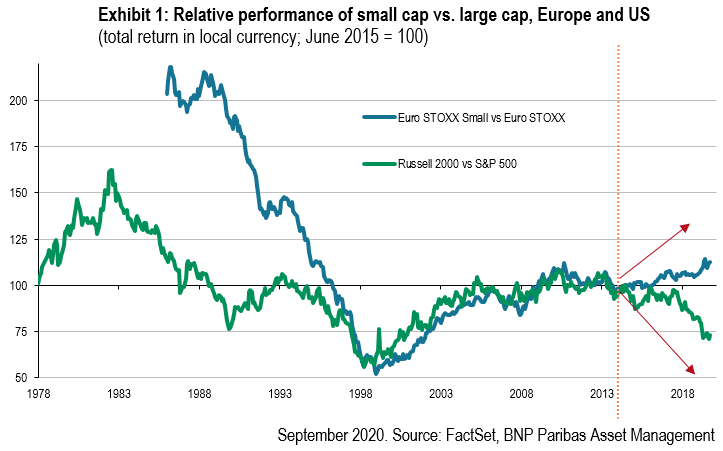
In contrast to the TMT bubble of the late 1990s, when European shares actually rose by more than those in US, Europe has not participated in the latest tech sector surge.
The broad tech sector (including internet retail and media & entertainment) makes up 38% of the MSCI US IMI index (which incorporates small-cap stocks), but just 10% of the European index.
Comparing the contribution by sector of small-cap outperformance and underperformance illustrates how tech has dragged on US small-cap returns.
Since June 2015, European small caps have outperformed large caps by 2.5% annualised, while US small caps have lagged large caps by 5.7%. The biggest contributors to this divergence were technology, financials, and consumer discretionary ex-internet retail (see Exhibit 2).
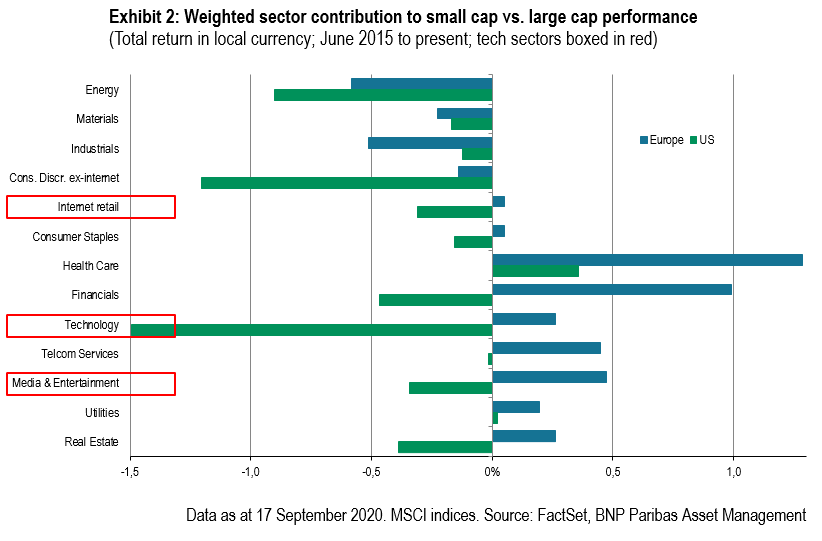
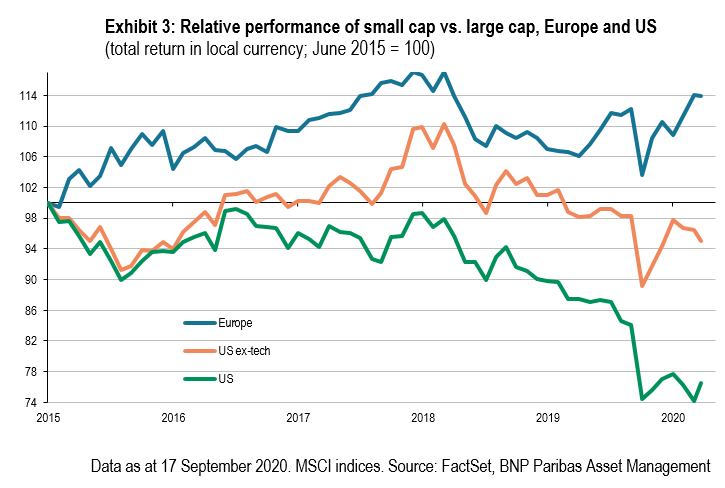
Notably for small-cap financials and real estate, Europe outperformed, but the US underperformed. This shows that there were other reasons than just tech for the US small-cap underperformance. Even excluding tech still does not result in superior performance relative to large caps (see Exhibit 3).
What about the future?
Given the relatively poor performance of US small caps over the years, it should not be surprising that valuations are now in small caps’ favour, but again, it is crucial to account for the tech sector.
Historically, small caps trade at a premium to large caps: about 25% higher in the US and 10% higher in Europe. Currently, the premium in the US is just 8%, suggesting small caps are cheap.
But when we exclude the expensive tech large caps, the premium rises to 30%, matching the long-run average. Europe multiples are similar, so there is no obvious opportunity simply based on valuations.
Earnings views brighter for US small caps
Analyst earnings revisions have been much more positive for US small caps, but this mostly reflects an expected rebound after the even bigger collapse in expectations at the onset of the pandemic. Estimates are still 27% below February levels, while US technology estimates are just 3% lower.
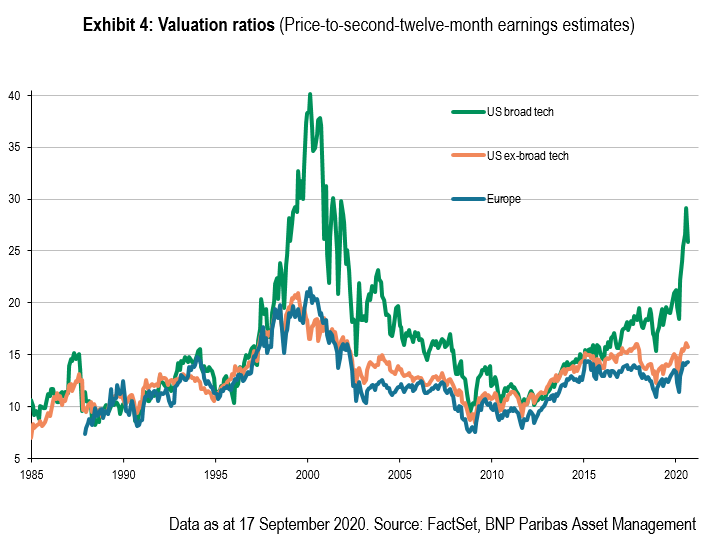
As for large-cap tech, it is notable that since May, second-twelve-month forward earnings estimates have risen by less than they have for the rest of the market. The significant gains in tech share prices since March assumedly reflect a big rise in future earnings, but analysts do not seem to share that view.
The lack of more positive earnings estimate revisions explains why multiples for the sector have risen so sharply this year, and remain high even after the correction over the last few weeks (see Exhibit 4).
What will it take small caps to gain the lead?
For US small-cap indices to outperform large caps, we will need to see a more significant, sustained correction in tech valuations. Small-cap stocks outside of the tech sector can certainly outperform, as Europe has shown, though with valuations at average levels, the potential is modest.
A recovery from the recession, particularly in consumer sectors that were hit badly by the lockdown restrictions, should result in a stronger bounce.
A Democratic sweep in November’s US elections would be particularly helpful as the expected fiscal stimulus would focus on domestic spending and income support, while any tax increases will affect companies. Offsetting this is the US weaker dollar. This typically benefits large-cap stocks.
Also read:
- US small caps set for ‘several years of dominance’ and other articles by Pamela Woo, head of US equities