
Which countries are most exposed to the fallout from the coronavirus crisis in China? How will companies around the world react as supply chains are disrupted, forcing them to close factories and halt product shipments?*
- The coronavirus (Covid-19) outbreak looks set to cause global disruption, even if only transitorily, in tourism, international trade and supply chains
- Asia’s tourism will probably be hit harder with implications for current account positions
- The impact on supply chains stems from a dependence on China as a source of demand and intermediate goods
- China’s shutdown affects countries with large direct investments and production onshore. This could structurally change global supply chains as companies reassess their China exposure.
The exact economic implications are difficult to gauge at the time of writing. Much depends on the length and virulence of the outbreak and the effect of government measures to control it.
What looks certain already now is the impact of China’s slowdown will be much bigger than it was 17 years ago during the SARS epidemic. China now accounts for 18.7% of the global economy, 12.4% of global trade and 12.0% of global oil demand. This compares with 8.2%, 5.0% and 6.0% respectively, in 2003.
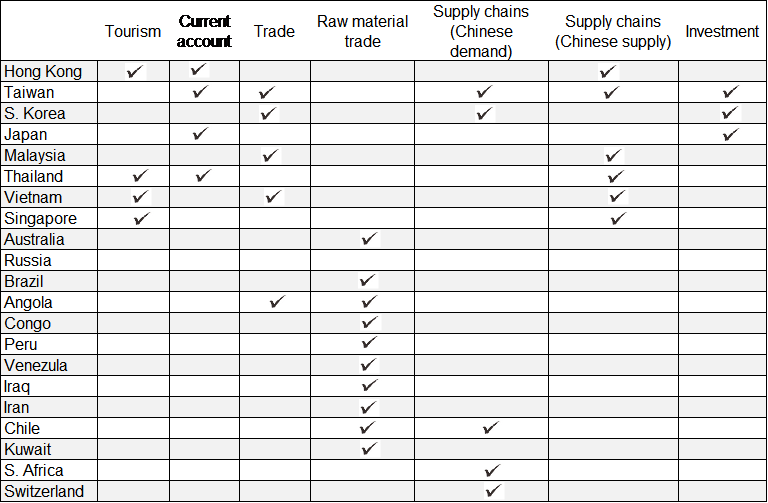
Here we provide a country-by-country overview (see table 1) and discuss the effects in more detail below.
Table 1: In which business sectors and economic indicators is the impact of disruption from the coronavirus outbreak in China felt the most?
table shows the above-average impact on country GDP by disruption channel
Source: BNPP AM (Asia)
Tourism and beyond
Chinese holidaymakers, the source of a major tourism boom across the world, especially in Asia, are staying home. With China accounting for USD 270 billion in annual outbound tourism, the negative impact on global tourism will go beyond the drop in tourist arrivals, spilling over onto sectors including transportation, accommodation, food services, everyday and high-end retailing, and financial services.
So far, 128 countries have restricted travel to and from China. Asia will feel most of the effects as over 90% of Chinese tourists travel within the region. Those economies that receive the largest number of Chinese tourists will be hit hard.
The impact on Hong Kong’s gross domestic product is substantial as Chinese tourist spending accounts for 4.8% of GDP. Thailand, Vietnam and Singapore all suffer more than the average due to the loss of Chinese tourist revenue.
Tourist revenue is also an important contributor to current account balances. For Thailand, Taiwan, and Japan, a drop in Chinese arrivals would lead to a bigger-than-average deterioration. Hong Kong’s change would be dramatic as its current account would move from a surplus to a deficit.
From a macroeconomic risk perspective, luckily, countries such as Indonesia and the Philippines that have weaker fundamentals such as current account and fiscal deficits and high foreign debt, the impact would be relatively small.
Trade disruption
Economies that depend heavily on imports by China both in terms of total value and as a percentage of GDP are affected more by the shutdown. Relative to the size of local GDP, the impact of a drop in Chinese imports is more serious on Taiwan, Vietnam, Malaysia and South Korea.
Given that China is the world’s biggest raw materials buyer, with over USD 500 billion in imports in 2018, the effects of the epidemic will be noticeable. China has halted all kinds of construction activities. A resumption is not likely until March 2020 at the earliest.
China’s energy demand has fallen due to a substantial drop in traffic. Refiners have started cutting production, helping to send the crude oil price to its lowest since early 2019.
In terms of value, Australia, Brazil and Russia are the top three raw material exporters. China accounts for over a third of their overall exports including iron ore and energy.
For these countries, the drop in demand is compounded by China’s pledge to buy more US energy and agricultural goods under the temporary trade deal signed in January.
In terms of the shock on GDP, the impact falls more on the typical commodity-producing countries in the Middle-East, Africa and South America than on Asia.
Supply chain shocks
China as a source of demand
China imported USD 430 billion of intermediate goods in 2018, including goods that manufacturers process and export again. The shutdown of factories has cut demand sharply. Relative to the size of their economies, the impact on local GDP is the biggest in South Korea, Taiwan, Switzerland, Chile and South Africa.
China as a supplier
According to United Nations Conference on Trade and Development data, China’s exports of intermediate goods used by other countries as inputs for their exports rose to 32% of total Chinese total exports in 2018 from 24% in 2003. Reflecting a shortfall in parts, Hyundai and Nissan have closed factories in South Korea and Japan, respectively, and Apple has delayed iPhone shipments.
Hong Kong and Vietnam stand out as the most exposed economies, while Singapore, Malaysia, Taiwan and Thailand also depend heavily on China’s supply chain.
Changing dynamics
While China has increased its exports of intermediate goods over the years, it has also reduced its imports of foreign inputs. This shift is likely to continue as Chinese manufacturers use more local components.
Disruption to investment
In recent years, Japan, South Korea and Taiwan have sought to diversify investments away from China to South East Asia, but their stock of direct investment in China remains large. Furthermore, South East Asia is deeply integrated in the supply chains that depend on China. This has greatly eroded the potential benefits of diversification.
So, the shutdown of virus-hit Chinese provinces such as Hubei (which accounts for 4.5% of national GDP) and the restrictions on other major production centres in coastal China, where most of the foreign investment and facilities are located, has hit production lines in North Asia directly as well as their investment in South East Asia.
In a nutshell
The world’s ability to avoid a production and supply disruption fell dramatically as it became more dependent on China for intermediate goods. Companies might now feel a greater need to relocate away from China and China-dominated regions to manage disruption risks better.


