
Investor sentiment in US equity markets has improved dramatically in recent months as pessimism surrounding tariff rhetoric from the new US administration has moderated to more of a wait and see approach. What does that mean for US small-cap stocks with the market recovery well under way, asks Vincent Nichols.
There is still plenty of uncertainty largely hinged around trade policy, but some of the worst-case outcomes seem to be more unlikely now. Even if there are reported disruptions in the hard data during 2Q (which seems likely), investors may be more inclined to look past this if there continues to be positive developments in trade negotiations. This could be further supported by more imminent likelihood of tax cuts, partly funded by tariff revenues.
Inflation data has been coming in quite soft even though tariff impact is not yet reflected in most of the data. There was a lot of inventory build up in anticipation of the tariff implementation and second quarter imports have been substantially lower. Until inventory excesses wind down and import volumes recover, uncertainty concerning the tariff impact on consumer prices will remain.
The near-term trajectory of the economy and markets are still going to be heavily influenced by each subsequent development in this trade war, but investors are increasingly shifting their focus back to fundamentals until more concrete evidence on the economic impact of trade policy presents itself.
So, are we likely to see more rate cuts?
The US economy was already decelerating prior to the recent tariff disruptions, so even in a more benign trade policy environment, the US economy may remain challenged.
In the case of a more pronounced slowdown or recession, we believe the US Federal Reserve has ample room to soften its monetary stance given that policy rates are still restrictive at well above 4%, but investors worry that potential price pressures from the tariffs will handcuff the Fed’s ability to manoeuvre.
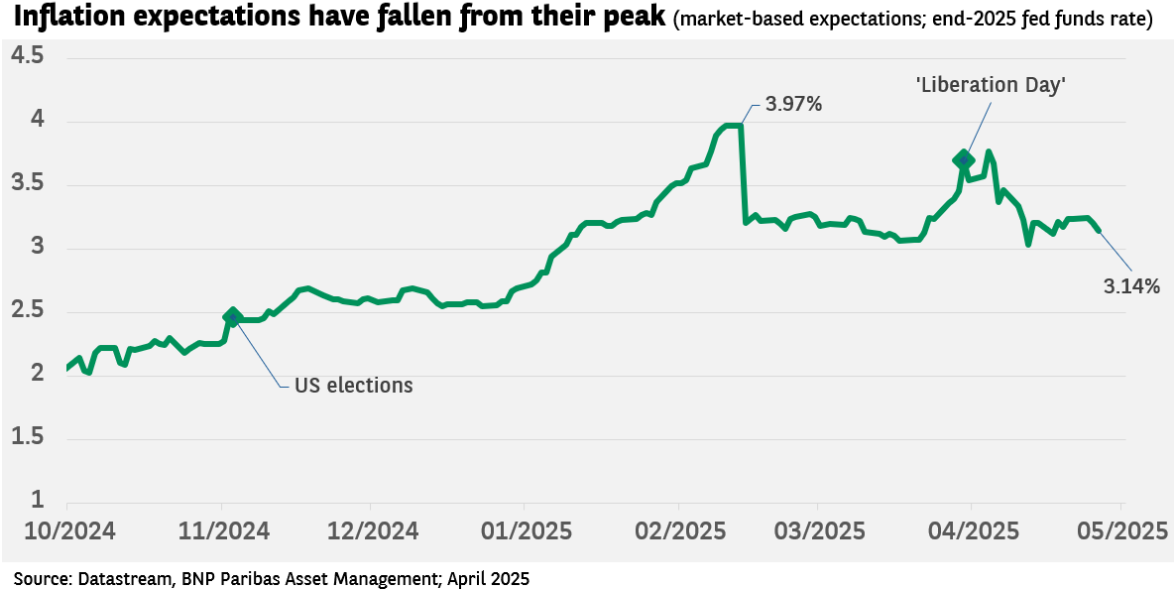
Even so, the potential for rate cuts from the Fed would likely only be delayed. Implied inflation expectations (as per one-year breakeven inflation rates) have fallen by more than 1.5% to 2.6% from their peak earlier this year, indicating skepticism that a material reacceleration in inflation would result from higher tariffs.
Long-running support for small caps
In the intermediate term (or the short term if tariff impact is better than feared) the secular drivers that we see for small caps remain in place.
After Donald Trump’s reelection, US small cap stocks rallied sharply on expectations that the new administration would focus on reinvigorating domestic industrial activity and implement corporate friendly policies such as deregulation and tax cuts. So far, the actions of the new administration remain consistent with this framework, but it will take much longer for evidence of this thesis to appear in the data, even if correct.
Over the last two years, US GDP growth has been more resilient than expected, largely supported by resilient consumer spending, a healthy labour market and real (inflation-adjusted) growth in wages.
However, many aspects of cyclical momentum have simultaneously been in a protracted multi-year downturn. The slowdown that we’ve now entered may be setting the stage for recovery, which investors often position for several months in advance.
In such a scenario, the much-anticipated broadening-out of earnings growth and market performance beyond large-cap (tech) companies may finally be at hand. Small cap sector and industry exposure is more diversified than with large caps and performance is more highly correlated with cyclical momentum. Small cap net income is down more than a third from its peak in 2022, so there is ample opportunity for a dramatic recovery in earnings growth from these low levels.
Lower policy rates, even if delayed, should help improve stagnant loan growth, lower the country’s fiscal burden, similarly reduce interest expense for companies (especially smaller companies), and revitalise already depressed merger & acquisition activity.
Focusing on innovation in healthcare
There remains an abundance of innovation in the small-cap space, notably across the healthcare sector.
After all the genetic sequencing done over the last few years, some of the most impactful innovations will now likely come from translating that work into drugs over the next decade.
Various techniques can now, for example, combine antibodies with chemotherapeutic payloads, as well as harness the immune system by putting T-cells engineered to attack cancer cells back into the body.
Advancements in gene therapy and gene editing and the ability to interfere at the RNA level are also creating opportunities.
Many active asset managers of US small caps have avoided early-stage biotech companies given their complexity and binary performance profile. Our strategy has managed to pick winners in this industry over the last decade and a continued recovery in biotech should disproportionately benefit the strategy relative to peers.
Healthcare mergers and acquisitions have picked up notably recently as large cash-rich pharmaceutical companies face patent cliffs and are looking to backfill drug pipelines. They often pay substantial takeout premiums.
The combination of likely rate cuts by the Fed, boardroom optimism and a measure of economic stability could lead to more widespread vibrant M&A. That would be another tailwind for small caps – it supports valuations and opens opportunities for high premium takeouts in our strategy’s portfolio.


