
US stock markets surged by more than 23% in 2024 as fears of a US recession gave way to anticipation of President Donald Trump’s pro-market policies (dubbed ‘Trumponomics’). Stock markets in the US (and by implication, around the world) now face uncertainty over the outlook for monetary policy this year.
Listen to the article
Market expectations on how far the US Federal Reserve’s rate-cutting cycle will go have shifted. The so-called terminal rate is now seen at about 4.0% – that is up from less than 3.0% in September 2024. Fewer rate cuts are now expected. The shift comes as the 10-year US Treasury yield has risen by one full percentage point.
Will higher bond yields hurt equity prices?
Inflation is key – or is it?
While stronger-than-expected US non-farm payroll data sent US stocks down by more than 2.0% on 10 January as suggested inflation risk remains, better-than-expected inflation data published on 15 January pushed up the S&P 500 index by 1.8% in a single day. Such volatility shows that market sensitivity to the inflation-growth dynamics has risen sharply.
Core US consumer price (CPI) inflation eased unexpectedly to 3.2% (year-on-year(YoY)) in December from 3.3% in November, while core producer price inflation was unexpectedly steady at 3.5% YoY. Meanwhile, the New York Empire Manufacturing Index, which measures business activity in New York State, plunged below the zero boom-bust line to -12.6 versus a forecast 2.7.
Europe and the UK showed a similar picture of moderating inflation – and a weak growth outlook – in December. Notably, the European Commission’s Economic Sentiment Survey for December declined to its weakest since September 2023 due to a broad-based worsening of sentiment; UK services inflation eased to 4.4% YoY from 5.0%.
Earnings versus interest rates
The crux of the matter is which factor – corporate earnings growth or interest rates – will be stronger in driving future stock price movements. The asset pricing model – which states that the stock price is determined by the present value of an earnings stream discounted by the long-term interest rate – can provide clues.
A fast pace of growth in earnings boosts expected future dividends, which tends to make stocks more attractive, pushing up valuations. Earnings growth and stock prices thus tend to move in tandem.
Meanwhile, rising interest rates (bond yields) reduce the discounted present value of future cash flows, making stocks less attractive and reducing valuations of equities, so that bond yields and stock prices move in opposite directions. However, both US bond yields and equity prices have moved in tandem since the second half of 2024 (see Exhibit 1), defying the theoretical implications.
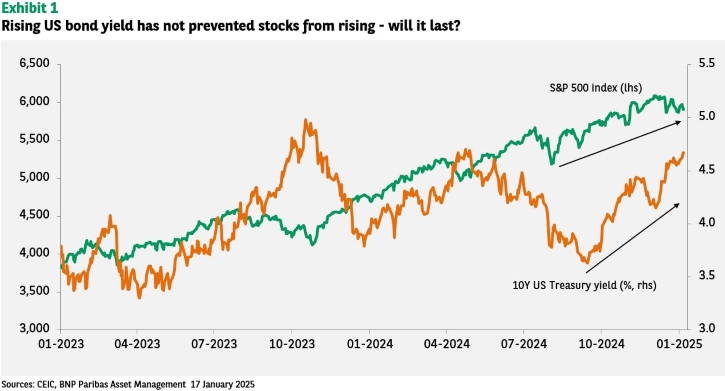
Rising yields and stock prices
A plausible explanation lies in the structural interaction between inflation expectations and economic (earnings) growth. In the 1970s, for example, when inflation was high and rising, the US Fed tightened policy significantly. That pushed bond yields up sharply, leading to economic recession, falling earnings growth and stock prices.
However, in periods when inflation is falling, as in the 1980s and 1990s, bond yields also fall. In this situation, any changes in yields mostly reflect changes in real economic (earnings) growth rather than inflation expectations. We conclude that earnings growth is the dominant factor affecting stock price movement when inflation is not a concern.
What about 2025?
The rise in US bond yields since September 2024 seems to be reflecting market expectations of potentially stronger US GDP growth momentum and constrained inflation rather than rising inflation expectations that could prompt the Fed to tighten policy significantly into restrictive territory. Why?
Firstly, ‘Trumponomics’ will likely keep the economy from weakening significantly and allow corporate earnings to grow at double-digit rates, according to analysts’ estimates. While there are inconsistencies in Trump’s policies – such as tax cuts versus tariff hikes, or GDP growth versus immigration restrictions – the overall policy direction is aimed at boosting productivity, GDP growth and asset prices.
Strong earnings growth reported by the four big US banks – JPMorgan, Wells Fargo, Goldman Sachs and Citigroup – last week, which collectively posted the second highest yearly profit ever, appears to underscore expectations for robust earnings.
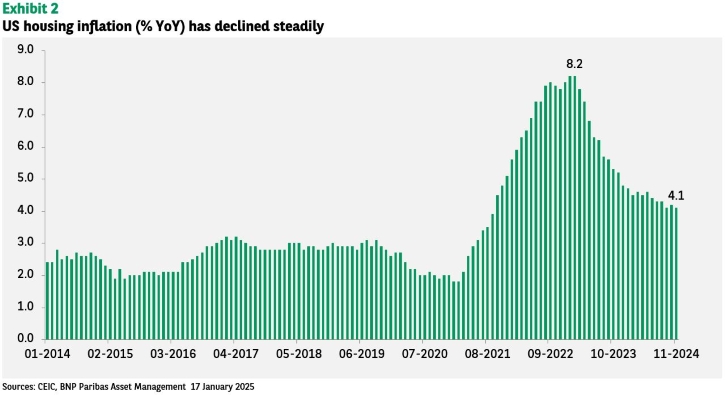
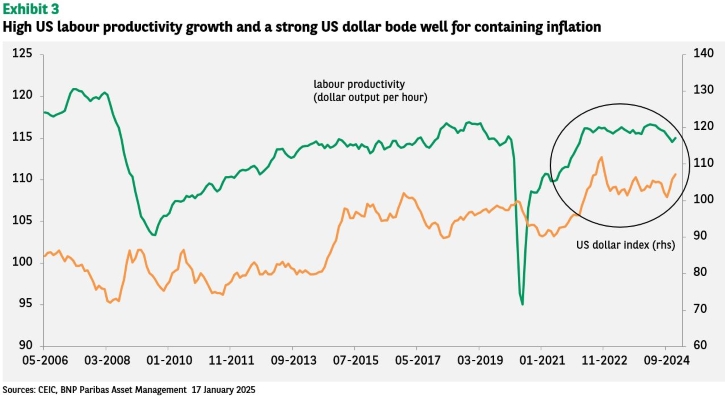
Secondly, core inflation will likely continue to nudge down towards the Fed’s target of 2.0% because rental inflation (the biggest component in both core CPI and personal consumption expenditures (PCE) inflation) has fallen sharply (see Exhibit 2). Crucially, strong labour productivity growth and a strong US dollar look set to continue to act as anti-inflationary forces (see Exhibit 3).
Thus, in an environment where inflation expectations are drowned out by economic and earnings growth as the drivers of stock prices, rising bond yields may not necessarily hurt stocks. This underscores our constructive view on global equities, especially US stocks, even though the number of expected Fed rate cuts has been scaled back to just two this year from four.
Risks and opportunities
What about the risks? Once inflation heats up again, the Fed will likely feel forced to raise rates, pushing monetary policy into restrictive territory. Stocks could fall, as they did in a rising inflation environment in the 1970s. While there is a risk of stagflation, we see only low odds of this happening, at least for now, because of (as said) falling rental inflation, rising productivity and a strong US dollar.
On the other hand, should the US economy fall into a recession unexpectedly, corporate earnings would suffer and stock prices could drop sharply. However, Trump’s proposed stimulative fiscal policy could put a floor on economic growth, reducing the odds of recession, and of a steep drop by equities.
Encouragingly, China’s economy appears to be showing signs of stabilising as Beijing’s assertive measures filter through, adding to a positive risk appetite. Fourth-quarter growth came in at 5.4% year-on-year, beating expectations by 40bp and pushing the full-year growth rate to Beijing’s 5.0% target.
In December, 23 of the 70 major Chinese cities reported month-on-month increases in home prices (up from 17 in November), retail sales rose by 3.7% YoY from 2.5%, the contraction rate in private investment narrowed to 0.1% from 0.4% YoY in November, and industrial output grew by 6.2% from 5.4% in November.
Overall, the positives – steady GDP and corporate earnings growth and moderating inflation – appear to be outweighing negatives such as market concerns over stagflation and policy tightening. We conclude that rising bond yields do not look to be a threat to stocks at this point.


