
Graph of the Week – Asia to benefit from US rate-cut cycle

This material is intended for Institutional Investors (as defined in the Securities and Futures Act, Chapter 289 of Singapore) only and is not suitable or intended for persons who do not qualify as such.

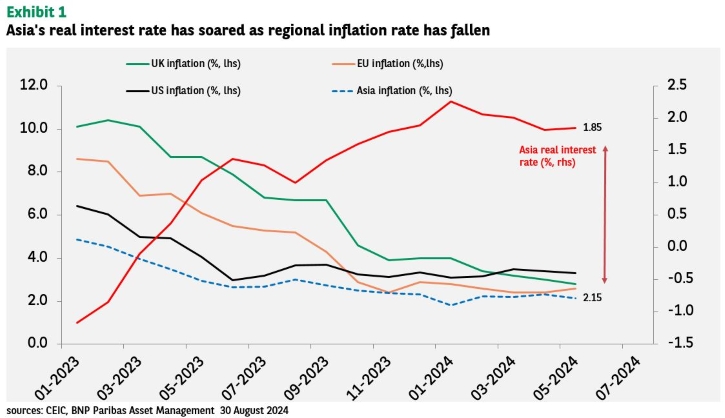
Emerging Asia stands to benefit from cuts in US interest rates that now look increasingly likely and imminent. The region mainly uses the US dollar for trade and investment transactions, effectively making it a dollar bloc. While US rates remained high, Asian economies suffered, held back by still high real (inflation-adjusted) local rates even as regional inflation fell. That is about to change.  

Impending cuts in US interest rates should provide Asia with a liquidity boost. Since inflation in Asia is lower than in many major developed economies, the beginning of a US rate-cutting cycle leaves regional central banks well positioned to follow suit. Late last month, US Federal Reserve Chair Jerome Powell flagged the Fed’s first move to lower borrowing costs, saying that “the time has come”.

Other central banks have already kicked off campaigns to lower rates as economies slow and demand for labour tapers off. With monetary policy shifting to a more aggressive easing, global growth should benefit.

Such a benign macroeconomic backdrop underpins our constructive view on emerging market debt in local currency, including Asian local EM bonds.
Important information

This advertisement has not been reviewed by the Monetary Authority of Singapore. Please note that articles may contain technical language. For this reason, they may not be suitable for readers without professional investment experience. Any views expressed here are those of the author as of the date of publication, are based on available information, and are subject to change without notice. Individual portfolio management teams may hold different views and may take different investment decisions for different clients. This document does not constitute investment advice. The value of investments and the income they generate may go down as well as up and it is possible that investors will not recover their initial outlay. Past performance is no guarantee for future returns. Investing in emerging markets or specialised or restricted sectors is likely to be subject to a higher-than-average volatility due to a high degree of concentration, greater uncertainty because less information is available, there is less liquidity or due to greater sensitivity to changes in market conditions (social, political and economic conditions). Some emerging markets offer less security than the majority of international developed markets. For this reason, services for portfolio transactions, liquidation and conservation on behalf of funds invested in emerging markets may carry greater risk. This material is produced for information purposes only and does not constitute: 1. an offer to buy nor a solicitation to sell, nor shall it form the basis of or be relied upon in connection with any contract or commitment whatsoever or 2. investment advice. It does not have any regards to the specific investment objectives, financial situation or particular needs of any person. Investors should seek independent professional advice before investing, or in the absence thereof, he/she should consider whether the investments are suitable for him/her.

Back to Top