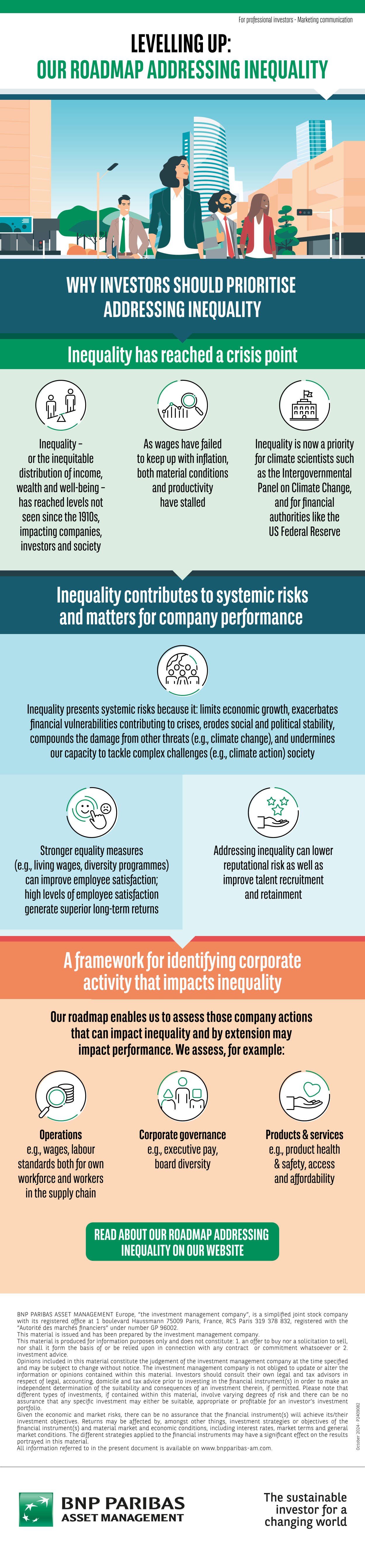
Why investors should make addressing inequality a priority
This material is intended for Institutional Investors (as defined in the Securities and Futures Act, Chapter 289 of Singapore) only and is not suitable or intended for persons who do not qualify as such.
A peak in the unequal distribution of income, wealth, and well-being – even in wealthy countries – is underpinning and reinforcing material social risks and threats to stability, growth and sustainable returns. Investors take note!
Our infographic highlights key points from our Equality Roadmap. It outlines how inequality contributes to systemic risks and matters for company performance. We present a framework for identifying corporate activity that impacts inequality.
This advertisement has not been reviewed by the Monetary Authority of Singapore.
Please note that articles may contain technical language.
For this reason, they may not be suitable for readers without professional investment experience.
Any views expressed here are those of the author as of the date of publication, are based on available information, and are subject to change without notice. Individual portfolio management teams may hold different views and may take different investment decisions for different clients. This document does not constitute investment advice.
The value of investments and the income they generate may go down as well as up and it is possible that investors will not recover their initial outlay. Past performance is no guarantee for future returns.
Investing in emerging markets or specialised or restricted sectors is likely to be subject to a higher-than-average volatility due to a high degree of concentration, greater uncertainty because less information is available, there is less liquidity or due to greater sensitivity to changes in market conditions (social, political and economic conditions).
Some emerging markets offer less security than the majority of international developed markets. For this reason, services for portfolio transactions, liquidation and conservation on behalf of funds invested in emerging markets may carry greater risk.
This material is produced for information purposes only and does not constitute: 1. an offer to buy nor a solicitation to sell, nor shall it form the basis of or be relied upon in connection with any contract or commitment whatsoever or 2. investment advice. It does not have any regards to the specific investment objectives, financial situation or particular needs of any person. Investors should seek independent professional advice before investing, or in the absence thereof, he/she should consider whether the investments are suitable for him/her.
Environmental, social and governance (ESG) investment risk: The lack of common or harmonised definitions and labels integrating ESG and sustainability criteria at EU level may result in different approaches by managers when setting ESG objectives. This also means that it may be difficult to compare strategies integrating ESG and sustainability criteria to the extent that the selection and weightings applied to select investments may be based on metrics that may share the same name but have different underlying meanings. In evaluating a security based on the ESG and sustainability criteria, the Investment Manager may also use data sources provided by external ESG research providers. Given the evolving nature of ESG, these data sources may for the time being be incomplete, inaccurate or unavailable. Applying responsible business conduct standards in the investment process may lead to the exclusion of securities of certain issuers. Consequently, performance may at times be better or worse than the performance of relatable strategies that do not apply such standards.