
As of 14 April, worldwide COVID-19 cases were closing in on 2 million, while deaths now exceed 121 000. In terms of the broad trends at the regional level, we highlight a few key takeaways:
- Europe is moving beyond the peak based on a three-day rolling average of the daily death toll, although the daily numbers remain in the high triple digits.
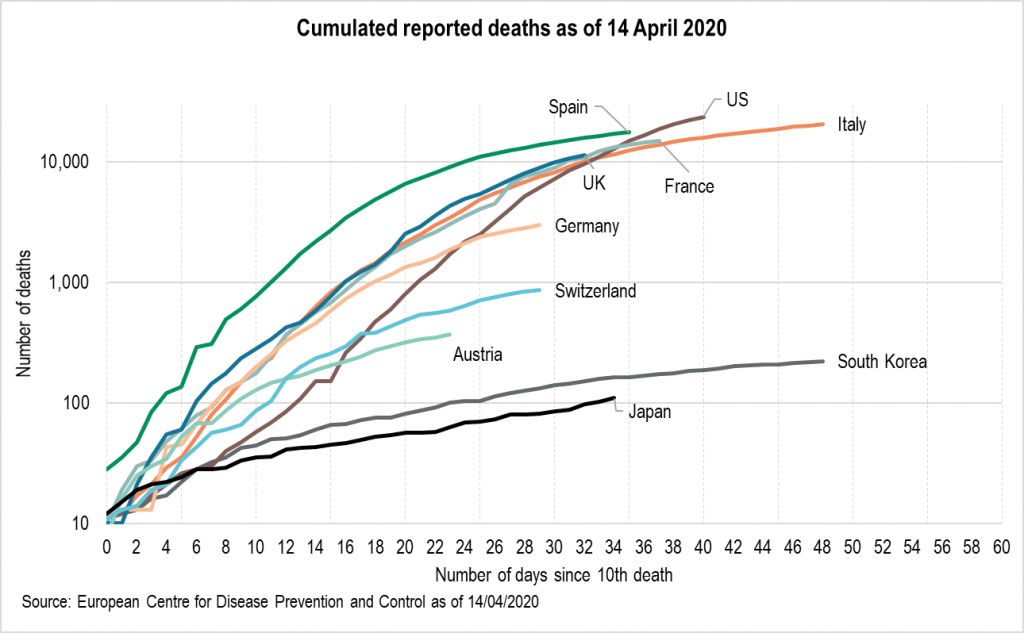
- The death toll trajectory in the US is now looking worse than in Italy (see Exhibit 1) and US Centers for Disease Control and Prevention (CDC) Director Robert Redfield has forecast that the country is approaching the peak.
- New cases are reaccelerating in Japan and Singapore despite the recently announced mobility restrictions in both countries, and China registered its highest-ever single day number of imported cases over the weekend.
- The death toll is rising in many developing economies, including India, Turkey, Mexico and Brazil. The low number of confirmed cases in these countries probably reflects inadequate testing.
Exhibit 1:
A beginning to the end of lockdowns
The lockdowns are taking a ruinous toll on the economy and public finances. The key issue for finance ministers and investors alike is therefore the exit strategy from the lockdowns. Several countries in Europe are now making plans to wind down containment.
Austria, Denmark and Norway will start to gradually loosen their measures this week. Of course, the North Asian experience – with a second wave of both imported and local infections – reminds us that learning to live with the virus outside of lockdowns is not straightforward.
Economic outlook
As far as the economic outlook is concerned, we will not have official confirmation for some time on exactly how large the contraction in output has been. The latest set of International Monetary Fund (IMF) macroeconomic forecasts put the likely scale of the current contraction in context:
Exhibit 2:

In summary, the IMF now expects global GDP to fall by 3% in 2020, a downgrade of over 6 percentage points to the estimate of global growth that was made in January 2020. On this basis the recession in 2020 will likely therefore be far worse than that in the wake of the Global Financial Crisis and the largest we have experienced since the Great Depression.
Policy response – over the last week, the US has left Europe behind
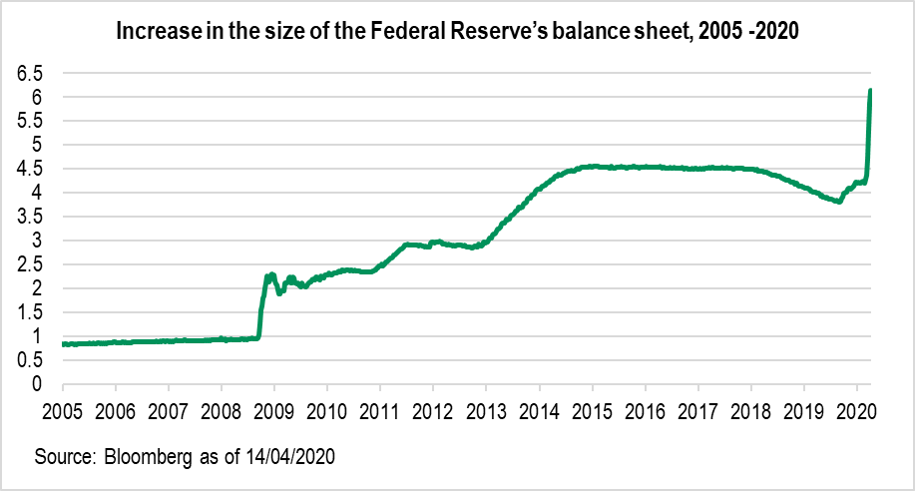
An economic contraction on this scale demands a sizeable policy response. There is a sense that Europe is slipping behind the US on this front. In the last week, we have seen a significant expansion of the Federal Reserve’s activities, while Europe continues to struggle to find a solidarity solution to financing the necessary spending on fighting the virus.
The Fed has been buying assets at a prodigious pace, acquiring far in excess of USD 1 trillion of US Treasury securities over the past month. There has been a proliferation of schemes designed to support liquidity in the money markets and the provision of credit to the real economy. In its latest announcement, the Fed took further steps to provide up to USD 2.3 trillion in loans via a number of facilities including:
- Provision of term funding to financial institutions via the Protection Programme Liquidity Facility (PPLF)
- Purchases of up USD 600 billion of loans that are made through the Main Street Lending Programme
- Purchases of corporate bonds and asset-backed securities (ABS) to support up to USD 850 billion in credit through three facilities – the Primary and Secondary Market Corporate Credit Facilities (PMCCF and SMCCF) and the Term Asset-Backed Securities Loan Facility (TALF)
- The Municipal Liquidity Facility that will offer up to USD 500 billion in loans to states and municipalities.
Exhibit 3:
The Eurogroup’s recent agreement on the crisis response was a step in the right direction, including innovative elements involving different European institutions, but unfortunately, it was far from a decisive step. The package involves:
- European Stability Mechanism (ESM): a safety net for eurozone governments based loosely on the existing credit line facilities, but with light conditionality (that countries spend the money on fighting the virus) and up to 2% GDP in terms of the size of the loans.
- European Investment Bank (EIB): a guarantee scheme that could support up to EUR 200 billion of financing for European small and medium-sized enterprises.
- European Union: a loan facility of up to EUR 100 billion in total that will provide financial support for schemes targeted at protecting workers and jobs, referred to as Support to mitigate Unemployment Risks in an Emergency (SURE).
- Recovery Fund: a proposal to work on a fund that could finance measures designed to kick-start the economy and ensure EU solidarity with the most affected member states. Discussions are underway on the sources of financing for the fund and on ‘innovative financial instruments’ (consistent with EU Treaties).
Italian Prime Minister Giuseppe Conte has described the ESM solution as a ‘totally inadequate tool’ and has made it clear that Italy did not intend to access the facility.
An update on the market environment
Valuations of risky assets have continued to rebound as policy measures, from the Fed in particular, have demonstrated a determination by monetary authorities to ensure an orderly functioning of financial markets. In the wake of the 9 April announcement by the US central bank (see above), high-yield bonds had their strongest single-day rally since 2008.
Stock markets in developed countries have continued to rally over the last week. US and European markets have now retraced around 50% of their losses during the coronavirus-related sell-off. While this is positive news, the rally has been confined to larger stocks, particularly those that dominate the internet.
No time to sell risky assets
In summary, the policy responses and first signs of a – gradual – lifting of the lockdowns provide grounds for optimism. Our signposts continue to suggest to us that this is no time to sell risky assets. We continue to seek opportunities to rebuild positions in those asset classes, such as equities, where some valuations still reflect indiscriminate selling.
Denis Panel, Chief Investment Officer Multi Assets & Quantitative Solutions, and Marina Chernyak, senior economist and coordinator of COVID-19 research


