
China´s transportation transformation

In an era where people are increasingly recognising the need to lead more climate-friendly, environmentally positive lives, the adoption of electric vehicles (EVs) is advancing rapidly. There are now 12 million passenger EVs being used on the road worldwide, with 1 million commercial EVs – such as delivery vans and trucks – as well as over 260 million electric two and three-wheelers[1].

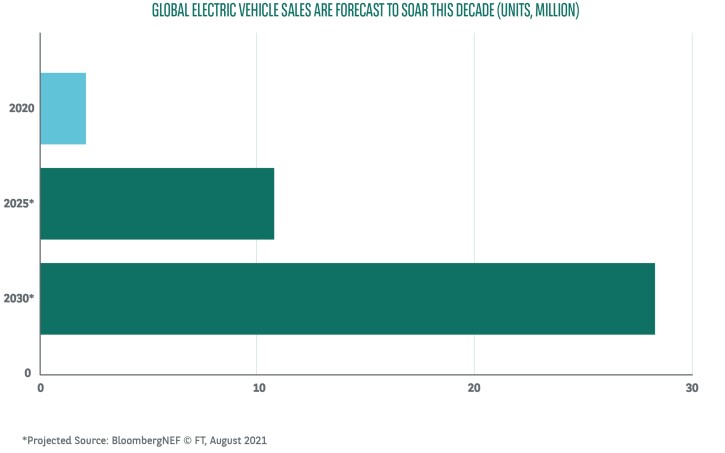
The shift to EVs is accelerating thanks to government support, technological improvements, lowering battery costs, more charging infrastructure and commitments from automakers. In fact, BloombergNEF predicts passenger EV sales should reach 14 million by 2025[2] before accelerating even faster during the rest of the decade.
China is prioritising its transportation transformation and its pace of EV adoption and has placed it at the centre of several government initiatives. EVs were named as one of the key industries of its ‘Made in China 2025’ programme and the electrification of transport is one of the core components in its drive to achieve carbon neutrality by 2060.
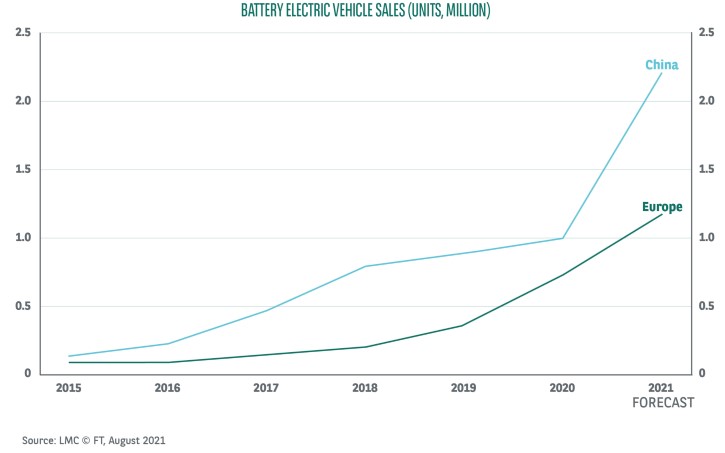
While the government is targeting new energy vehicles[3] (NEVs) to make up 20% of new car sales by 2025, we expect penetration to be faster thanks to China’s favourable government policies and their increasing consumer popularity, reflecting more competitive pricing, the introduction of new features and the rollout of more charging stations. In fact, this faster-than-expected transition is starting to reflect in the latest data, with China Passenger Car Association suggesting NEVs reached 20% of new car sales in August[4].

Favourable government policies

NEV sales in China have been growing exponentially since 2009, when the government introduced subsidies and its electric vehicle pilot programme, “Ten Cities, Thousand Vehicles”. These initiatives have proven to be highly successful, with NEV sales representing approximately 6% of new car sales.
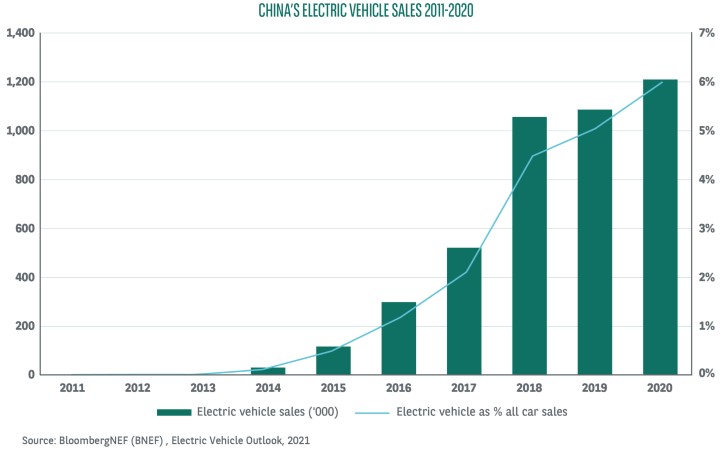
However, as the industry matures and the cost of EVs continues to decrease, the government is starting to phase out these subsidies by reducing the amount in 10% annual increments. Instead of encouraging consumers, it has shifted its focus towards EV producers and introduced a dual-credit policy in 2017, which requires automakers to meet an annual credit target by selling a certain percentage of EVs. This target will become more stringent each year and auto makers that do not produce enough EVs and do not increase their average fuel economy levels will be forced to buy credits from those that have achieved a surplus.

Additional policies to support EV adoption in China include mandating EVs as the preferred choice for government procurement, exempting them from vehicle purchase tax until 2022 and offering preferential access to licence plates in a number of cities.

Overcoming the barriers

Historically, the adoption of EVs has been impeded by some major barriers, notably the higher cost of these vehicles versus traditional combustion engine models and anxiety about batteries’ range capabilities. Yet advances in battery technology and economies of scale has seen the cost of batteries fall significantly in recent times – the price of lithium-ion batteries has fallen 89% since 2010[5]. The reduced cost of this key component has enabled automakers to launch EVs at a more competitive price and the range capabilities of these models has also increased. For example, Tesla has recently introduced a new version of its Model Y in China that uses lithium iron phosphate (LFP) batteries instead of Nickel Manganese Cobalt (NMC) batteries, which can achieve a comparable range (525km) to the longer-range model (595km) but at a 20% lower cost.

The greater rollout of charging stations is another pivotal step to easing range anxiety and therefore supporting the growth momentum of EV adoption. According to BNEF, there are 884,400 public charging connectors in China as of July 2021, which is equivalent to five EVs per connector and this compares favourably against other countries. Even so, charging speeds and reliability remain an issue as many public chargers use slow AC and some connectors are not operational. Automakers are doing their bit to address this issue. Chinese car manufacturer Nio has developed a battery swapping EV model, while other companies – including Tesla and Xpeng – are expanding their fast-charging networks, which should be a more scalable and economic solution.

Innovative new features

An additional attraction of EVs is that they are at the forefront of smart and autonomous driving technologies, with automakers investing heavily in this area to provide points of differentiation with rivals. Upcoming mass-produced models will include innovations such as remote sensing LIDAR technology (Light Detection and Ranging) and Navigation Guided Pilot (NGP) systems, both of which will aid vehicles to drive from point A to point B largely without human intervention.

The Chinese government supports the development of autonomous driving and aims to have 50% of new car sales equipped with Level 2 and Level 3 automation by 2025 and 70% by 2030[6]. In our view, regulations that are supportive of these technologies will be a positive for the industry and can help enhance safety mechanisms and reliability.

Increased competition as the demand for EVs expands

There will be no ignoring the electric car revolution in the coming years. While China has been driving EV adoption, demand is expected to spread across the world. And as demand for EVs rises, so will the competition.  

The supply and choice of electric or hybrid models (that combine a battery and traditional engine) models is set to expand from around 330 currently to over 500 by 2025.[7] Additionally, a number of incumbent auto makers are looking to enter the EV market alongside more new entrants, particularly among the technology giants, which should inject around USD330 billion of investment into the sector by 2025[8] .

Amid such a changing investment environment, identifying those companies with a strong brand presence, differentiated offerings (in terms of both hardware and software) to serve the target audience and a secure upstream supply chain will be key. At BNP Paribas Asset Management, our Environmental Strategies Group is using their technological knowledge and understanding of this rapidly changing marketplace to uncover EV businesses set to win this long-term race and those that will be left by the roadside.


[1] https://about.bnef.com/electric-vehicle-outlook/

[2] https://about.bnef.com/electric-vehicle-outlook/

[3] NEV include battery electric vehicles, plug-in hybrid electric vehicles and hydrogen fuel cell vehicles

[4] China Passenger Association

[5] https://about.newenergyfinance.com/electric-vehicle-outlook/

[6] https://www.caixinglobal.com/2020-11/china-wants-self-driving-tech-in-half-of-new-cars-by-2025-101626619.html

[7] https://www.ft.com/content/fb4d1d64-5d90-4e27-b77f-6e221bc02696?segmentId=b0d7e653-3467-12ab-c0f0-77e4424cdb4c

[8] https://www.alixpartners.com/media-center/press-releases/2021-alixpartners-global-automotive-outlook/


Important information

Please note that articles may contain technical language. For this reason, they may not be suitable for readers without professional investment experience. Any views expressed here are those of the author as of the date of publication, are based on available information, and are subject to change without notice. Individual portfolio management teams may hold different views and may take different investment decisions for different clients. This document does not constitute investment advice. The value of investments and the income they generate may go down as well as up and it is possible that investors will not recover their initial outlay. Past performance is no guarantee for future returns. Investing in emerging markets, or specialised or restricted sectors is likely to be subject to a higher-than-average volatility due to a high degree of concentration, greater uncertainty because less information is available, there is less liquidity or due to greater sensitivity to changes in market conditions (social, political and economic conditions). Some emerging markets offer less security than the majority of international developed markets. For this reason, services for portfolio transactions, liquidation and conservation on behalf of funds invested in emerging markets may carry greater risk.

China´s transportation transformation

In an era where more people are recognising the need to lead climate-friendly, environmentally positive lives, electric vehicles are being adopted rapidly: There are now 12 million passenger EVs on the road worldwide, one million commercial EVs and over 260 million electric two and three-wheelers,[1] write Ulrik Fugmann and Edward Lees of the Environmental Strategies Group.

The shift to EVs is accelerating thanks to a number of factors:

  •  Government support
  •  Technological improvements
  •  Falling battery costs
  •  More charging infrastructure
  •  Commitments from carmakers.

In fact, BloombergNEF predicts passenger EV sales should reach 14 million by 2025[2] before accelerating even faster in the rest of the decade.

China is prioritising the transformation of transportation and the pace of EV adoption by placing it at the centre of several government initiatives. EVs were named as one of the key industries of its ‘Made in China 2025’ programme and the electrification of transport is a core component in its drive to achieve carbon neutrality by 2060.

While the government is aiming for new energy vehicles[3] (NEVs) to make up 20% of new car sales by 2025, we expect penetration to be faster thanks to favourable government policies and their growing popularity among consumers, more competitive pricing, the introduction of new features and the rollout of more charging stations.

In fact, this faster-than-expected transition is starting to show up in the latest data: NEVs reached 20% of new car sales this August.[4]  

Favourable government policies

NEV sales in China have been growing exponentially since 2009, when the government introduced subsidies and its Ten Cities, Thousand Vehicles pilot programme.

However, as the industry matures and the cost of EVs continues to fall, the government is starting to phase out subsidies by reducing the amount by 10% a year. It has shifted its focus to EV producers. A dual-credit policy requires carmakers to meet an annual credit target by selling a certain number of EVs. This target becomes more stringent each year and carmakers that do not produce enough EVs and do not increase their average fuel economy levels will be forced to buy credits from those that have achieved a surplus.

Additional support for EV adoption includes mandating EVs as the preferred choice for government procurement, exempting them from vehicle purchase tax until 2022 and offering preferential access to licence plates in a number of cities.

Overcoming the barriers

Advances in battery technology and economies of scale has seen the cost of batteries fall significantly recently – the price of lithium-ion batteries has fallen by 89% since 2010[5]. The lower cost has enabled carmakers to launch EVs at a more competitive price and the range capabilities of these models has increased.

The increased number of charging stations is another pivotal step to ease range anxiety and supports EV adoption. According to BNEF, there were 884 400 public charging connectors as of July 2021. That is equivalent to five EVs per connector. This compares favourably to other countries.

Even so, charging speeds and reliability remain an issue as many public chargers use slow AC and some connectors are not operational. Carmakers are doing their bit to address this issue, for example, through a battery swapping EV model or expanding their own fast-charging networks.

An additional attraction of EVs is that they are at the forefront of new technologies. The Chinese government supports the development of autonomous driving and aims to have 50% of new cars equipped with Level 2 and Level 3 automation by 2025 and 70% by 2030.[6]

Increased competition as demand for EVs expands

There will be no ignoring the electric car revolution in the coming years. While China has been driving EV adoption, demand is expected to spread across the world, and with it, competition.

The supply and choice of electric or hybrid models is set to expand from around 330 currently to over 500 by 2025.[7] A number of incumbent carmakers are looking to enter the EV market alongside more new entrants, particularly among the technology giants. This should inject around USD 330 billion of investment into the sector by 2025.[8]  

In such a changing investment environment, identifying those companies with a strong brand presence, differentiated offerings in terms of both hardware and software to serve the target audience and a secure upstream supply chain will be key.

The Environmental Strategies Group is using its technological knowledge and understanding of this rapidly changing market to uncover EV businesses set to win this long-term race and identify those that will be left by the roadside.


[1] https://about.bnef.com/electric-vehicle-outlook/

[2] https://about.bnef.com/electric-vehicle-outlook/

[3] NEV include battery electric vehicles, plug-in hybrid electric vehicles and hydrogen fuel cell vehicles

[4] China Passenger Association

[5] https://about.newenergyfinance.com/electric-vehicle-outlook/

[6] https://www.caixinglobal.com/2020-11/china-wants-self-driving-tech-in-half-of-new-cars-by-2025-101626619.html

[7] https://www.ft.com/content/fb4d1d64-5d90-4e27-b77f-6e221bc02696?segmentId=b0d7e653-3467-12ab-c0f0-77e4424cdb4c

[8] https://www.alixpartners.com/media-center/press-releases/2021-alixpartners-global-automotive-outlook/


Important information

Please note that articles may contain technical language. For this reason, they may not be suitable for readers without professional investment experience. Any views expressed here are those of the author as of the date of publication, are based on available information, and are subject to change without notice. Individual portfolio management teams may hold different views and may take different investment decisions for different clients. This document does not constitute investment advice. The value of investments and the income they generate may go down as well as up and it is possible that investors will not recover their initial outlay. Past performance is no guarantee for future returns. Investing in emerging markets, or specialised or restricted sectors is likely to be subject to a higher-than-average volatility due to a high degree of concentration, greater uncertainty because less information is available, there is less liquidity or due to greater sensitivity to changes in market conditions (social, political and economic conditions). Some emerging markets offer less security than the majority of international developed markets. For this reason, services for portfolio transactions, liquidation and conservation on behalf of funds invested in emerging markets may carry greater risk.

Back to Top