
The latest purchasing manager indices (PMIs) illustrate the divergence that is appearing in the economic fortunes of Europe and the US.
The composite PMI for the US rose to 55.5 in October, indicating that the recovery has gained momentum amid a sustained upturn in demand. By contrast, it fell to 49.4 in the eurozone, signalling a renewed economic downturn (the threshold separating growth and contraction is 50).
Exhibit 1:
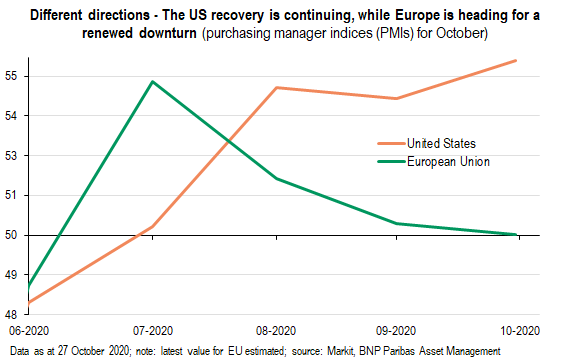
Restrictions – Tighter in Europe, more laissez-faire in the US
The primary driver of this divergence in the numbers for both the manufacturing and services sectors is the difference in responses by governments to rising COVID-19 infection rates — more restrictions in Europe, far fewer in the US. The number of confirmed new cases is now several times higher in most countries than it was during the initial wave in March and April (five times higher in France). Fortunately, the number of deaths is far lower (one fourth in France).
In fact, The Economist believes that the higher number of cases primarily reflects more testing[1] and the actual number of new cases is fewer (again, about one fourth in France). Be that as it may, politicians and health officials are having to react and are re-imposing restrictions, moving closer and closer towards full lockdowns. While most hope to avoid the most economically damaging restrictions, stock markets are already reflecting worries that activity will not rebound in the fourth quarter as hoped.
Markets look beyond surprisingly good earnings…
It is perhaps because of these concerns that investors have reacted less positively to what has been a surprisingly good season for company earnings reports, at least so far. The headline earnings figures have inevitably been poor (down by 10% year-on-year in the US), but what matters more for markets are the earnings surprises and changes in guidance.
Earnings have beaten analyst expectations by 16% in the US and by an even higher 23% in Europe, and this across most sectors. When companies have provided guidance on future earnings, two-thirds have raised it. Analyst earnings revisions similarly reflect rising spirits, with three times as many upward as downward earnings revisions in the US. In Europe, it is just 1.4 times. Whether this optimism can withstand the deteriorating pandemic headlines is one of the key questions facing the markets over the next few months.
…and anticipate a Biden victory
The other crucial factor for the outlook will be the outcome of the US elections. Will the fiscal stimulus, changes in tax policy and legislative changes that would follow a ‘blue sweep’ (a Joe Biden victory and a meaningful Democratic majority in the Senate) materialise or will gridlock continue?
The amount of legislation that has been passed in the current Congress is 60% lower than it was during the first two years of Trump’s term when Republicans controlled both the Senate and the House. Even with a Biden victory, if the Democrats do not secure a working majority in both chambers, the prospect of significant policy changes is perhaps lower than the markets currently expect.
What the markets anticipate can perhaps be divined from the relative performance of several equity sectors in the week after the first presidential debate, when polls and betting markets showed rising expectations of a blue sweep.
Exhibit 2:
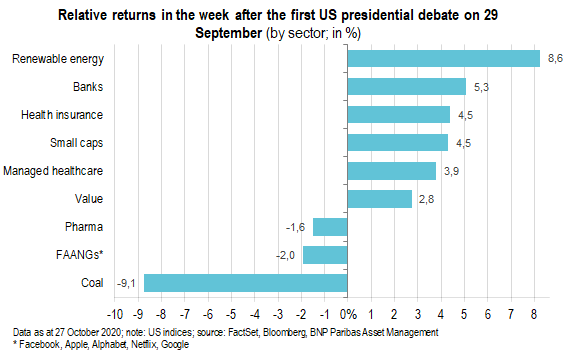
Greener policies to the benefit of renewables and the detriment of ‘dirty’ coal signal expectations of a Biden victory, as do hopes for improved access to healthcare, curbs on drugs prices and restrictions on tech giants.


