
In many developed and emerging markets, the residential real estate sector is seeing prices stall and sales volumes fall. India provides a sharp contrast: Its USD 180 billion real estate sector – the country’s second-largest employer generating 7% of GDP – is enjoying significant growth. It could offer investors an attractive medium-term opportunity.
Post-Covid, India is the fastest growing economy among the world’s large countries, and we believe it is likely to sustain its growth momentum over the medium term. Other major emerging market (EM) countries such as China, Turkey and Brazil have yet to manage a strong or consistent recovery.
This suggests to us that, rather than ‘putting all EMs in the same basket’, investors would do well to consider each market’s differentiated growth trajectory, opportunities, and risk & return profile, and take country-specific – and even sector-specific – positions. India’s residential property market is one example worth looking at, in our view.
Indian real estate: A case apart
Home sales and prices are slipping below their pandemic peak in many developed and emerging markets; China’s property market woes are well documented.
In India, however, after several years of house price and inventory consolidation, real estate activity and prices have picked up strongly since 2021 (see Exhibit 1). The property market is now far healthier, for a variety of reasons:
- Improved governance
- Transparency laws and other government reforms
- Developer consolidation
- Stronger balance sheets
- Better affordability.
Taken together, we believe these bode well for further housing segment growth.

A potential USD 1 trillion opportunity
Estimated at around USD 180 billion, India’s property sector accounts for 7% of the country’s GDP and is the second-highest generator of jobs, after agriculture.
According to the Indian Brand Equity Foundation (IBEF), the sector is expected to be worth USD 1 trillion by 2030, implying a compound annual growth rate (CAGR) of 19% over the current decade. This is almost twice the rate of India’s GDP growth. Its contribution to GDP could nearly double.
With GDP forecast to reach USD 5 trillion or more in the next half decade, we believe real estate could play a significant role as it can have a cascading effect on other industries including cement, construction, building materials and consumer discretionary. Importantly, property sector growth will also create jobs.
Poised for upcycle
Residential is the largest segment in real estate and we believe it is in a sweet spot, with all the ingredients in place for robust growth.
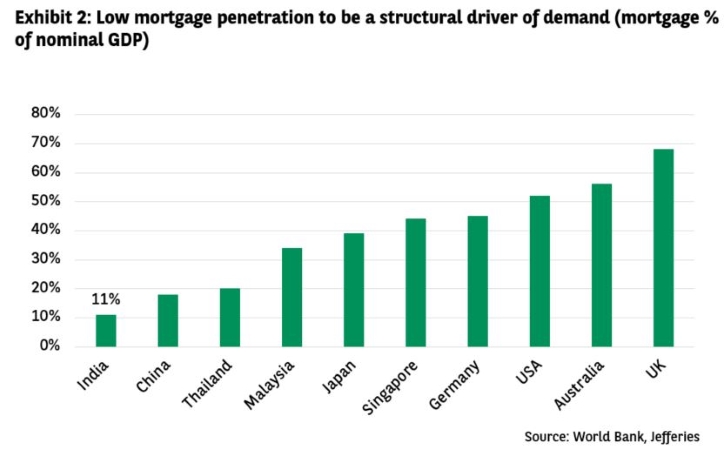
Firstly, mortgage penetration continues to lag that in most developed and even emerging economies but it is set to grow significantly (see Exhibit 2).
Housing prices have been stagnant across the top seven cities over the last seven years. This follows a huge spike from 2009 to 2014 when affordability became a challenge for average income households. With low volumes, stagnant prices and high interest rates, the sector slowed sharply. Furthermore, major government policy initiatives – demonetisation, the Goods & Services Tax (GST), and the Real Estate Regulation Act (RERA) – sent shockwaves through the industry.
This led to massive consolidation, with significant unsold inventory and 40%-80% of residential developers across the top seven cities exiting the industry.
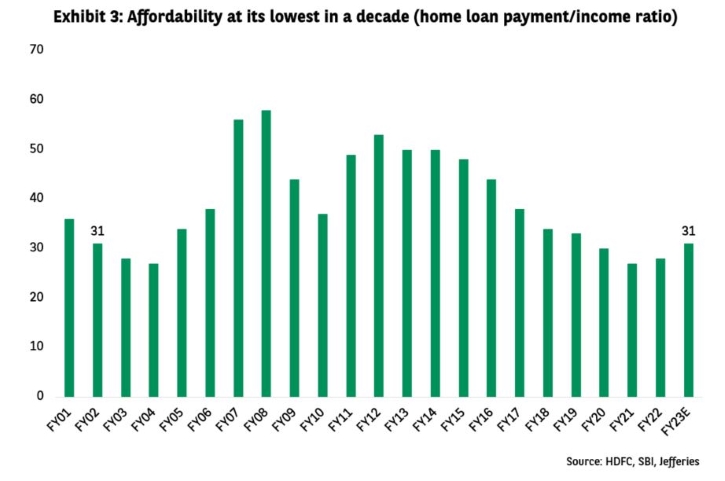
However, since Covid, the residential real estate sector has been poised for an upcycle, buoyed by improved affordability (see exhibit 3), a decade-low (sub-7%) interest rate regime, stagnant prices and a rising income base – the CAGR of which over the last 10 years has been 7%-10%. Also, the entire inventory of recent years was sold off in the pandemic, creating room for new construction.
Four main drivers
1. Robust demand – There is a ‘perfect storm’ of factors driving demand for residential property, including India’s rapid rate of urbanisation, growing working population, rising disposable incomes and easily available finance.
2. Government reforms – The government has launched a range of supportive policies, including boosting affordable housing construction, offering interest rate subsidies to homebuyers and exempting property from the dividend distribution tax (DDT), which makes real estate a more appealing asset in which to invest.
3. Attractive opportunities – Moody’s investment services company ICRA estimates that Indian firms are expected to raise more than USD 48 billion through infrastructure and real estate investment trusts in 2022, nearly twice the level previously raised.
4. Increasing investment – Construction is India’s third-largest sector in terms of foreign direct investment inflows. FDI in the sector including construction development and related activities totalled USD 54.17 billion between April 2000 and March 2022, equivalent to more than 1.5% of GDP. Additionally, the government’s ‘Housing for All’ initiative is expected to attract USD 1.3 trillion of investment by 2025.
We foresee a ‘virtuous growth spiral’ for India’s residential property sector: As housing construction rises, its impact on GDP growth will increase, driving overall growth higher.
Disclaimer


