
Investors are having to digest rapidly evolving news on both US politics and the coronavirus pandemic. The appreciation of the US dollar since mid-September has been the most obvious sign of investors seeking safe havens amid the threat of storms.
Tighter measures as virus spreads rapidly?
The number of COVID-19 infections has continued to rise rapidly in many countries in Europe, although thankfully, the fatality rate has been far lower than it was earlier this year as the majority of new cases are among younger people, many of whom are asymptomatic.
While the arrival of a second wave was expected, many observers have been surprised by how quickly the virus spread once lockdown restrictions were eased. The most pertinent question for investors is what measures governments will take to slow the spread, as any return to lockdowns will quickly be reflected in asset prices.
Nationwide clampdowns look unlikely
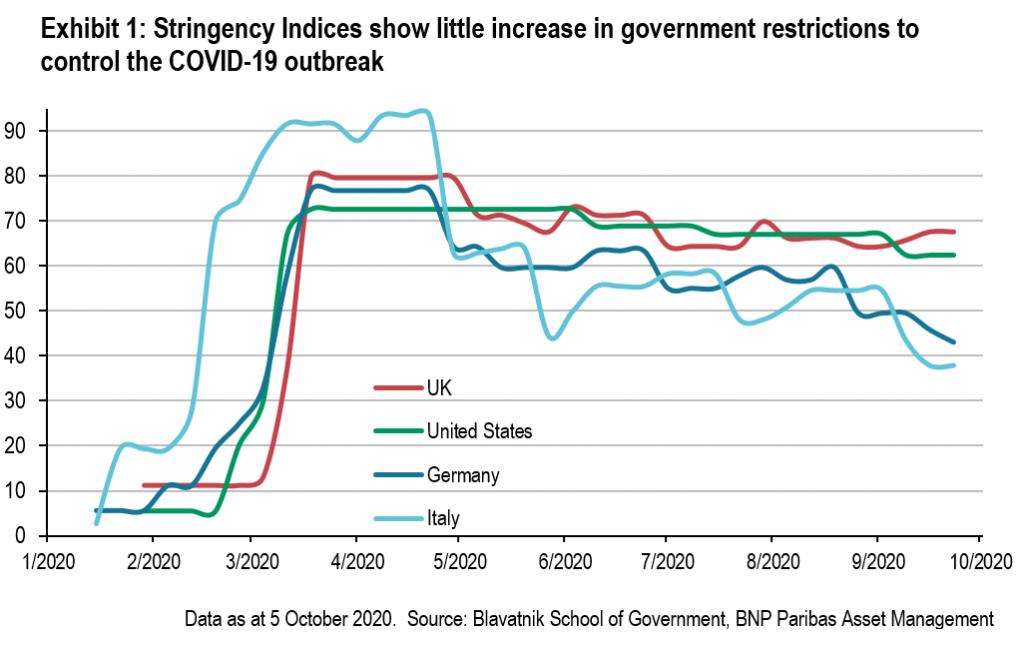
Full lockdowns look unlikely at this point, as much due to the significant economic and psychological costs of such strict measures as to questions about their long-term viability: lockdowns only suppress the spread of the virus while they are in place, but they cannot be maintained indefinitely. Consequently, governments are imposing more targeted measures to lower infections in particular areas while allowing most economic activity to continue.
One can see government reticence reflected in the Blavatnik School of Government’s Stringency indices, which measure the restrictiveness of government policies. These have changed little over the last few months, though there is still significant uncertainty over the course of the virus as we move towards the winter flu season (see Exhibit 1).
US: Stimulus package on the backburner
There had always been expectations that the US election campaign would be volatile, but recent events have still surprised, from a tumultuous first presidential candidate debate in late September to President Trump’s coronavirus diagnosis and apparent swift recovery.
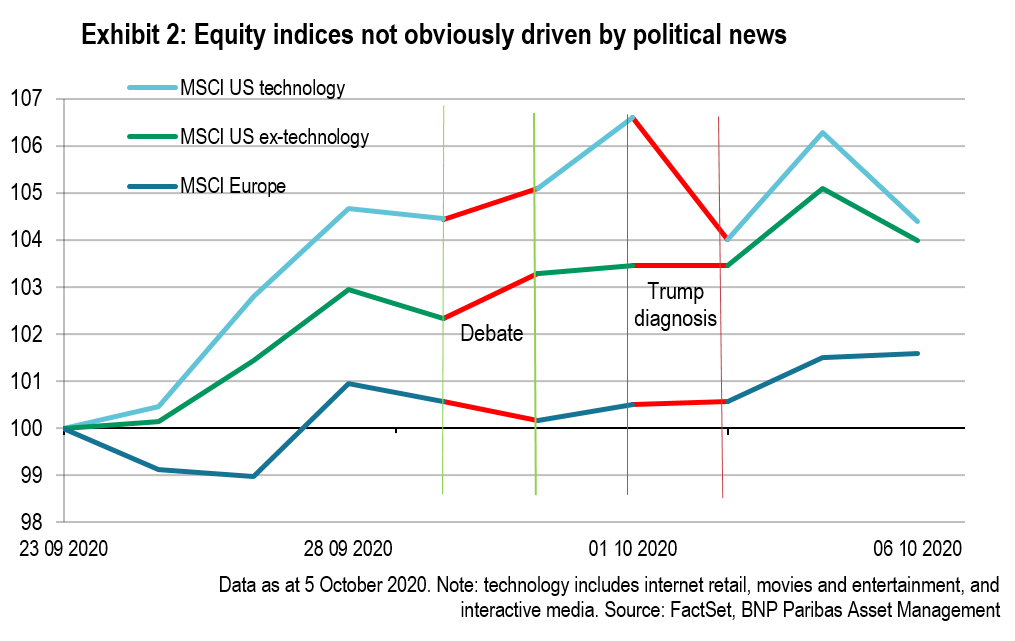
Opinion polls and betting odds have moved sharply, even though the majority of voters supposedly made up their minds long ago. While much commentary has focused on the reaction of equity markets to the rising or falling odds of either candidate’s victory, it is not clear that this is actually an important driver, at least at this stage.
US equities did fall on the diagnosis news on 2 October, but the declines were concentrated in the technology sector and the rest of the market (along with European equities) was flat. Following the 29 September debate, perceived as positive for Trump’s rival Biden, markets rose (see Exhibit 2).
Election results – Expect a disparate market impact
One challenge in reading the equity market tea leaves is that the impact on different sectors of the market will vary depending not only on the victor in the presidential race, but also on the configuration of Congress. Different parts of the energy, financial, healthcare and technology sectors will likely gain after the election while some will lose out, with the net effect uncertain.
The US Treasury market and breakeven inflation may be clearer indicators of market sentiment as the 10bp rise in yields over the last week may reflect expectations of greater fiscal stimulus under a future Biden administration and Democratic Congress, irrespective of whether protracted pre-election wrangling between Republicans and Democrats can still lead to a new deal.
The USD 2 trillion CARES act stimulus package earlier this year merely offset part of the USD 1.8 trillion collapse in GDP in the second quarter, while a USD 2-3 trillion stimulus package next year would support an economy already expected to expand by nearly USD 700 billion.
On Tuesday, President Trump dashed any market hopes for an immediate coronavirus relief package after he instructed his representatives to stop negotiating until after the election. Stock prices fell sharply on the news. Trump later said he was open to a number of independent fiscal stimulus measures, changing course.
Mixed data
Recent economic data has been mixed geographically, with PMIs, payrolls, and retail sales numbers showing the recovery continuing in the US and China, though inevitably at a slower pace following the initial sharp bounce.
Data for much of Europe was more tepid. As economic restrictions have not been increasing significantly in Europe, as we noted above, the weaker figures may simply reflect consumer and business anxiety about the evolution of the pandemic.


