
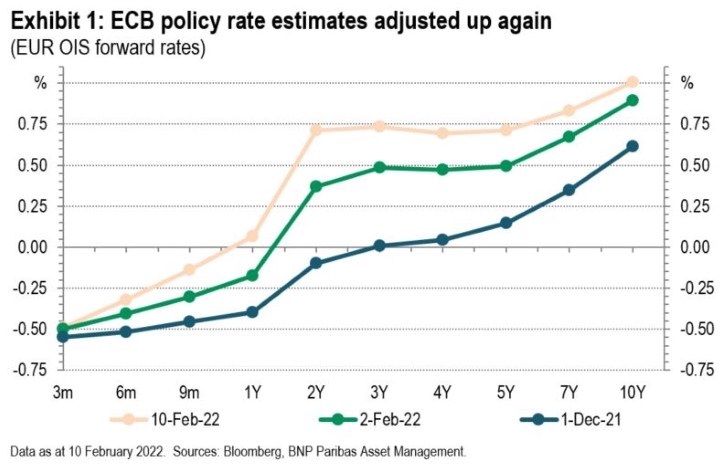
As has often been the case recently, most market observers expected the ECB meeting on 3 February to be another uneventful gathering. Instead, the central bank made a hawkish pivot. This caused market expectations for its deposit rate in one year to jump, taking the increase over the next year to more than 50bp. That is more than three times the 15bp seen just two months ago.
The ECB now also looks likely to exit its multi-billion euro quantitative easing programme much faster than expected previously: It appears set to end in Q3 this year instead of Q1 2023.
The change in outlook has significant implications for markets in eurozone sovereign debt, corporate bonds, equities and the euro.
A two-fold catalyst for the ECB’s pivot
- Yet another eurozone inflation report that topped market expectations — the latest year-on-year figure was 6.1% vs. a 5.5% consensus estimate
- A labour market that has improved faster than anticipated – unemployment in the eurozone had fallen to 7.1% by December 2021, its lowest since 1989.
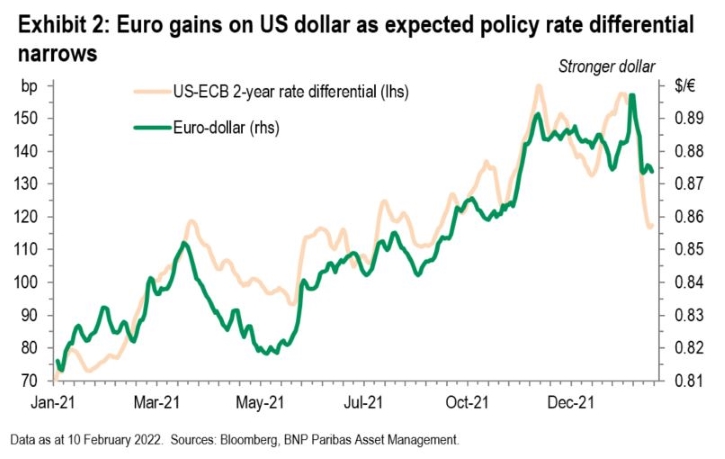
The bloc’s common currency jumped sharply against the US dollar as the expected gap in policy rates between the US and the eurozone narrowed (see Exhibit 2).
The euro’s deprecation since the start of 2021 has been driven partly by the expectation that policy rates would rise by more in the US than in the eurozone. The evolution of the single currency from here onwards will likely continue to depend on changes in expectations rather than on the actual gap in yields.
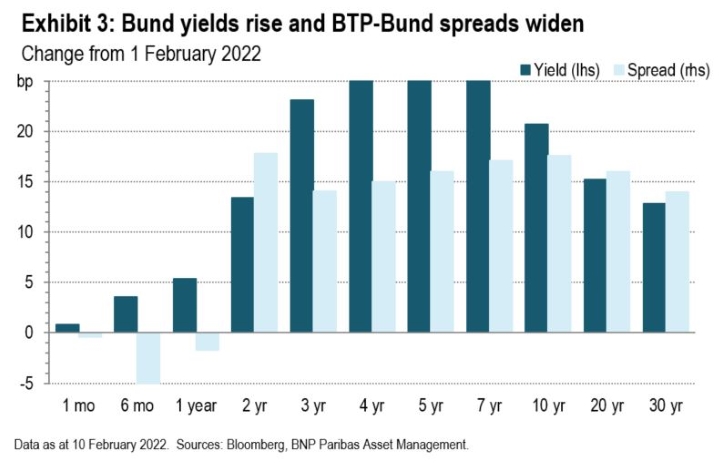
There was a corresponding jump in interest rates on government bonds. For example, German 10-year Bund yields rose by 25bp, notably pushing them from negative into positive territory.
Somewhat worryingly for the ECB, ‘peripheral’ eurozone government bond yields rose by even more, meaning that spreads over Bunds widened. For 10-year Italian BTPs, spreads have widened by almost 20bp (see Exhibit 3).
While yields are still low in absolute terms, the increase will likely heighten worries about economic growth in the eurozone. Investors can take comfort from the fact that even if GDP growth were to slow, the starting point is unusually high: Consensus GDP growth estimates for this year are well above long-run averages, although the cushion is somewhat lower next year when one would expect the tightening of monetary policy to start impacting growth.
Higher yields favour ‘value sectors’
The returns on European equities so far this year have reflected the rise in (real) yields in the US, with ‘value sectors’ such as energy, materials and financials outperforming growth. With the interest-rate tide now lapping at Europe’s shores, these same sectors got a further boost. Since early February, the top sectors have been commodities and financials; technology and interest-rate sensitive sectors such as utilities and real estate have lagged.
An important support for equities to offset the rise in yields will be earnings. The indications from the current earnings season are encouraging. Growth rates were inevitably going to be high given that during the year-ago period, many countries were in some sort of lockdown.
Indeed, with 107 companies having reported results so far (out of 341), earnings have risen on average by over 60%. The energy sector has done particularly well, but excluding that, the average increase is still 30%. Even with these high figures, however, companies have managed to beat analyst expectations, with earnings surprises running at nearly 10%.
Disclaimer


