
Important notes:
• The fund seeks to increase the value of its assets over the medium term by investing primarily in innovative technology companies.
• The fund has significant exposure to a single sector and is likely to be subject to a greater concentration risk and higher volatility than a more diversified investment.
• The management company may at its discretion pay dividends out of the capital of the fund. Payment of dividends out of capital amounts to a return or withdrawal of part of an investor’s original investment or from any capital gains attributable to that original investment. Any distributions involving payment of dividends out of the fund’s capital may result in an immediate reduction of the net asset value per share.
• Investors should not solely rely on this document to make any investment decision. Please refer to the Hong Kong offering document for further information (including the risk factors) about the fund.
Executive highlights:
• Artificial intelligence (AI), a pivotal theme in the digital transformation, is still early in its adoption curve, supported by cloud computing, automation, the Internet of Things (IoT), and foundational technologies including semiconductors and data centre infrastructure.
• We believe companies that are leading and enabling digital transformation will continue to provide superior growth, earnings and returns, creating value for investors.
• The best-positioned stocks can be found both within and beyond the technology sector as it is traditionally defined.
• BNP Paribas Disruptive Technology has a record of outperforming its peers, providing smoother returns and lower volatility due to its valuation discipline and flexible multi-sector, multi-thematic investment approach.
Among the hype surrounding the performance of the global technology sector, led predominantly by the Magnificent Seven1, a deeper and far more interesting story has been growing for decades around technology’s structural impact on almost every other sector that characterise markets today.
AI represents a once-in-a-generation technology shift that will unfold over many years. In the long run, the technology sector may outperform the broader market, driven by superior revenue growth and positive earnings revisions. As winners and losers in this space emerge and evolve over time, we believe an active approach to portfolio management is essential to navigate these secular shifts.
We see three key drivers sustaining the momentum of an AI-driven technology transformation. First, demand for processing power and storage is expected to accelerate. Second, greater access to AI capabilities and storage will empower innovative companies across sectors to develop applications that boost productivity and lower costs. Finally, an improving macroeconomic environment may provide a favourable backdrop for continued investment and growth within the tech sector.
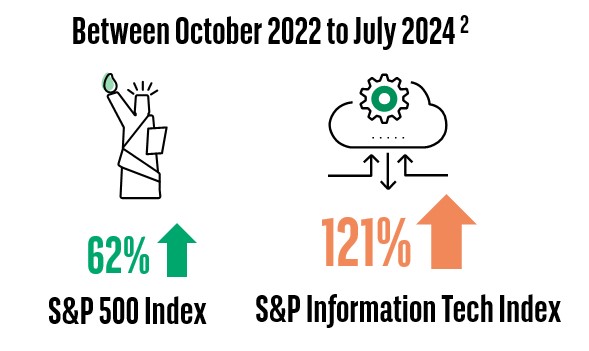
Observations of the market add weight to this view. For instance, between October 2022 and the market peak in July 2024, the S&P 500 rose by 62%, while the S&P Information Technology Index surged by 121%, underscoring the sector’s over performance during this period2.
Surge or bubble? Analysing the market
Stock price volatility amongst some Magnificent Seven tech stocks, such as Nvidia and Tesla, has provoked commentaries in the media and among investors of a tech bubble. Although some stocks may be over-valued – and some may still remain over-valued – our analysis indicates that the overall tech market is not in bubble territory.
The current forward price-earnings ratio3 of around 25x for the NASDAQ 100 index (according to IBES4 at the time of writing) may be near the 20-year high. However, it is far lower than the peak levels of the late 1990s/early 2000s tech bubble, when stock valuations were as high as 90x. Above-average valuations today reflect the increasing profit-generating capability of companies in the NASDAQ, which has seen return on equity rise from 16% at the peak of the 1990s/ early 2000s tech bubble to nearly 26% today5.
The digital infrastructure boom continues
During the most recent rally, the biggest beneficiaries were the manufacturers and installers of graphics processing units (GPUs) and cloud platforms that enable AI to function.
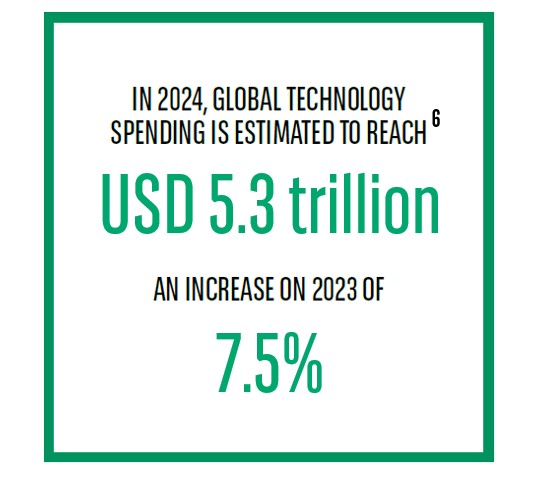
The build-out of technology infrastructure still has some way to run. Global IT spending is accelerating and is expected to reach USD 5.3 trillion this year, up 7.5% from 20236, and global real estate services operator JLL says that even in the United States, the epicentre of global investment in data centre capacity, vacancy rates are at a record low of around 3%7, indicating that demand for key IT infrastructure continues to outstrip supply.
AI set to enable the coming software boom
But infrastructure investment is just an enabling phase. According to Bloomberg, a 42% compound annual growth in generative AI revenue is expected over the next 10 years alone8. Near term, this development is driven primarily by training infrastructure, eventually shifting to inference devices that can interpret data and draw conclusions for large language models (LLM), digital ads, and specialised software in the longer term9.
AI’s long-term potential is starting to emerge across sectors, ranging from robotics companies investigating ‘autonomous agents’ that can problem-solve in real time; healthcare companies looking at everything from remote surgery to wearable heart-rate monitors; and consumer companies investing in AI to offer personalised shopping experiences.
However, tracking the course of technology themes and their growth is one thing, capturing the value from their rise is another.
A go-anywhere investment approach capturing the value of the digital transformation
Through the BNP Paribas Disruptive Technology strategy, we seek to provide investors with exposure to a curated mix of companies that are driving and benefiting from the proliferation of the digital transformation and the subsequent growth across sectors.
Crucially, we find compelling investment opportunities in a number of sectors outside of technology, including (but not limited to):

Our concentrated, high-conviction portfolio focuses on around 50 high-quality and attractively valued stocks ‒ with ~40% allocated outside the mainstream tech sector10 ‒ exhibiting relatively low volatility in aggregate.
Notably, we aim to capture innovative technologies ‘disturbing’ the old system, including cloud computing, automation and AI.
While 89% of BNP Paribas Disruptive Technology fund is exposed to AI, the exposure is very well-diversified, encompassing not only AI developers and beneficiaries, but also enablers of AI such as foundational technologies, which form a part of our strategy. We also explore emerging themes — like quantum computing and advanced genomics — that may become significant drivers over time.
Moreover, in a recent analysis, we found that 14 companies we currently hold in the portfolio, representing 20% of the strategy’s assets under management, were not held by any of the top 15 technology peer funds we track11. Positioned relative to the diversified MSCI World Index, we maintain less exposure to companies with the largest capitalisations than many tech-focused peers and indices. This approach limits our exposure to a single point of failure.
Given the broad implications of our approach, investment ideas can be sourced from any sector, region, or market cap, presenting potentially untapped opportunities to capture growth and value. Our strategy’s success is exemplified by its historical performance – BNP Paribas Disruptive Technology has significantly outperformed its Morningstar peer group on a year-to-date, one-year, and annualised three-year and five-year basis12.
[1] Magnificent Seven refers to Alphabet (parent of Google), Amazon, Apple, Microsoft, Meta, Meta (Facebook), Nvidia, and Tesla.
[2] SP Global
[3] A company’s forward P/E ratio may help to assess if a stock is overvalued or undervalued versus other industry peers.
[4] IBES: Institutional Brokers’ Estimate System
[5] Factset, 30 September 2024
[6] Gartner, “Gartner Forecasts Worldwide IT Spending to Grow 7.5% in 2024, 16 July 2024
[7] JLL 2024: U.S. Data Center Report – Midyear 2024
[8] Bloomberg, “Generative AI to become a $1.3 trillion market by 2032, research finds”, 1 June 2023
[9] Bloomberg, June 2023
[10] BNP Paribas Asset Management, as of 30 September 2024
[11] BNP Paribas Asset Management, as of 30 September 2024
[12] Morningstar, BNP Paribas Asset Management, 31 August 2024. Based on BNP Paribas Disruptive Technology, Classic USD Capitalisation share class. Data in USD. Calculated net of fees, NAV to NAV with dividends reinvested, includes the effect of the maximum subscription fee and redemption fee which the investor might or might not pay. Peer group is Morningstar’s EAA Fund Sector Equity Technology. Past performance is not indicative of current or future performance.


