
Investors’ views on the outlook for growth have gone from acceleration to anticipation of the coming peak, while on inflation, expectations have moved from a pickup – transitory or otherwise – to concern that central banks might appreciate an overshoot of their targets less than previously thought, even as medium-term inflation expectations have remained anchored.
The pandemic, of course, is not over as evidenced by the race between governments’ vaccination pushes and the spread of often more infectious variants. A Covid variant that is resistant to current vaccines, and the re-imposition of lockdowns that could entail, is one of the key risks to our outlook.
FIXED INCOME – US
FIXED INCOME – US
Two factors determine the path of US Treasury yields:
• The persistence of recent inflationary pressures
• The timing of steps by the US Federal Reserve to taper its support for the US economy.
For price increases to persist, the outlook for the labour market is key. As generous fiscal and monetary policy support return the economy to full employment in the first half of 2022, we expect the job market to go back to generating solid wage gains of around 3.5% a year resulting in a period of persistent, cyclical inflation.
How will the Fed react? We believe that while an inflation overshoot may be an objective, there is no commitment to it. If the Fed is less tolerant of inflation overshoots, there are several implications:
1. A more hawkish Fed weakens the rationale for pricing an inflation overshoot into longer bond maturities, or an inflation risk premium. So, 10-year breakeven rates should be closer to 2.3% than 2.6%, and longer-dated nominal Treasury yields should be lower.
2. To head off upside inflation risks, policy would be normalised more quickly: Asset purchases are wound up sooner; rate rises come earlier and less gradually. So, there is more upside to the front end of the yield curve.
3. Markets will become increasingly sensitive to employment and inflation data as investors look for progress towards the conditions for tapering of the quantitative easing (QE) to begin.
The primary risk to this outlook is the rapid spread of the Delta variant. This could unsettle investors and support a bid for Treasuries.
We expect QE tapering to start in early 2022 and rates to be raised from March 2023, taking the fed funds policy rate target to 1.75-2.00% by the end of that year. Investors would need to see a more rapid pace of employment gains to contemplate the scenario for rate increases.
Our target for the 10-year Treasury yield at the end of the third quarter is 1.50%, with 1.75% pencilled in for the end of 2021. The prospect of tapering in early 2022 provides for further upside later.
As said, a more hawkish Fed reduces inflation and term premia on longer maturities, and raises the odds of earlier (but more limited) rate rises at the shorter end. Nevertheless, we feel it is too early to position for a flattening yield curve, especially as QE tapering has to precede rate rises.
FIXED INCOME – eurozone
With an improving labour market and strengthening sentiment, the recovery in demand will likely pick up in the coming months. Additional support should come from the extension of government fiscal responses and spending from the Next Generation EU (NGEU) fund.
Eurozone inflation will likely breach the ECB’s 2% target amid near-term supply shortages and bottlenecks, and positive impacts from the economic reopening. In the longer term, however, we expect spare economic capacity and a downward shift in inflation expectations to weigh on inflation.
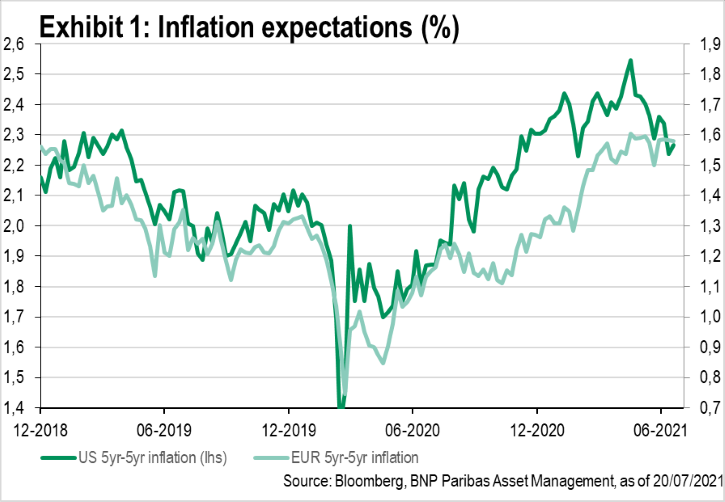
Slower QE asset purchases by the ECB amid improving economic activity should cause yields to rise, but net negative bond issuance, thin trading liquidity and growing concerns about the spread of the Delta variant should contain yields. Overall, we have turned neutral in eurozone duration.
On ‘peripheral eurozone bonds’, slower asset purchases by the ECB will likely reduce central bank demand for these bonds. Concerns over the upcoming elections in Germany and France leading to risks to the pro-European agenda will also not be favourable to this segment.
EQUITIES – Style and size
We expect equities broadly to rise given the solid earnings outlook, but see more variation in the returns between countries, sectors and styles depending on moves in interest rates.
For US value stocks, returns have been flat since mid-May as expectations for economic growth and inflation plateaued. Factors supporting value outperformance include the delayed reopening of the economy: the expected earnings recovery will now play out over a longer period. Earnings expectations should thus rise for longer.
Valuations also favour value stocks. Within growth, the high valuations are well above average for the largest sectors in the index, such as tech, but also healthcare and industrials, while they are less elevated for the main components of the value index.
Restrained inflation expectations could limit the outperformance of US small-cap stocks. Also, a peak in growth typically clouds small-cap performance, while investors might prefer the strong returns of the large-cap mega-tech stocks. European small caps may see more upside given that the cyclical momentum should be sustained for longer in Europe as the region’s economies reopen more slowly.
EQUITIES – Geographic allocations
US equities should modestly outperform European equities through the rest of the year. Aiding the US is a much stronger growth outlook thanks to greater willingness to remove lockdown restrictions, better progress on vaccinations and the benefits of fiscal stimulus. Weighing on the US is a more hawkish Fed that is likely to taper its asset purchases and raise rates well before the ECB. Also, US equities are expensive compared to those in Europe, although US earnings growth is typically superior.
Europe has the Next Generation EU funds to look forward to. The recovery in European earnings has lagged that in the US, though much of this is due to (as things often are) to the dominance of the US tech sector. For European equities, there is more room to catch up.
More cyclically oriented countries such as Japan and emerging markets should outperform. EM equities historically are more value oriented. With the growing weight of China in the EM index, the growth style has come to dominate. However, China has been a drag on overall EM performance as Beijing stepped up its scrutiny of the country’s tech companies and as corporate bond defaults rose.
We nonetheless expect the tech sector to recover given its strategic importance and good medium-term growth prospects. As vaccination rates rise, a fuller reopening should allow corporate earnings growth to accelerate broadly across emerging markets.


