Continued US ‘exceptionalism’, for both growth and inflation, is currently the broadly held base case scenario, also by us. It has been central to the ‘everything rally’ that started in late 2023. However, equities have rallied ahead of bonds and earnings expectations have softened; on the macroeconomic side, we see risk as skewed towards weaker growth, inflation, and earnings.
The ‘immaculate’ base case
The continued exceptionalism of the US as it stands out from the rest of the world in terms of growth and inflation is a key tenet of many forecasts as well as our own.
BNP Paribas Asset Management’s central research for 2024 and 2025 has now ‘marked-to-market’ US growth (revised higher) and inflation (revised lower). It no longer foresees a spell of sub-trend growth and stickier inflation through the forecast horizon. Economies in Europe and the UK, by comparison, are expected to be weaker, with substantially below-trend growth.
While our research team is broadly in line with mainstream expectations for the likely course of the US Federal Reserve (Fed), it remains notably more dovish on the path of the Bank of England: it regards the market and consensus expectations as inappropriate given the weak state of the UK economy.
In Europe, while the team sees stagnant growth with quickly falling inflation justifying the ECB cutting policy rates to below neutral, the central bank is expected to be hesitant to move before the Fed. Yet insofar as eurozone rates are currently seen to be 200bp or more above neutral, increasingly anaemic growth and trend inflation (outside the US) argue for a quick reversal.
A ‘spotless’ growth and inflation setting in the US, and strong policy support more broadly, have set fertile conditions for risk markets. US equity markets continued in January where they had ended 2023: charting gains and notching record highs. Most European markets recorded a positive return.
What might cause waves?
On our 12 to 18-month investment horizon, we see five chief areas of uncertainty. We will come back to each of these in coming monthlies.
- Weaker growth outcomes as the delayed impact of significant monetary tightening feeds through to economies and corporate earnings. The twin ‘offsets’ to higher interest rates that were central to supporting US growth in 2023 – fiscal easing and excess Covid-era savings – are expected to be less helpful in 2024.[1] Weaker nominal growth is consistent with continued margin normalisation and deeper prospective job cuts
- More hawkish/less dovish central bank reaction functions with a lack of clarity on R-star – or the neutral real rate of interest – and perceived benefits from treading carefully after the inflation burst of recent years. Fiscal dominance (partly linked to elections in many areas) may also support higher terminal rates
- Relatedly, prospect of contagion from real assets to the real economy either via real estate, or via channels such as non-bank lending that make up a greater proportion of US bank loans than cars (and only just below credit cards). Pressure from higher rates, weaker growth/earnings, or simply less policy support are all possible triggers
- The impact of mega-caps: mega-capitalisation companies are growing more dominant, notably US and Asian technology/artificial intelligence companies, which could result in outsized concentration risk
- Deflationary deleveraging in China: with the lack of a clear ‘red line’ for the government on when to stimulate growth, the investment and property-leveraged growth model could come under threat as the authorities act too late or too lightly. An escalation of trade tensions remains a live risk too, particularly around the US presidential elections.
Taking partial profits on long duration
Bond markets enjoyed a powerful rally at the end of last year, moves we used to take profits on about half our long duration positions built up over the course of 2023. The gains came as markets began to price in a ‘pivot’ from central banks, away from rate hikes towards strong policy easing in 2024 and 2025. Rates in Japan have continued to move in the opposite direction.
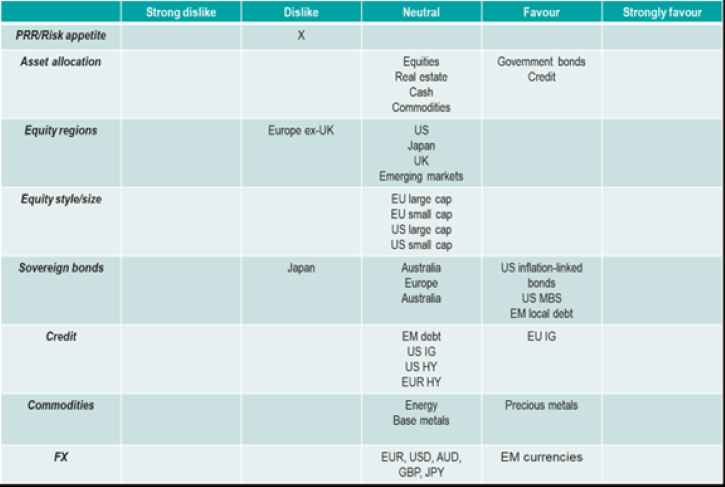
We continue to favour long-dated US real yields where current valuations lock in attractive risk-adjusted returns. We are also maintaining positions in European investment-grade corporate bonds and EM local currency debt.
Unlike US investment-grade credit and high-yield spreads, EUR investment-grade bonds still offer generous compensation for default risk and potential for further spread compression. Yield curves are broadly flat, but given the low spreads, this is less concerning. EM currency local debt, meanwhile, continues to carry attractively at 6%, with a resilient macroeconomic setting to boot.
Equity valuations – Little margin for error
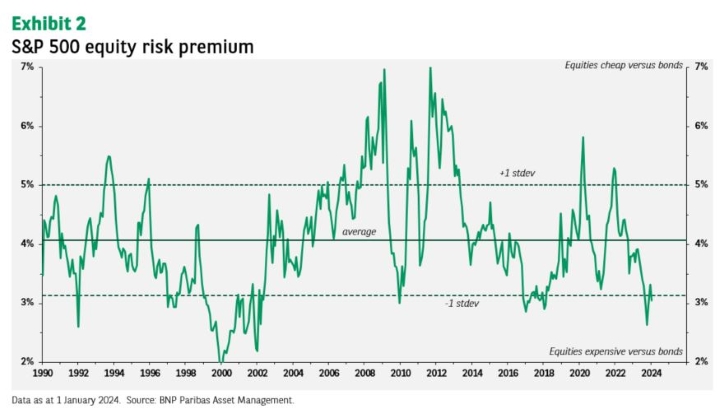
Unlike bonds, equity valuations appear priced for perfection. In our view, this leaves little margin for error. We decided to take profits on our modest long equity position in the US and EM (Latin America). Our continued short position in European equities and modest long position in the UK iron out to a neutral view on equities over our investment horizon, within a more cautious view on risk overall (see table below).
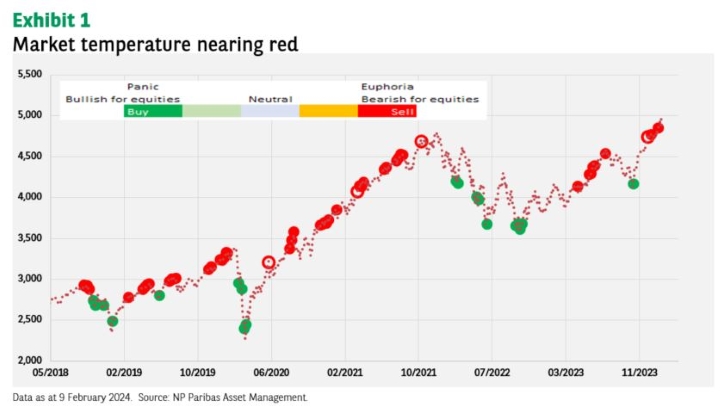
To be sure, equity valuations have been boosted by both euphoric price gains – which caused our market temperature gauge to flash red in December and January (i.e., sell; see Exhibit 1) – and falling earnings expectations. And, as equity indices have ground to new highs this year, expected earnings for the current calendar year have continued to fall – by 1% for global equities overall, for example. Europe, the area of our highest caution, looks particularly weak, with a 1.5-2% fall in expected 2024 earnings set against a still-lofty level of earnings expected for this point in the cycle.
Our asset class views