
Net positive inflows into Core ETFs in the days following ‘Liberation Day’ demonstrate broad investor demand for trading solutions offering good liquidity
There was wide dispersion within the ETF industry, however, as the flight to safety saw investors allocate in favour of low-risk credit and government bond ETFs
Active ETFs with more flexibility to navigate volatility also benefitted at the expense of passive exposures
US President Donald Trump announced a wave of new tariffs on 2 April, which he branded ‘Liberation Day’, arguing they would help boost the US economy. At this stage, uncertainty around trade policy, global growth, and inflation remains very high. It is impossible to predict exactly when markets will start to stabilise, and this has triggered a huge increase in volatility across financial markets globally. This uncertainty is highlighted by the Cboe Volatility Index (VIX), which recently closed at its highest level since April 2020, during the early months of the Covid-19 pandemic. The MSCI ACWI index dropped by 11% between 2 April and 8 April 2025. For many indices, it was the worst week since the Covid days, while over $5Trn in market value was wiped off the S&P 500 in the last two sessions of the week .
VIX Index jumps to highest since 2020 on stock rout

Source: Bloomberg as at 4 April 2025
Relative resilience of ETF flows following tariffs announcement versus Covid selloff
Despite markets experiencing the type of performance and volatility unseen since the Covid-19 pandemic, ETF flows in recent weeks indicate that investor reactions have been more measured following the announcement of tariffs.
Equity ETFs bore the brunt of the outflows during both periods, but an additional $4bn outflows was recorded during the initial Covid selloff. Overall, withdrawals across all asset classes have been significantly lower than those seen five years ago.
Flows in $mn

Source: ETFBook as at 11 April 2025
Investors are looking for safe heavens
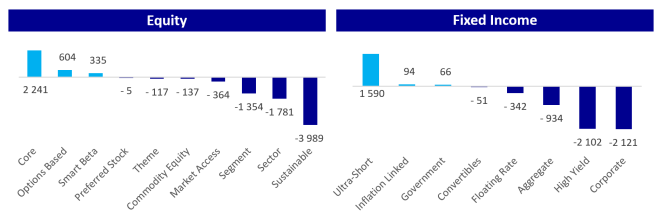
Core ETFs saw net positive flows of $2.2bn (2to 11 April) . Investors traded their US exposure in preference for Europe and Japan, areas that may present a better economic outlook. They also swapped out riskier ETFs as the markets declined. Sector and sustainable ETFs landed in negative territory. Option based UCITS ETFs, especially on US equities, gathered positive flows of $604mn in this period. Emphasising the ‘buy-the-dip’ mentality and an anticipated rebound in tech stocks from investors.
The shift toward safety was more evident in fixed income. Investors favoured low credit-risk segments such as ultrashort maturity (+$1.5bn) and government bond ETFs (primarily US TIPS) while looking to avoid the stock market decline. On the other end of the spectrum, high yield (-$2.1bn) and credit ETFs lagged, as these assets are generally more correlated to the stock market.
Flows in $mn
Source: ETFBook as at 11 April 2025
Active ETFs weather the shock
Following the announcement of tariffs on 2 April, UCITS ETFs saw outflows, with over $11bn withdrawn in just one week from the $92bn already collected year-to-date. In the same period in 2024, UCITS ETFs had gathered $56bn year-to-date, and $46bn in 2023. 2025 is already a record-breaking year for the UCITS ETF industry with flows as of 11 April being at $89bn despite the tariffs selloff, which had a relatively small impact.
During the same period from 2 April to 9 April 2025, however, actively managed ETFs experienced a positive inflow, with a net inflow of $20mn adding to the $7Bn collected year-to-date. This indicates that investors moved away from passive ETFs while actively managed ETFs displayed stability.
Flows in $bn

Source: ETFBook as at 11 April 2025
ETF liquidity as an answer to market volatility
Such heightened volatility creates a challenging environment for investors, prompting them to seek effective solutions for navigating these turbulent times. In this context, the importance of ETFs becomes evident. According to ETFBook, in the week following 2 April, UCITS ETF trading volume surged to $191bn – a striking two-fold increase from $101bn the week prior to the announcement. The peak was reached on the Monday 7 April as markets reacted to additional tariff announcements following the closing of the market in China at the end of the previous week, with $45bn in volume compared to an average $19bn in daily volume in March. This dramatic rise emphasises the critical role of ETFs in providing liquidity and facilitating price discovery amid market stress.
In just two weeks of April, AXA IM’s ETF range recorded its third busiest month on record, with orders volume totalling $173mn following Donald Trump’s ‘liberation day’. This activity highlights how AXA IM’s UCITS ETF product range and capabilities can effectively meet investors’ liquidity needs during periods of volatility.
Despite recent outflows in the UCITS ETF market driven by concerns over equities and fears of a global recession, the substantial uptick in trading volume illustrates that investors continue to turn to ETFs to meet their trading needs during these volatile periods.