
Regular investing by putting a set amount each month into a portfolio is a well-recognised approach to building wealth. Not only can it smooth returns, it can also take the hassle out of investing.
Makes investing accessible
Regular saving and investing is a great habit that can provide you with more flexibility further down the line. If you’re keen to begin investing but you don’t have a lump sum available, regular investing is a good way to slowly build up a pot.
Removes the worry about timing the market
It takes the emotion out of investing, as you don’t have to worry about when to enter the market, and just have to be confident that bad months will be outweighed by good ones over the long term. If you’re investing regularly, you don’t need to worry about trying to pick the right time to buy and sell your investments.
Smooth out market volatility
Rather than focusing on timing, if you routinely invest a regular amount over a period of time you will be investing across a range of prices. This averages the price of the investment, smoothing out the highs and lows in share prices. When they go up, the value of your stocks rise, and when they go down, your next contribution buys more.
Markets rise over time, just not every year
Markets do not rise every year, nor do stocks, even the best ones. This is because in the short term and maybe for extended periods, market levels and performance are not indicative of value. This makes it difficult for investors, who can find themselves oscillating between buying high (optimism or greed) and loss aversion, causing them to sell low (fear). In much the same way that diversification is a well-regarded investment approach as it is difficult to know which assets or sectors will be the strongest performers, cost averaging can be used to minimise the risk of buying or selling at the wrong time.
Cost averaging
Cost averaging is an investment strategy with the goal of reducing the impact of volatility on large investments. By dividing the total amount you are looking to invest into equal amounts, and investing at regular intervals, cost averaging aims to reduce the risk of incurring a substantial loss resulting from investing the entire lump sum just before a fall in the market.
The technique is so-called because it has the potential of reducing the average cost of shares bought. Cost averaging effectively leads to more shares being purchased when their price is low and fewer when the price is higher. As a result, it can lower the total average cost per share of the investment, potentially giving the investor a lower overall cost for the shares purchased over time. An example of this in practice can be seen below.
Please note that this strategy does not guarantee better results, as in a steadily rising market your investment could have benefited more from being made as an initial entire lump sum.
Drawbacks to this methodical approach
As can be seen in the example below, investors will miss out on the highest returns should the shares continue rising. The cost averaging strategy may trail a lump sum if this was purchased at a lower level. There are a couple more potential factors to consider – more frequent cost averaging trading could result in a higher level of dealing costs. It’s also important to consider what is being bought, as cost averaging in a poor-quality stock is of little benefit.
An illustrative example of cost averaging
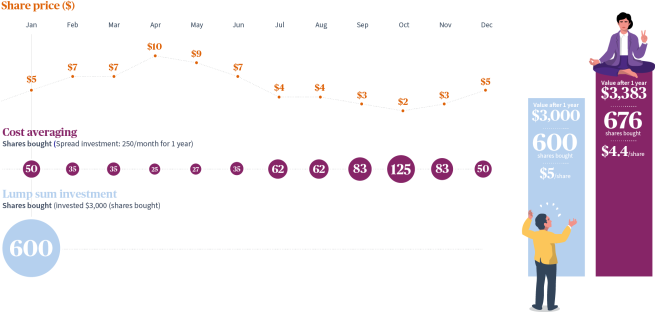
Source: AXA IM