
The first half of 2025 has been a volatile period set against a complex macroeconomic backdrop and a shifting interest rate outlook
We are neutral on equity markets overall and expect performance to be driven by earnings growth rather than a re-rating
‘Quality’ is currently our most favoured factor, which typically performs well when rates fall and macro conditions slow, while ‘Growth’ is the most improved factor
Year-to-date, markets have been besieged by uncertainty, primarily because of the upheaval brought on by President Donald Trump’s so-called ‘Liberation Day’ trade tariffs. But there has been much more to contend with than just US trade policy, such as the US’s loss of its AAA credit rating and escalating geopolitical tensions.
However, a pause on the introduction of tariffs, combined with resilient macroeconomic data and a rapid recovery in forecast corporate earnings triggered a strong market rally – despite the uncertain backdrop.
And the positive market sentiment has, so far, not been derailed by rising Middle East tensions but any sustained increase in oil prices, were it to occur, would pose risks to the global growth and inflation outlook. In absence of a shock, we are neutral on equity markets and expect performance to be driven by earnings growth rather than re-rating.
The interest rate outlook is complex. The Federal Reserve (Fed) is caught between inflation risks (tariffs and oil) and its growth/employment mandate. While we don’t think the Fed is in a hurry (it would prefer to see signs of labour market weakness before easing), we believe that on balance there is more growth than inflation risk and we expect rates to ultimately move lower. Markets continue to price in modest rate cuts over the next 12 months.
Equity factor outlook
Given the current macro and interest rate backdrop we have updated our Global Factor dashboard – see below:
AXA IM Equity Factor Dashboard: June 2025
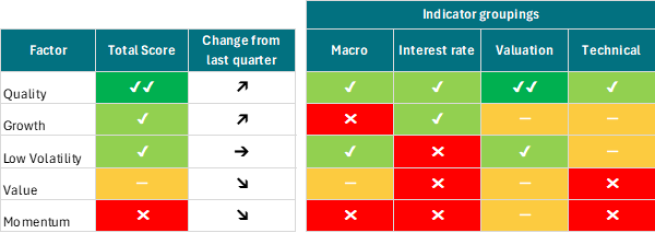
Source AXA IM, June 2025. ISM macro phase: Deceleration, VIX: Low, Interest rate direction: Falling Full details of our dashboard methodology can be found here.
In June, Quality became the highest-ranking factor on our dashboard, benefiting from supportive macro, technical and interest rate scores as well as attractive valuations. Value has fallen compared to three months ago, moving from first to fourth, as prospects of lower interest rates and technical elements weigh against it. Meanwhile Growth is the most improved factor, moving from the bottom of our dashboard in March to second place in June, benefiting from the current interest rate environment.
We set out in detail our outlook for equity market factors below.
Quality: Positive
Quality – equities with more consistent earnings growth and typically less share price volatility – is currently the highest-ranking factor on our dashboard. Quality typically performs well when interest rates fall, and macro conditions are slowing. Quality currently trades on valuation levels that have historically been supportive of future outperformance; technical factors, such as low levels of crowding (i.e. it’s not overbought), are also supportive.
Growth: Positive
Growth is the second highest-ranked factor on our scorecard and the most improved from three months ago. While Growth typically performs well when interest rates fall, it is less favourable for it when this occurs against a slowing macroeconomic growth backdrop. Growth valuations are not cheap but are also not expensive, resulting in a neutral valuation score at present.
Low Volatility: Positive
Low Volatility is currently mid-ranked on our scorecard. Low Volatility has been out of favour recently and is currently attractively valued. It typically benefits from slowing macroeconomic conditions; however, lower interest rates are generally unhelpful for this factor.
Value: Neutral
Value – stocks which appear to be trading for less than their underlying value – typically suffers when interest rates fall, although supportive valuations offset this potential headwind (value is cheaper than normal). Value also presently scores poorly on our scorecard’s technical pillar.
Momentum: Negative
Momentum – stocks which have had a positive price change relative to the market over the last 12 months – is the lowest-ranked factor on our scorecard. It has been among the best-performing sectors over the last year; however, an environment of falling rates and slowing macro conditions tends not to be supportive for momentum historically and in addition, it is currently a crowded trade.