
It is still uncertain when the US-Iran war shock on oil will end. But it is certain that energy demand will continue to rise with global warming, AI’s power demand, big data centre build-out, and general economic expansion. The oil shock stemming from the disruption to the Strait of Hormuz traffic has sent shivers through Asia, which relies heavily on oil imports from the Middle East. This has, in turn, prompted both public and private players in the region to strive for reducing their dependence on Gulf energy.
Alongside their search for alternative oil suppliers, Asian buyers are also trying to reduce oil and gas imports by drilling more at home (as India is trying to do), use more bio-fuel blends (like in Malaysia and Indonesia by raising the share of palm oil blended into diesel), and accelerate the shift to renewable energy. The last response suggests that Asia will make a big energy shift that will power regional growth through green tech investment, with China playing a central role in the efforts.
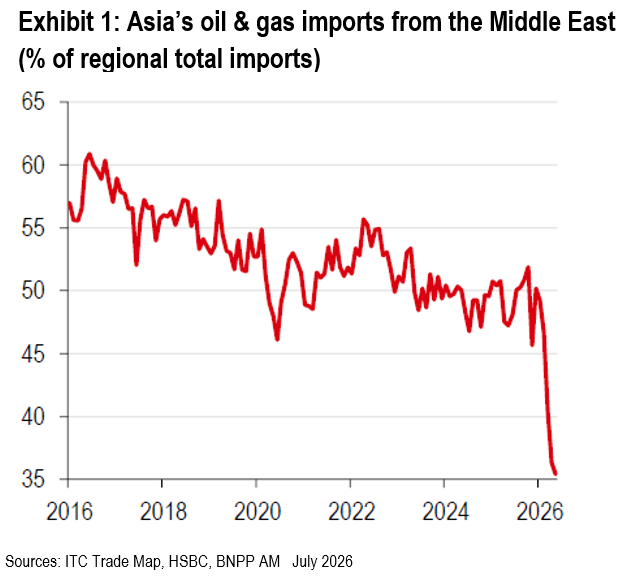
Data shows that Asia’s oil & gas imports from the Middle East dropped significantly and quickly since the Strait of Hormuz disruption from over 60% of the regional total to about 35% (Exhibit 1).
From oil to green energy
The potential for Asian investment in renewable energy generation is huge because the region’s energy transition efforts are still nascent. Despite rapid investment in recent years, renewables still make up a relatively small share of Asia’s total energy consumption, though New Zealand is the leader in the energy transition effort (Exhibit 2). So, to reduce its oil & gas dependence in the long-term, Asia must speed up its pace of energy transition both by increasing green investment and changing consumption habits.
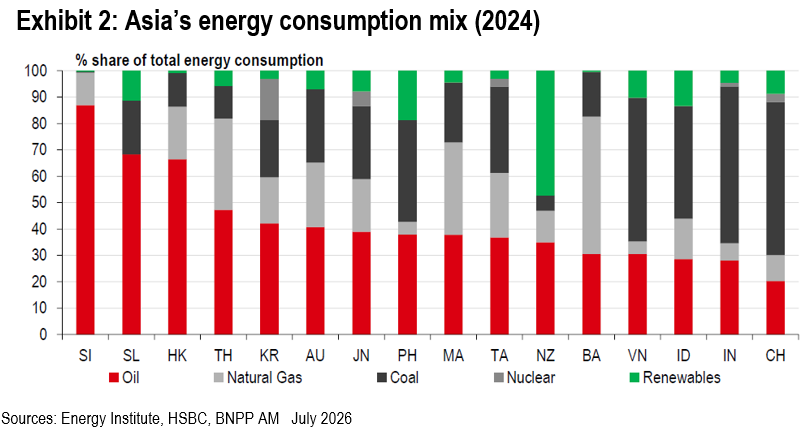
China leads Asia’s energy transition drive as it has built out significant renewable capacity in recent years. Although its share of renewable energy consumption is still small, as shown in Exhibit 2, that is mainly because much of its renewable production capacity is not fully connected to the grid. Once connected, and this will happen over time, the renewables share will rise significantly.
Technically, photovoltaic electricity generation is much cheaper than coal, oil & gas, or even nuclear power generation. And China is a technology leader and pioneer in photovoltaic power generation. However, India can produce solar power cheaper than China due to its lower labour and capital costs and abundant solar irradiation by being closer to the equator that provides more persistent sunlight.
Nevertheless, with a technological lead, China can quickly ramp up solar capacity. And it has done so decisively, with its solar capacity rising by nearly 300% between 2021 and 2025, (Exhibit 3). This contrasts sharply with the slow adoption of solar energy adoption by other Asia countries, whose capacity installation has also lagged behind Europe (see Exhibit 3).
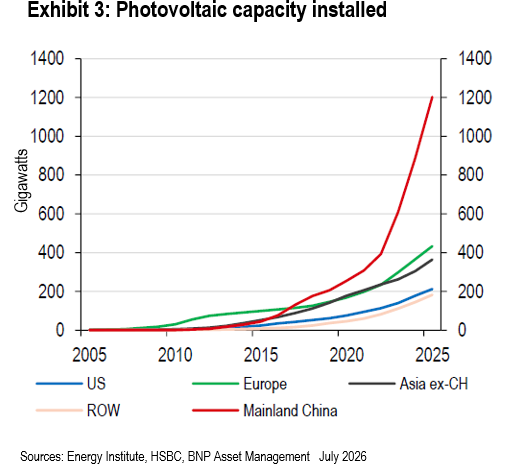
This means is that there is significant scope for Asia to catch up with renewable energy investment in the years ahead. China is the leader in this technology in terms of production capacity in the region. Its share of global production is overwhelming across many elements of green energy technology. Solar panels and batteries are notable examples, with China’s production accounting for more than 50% of the world total.
The current Hormuz disruption and the possibility of recurring energy crises are decisive push factors for Asia to speed up energy transition in the coming years.