
The June FOMC meeting revealed a hawkish tilt, with half of the voting members seeing a rate hike in the next 6 months. Some market expectations are even more aggressive by pricing in three rate hikes, starting in July or September this year, in the coming months. Generally, market interest-rate expectations have changed frequently and swiftly since late 2025 due to the volatile growth-inflation dynamics and shifting geopolitical tensions, with the latest round of rate-hike expectations emerged in mid-June 2026.
The market’s expectation may change again soon (back to no hike or even rate cuts), although no one is talking about this at this point. Why will that be?
Near term uncertainty
The near-term inflation and interest rate outlook is still uncertain. Against the current market expectations, however, there are reasons to expect that disinflation would return and that inflation could fall even faster later this year than currently expected if the Middle East war and oil shocks fade.
A lot has to do with the expected oil price performance in the short-term and the AI revolution in the medium-term. Even Fed Chair Warsh acknowledged at the Sintra (Portugal) central bank conference on 1 July that that inflation risks had receded due to the recent oil price decline and that AI would be a significant disinflationary force by boosting productivity.
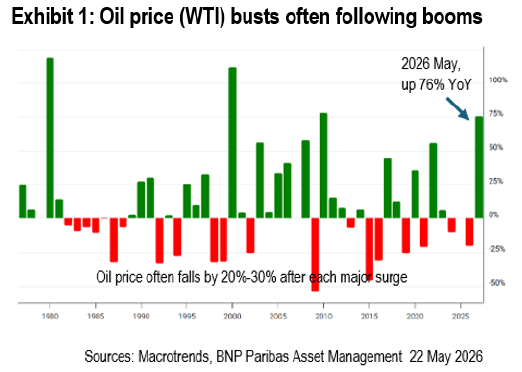
As shown in my last note, every major surge in oil prices since the 1980s was often followed by a subsequent crash (Exhibit 1), sometimes by as much as 50%. This should help negate the concern about
sustained elevation of oil prices due to the US-Iran war’s destruction of oil production facilities. A similar boom-bust outcome could unfold due to weak oil demand and more oil supply, if the US-Iran ceasefire MoU leads to an agreement and the Strait of Hormuz reopens.
Already, recent data shows that several OPEC+ members1 had started to increase production and that Saudi Arabia had made a big cut to the price of its main crude for Asian buyers by selling its oil at a discount to the Asian benchmark for the first time since 2020.
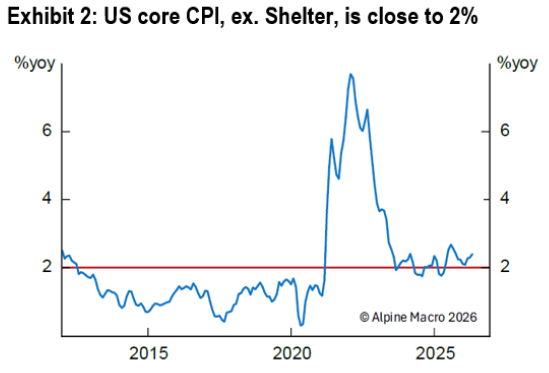
Back to US inflation, the recent rise in its core Personal Consumption Expenditure (PCE) inflation primarily reflected a series of negative supply shocks, ranging from tariff hikes to the oil crunch. The impact of these shocks is transient and will dissipate, ceteris paribus, as the tariff and Middle East tensions fade. Note that core CPI inflation excluding shelter is close to the Fed’s 2% target (Exhibit 2).
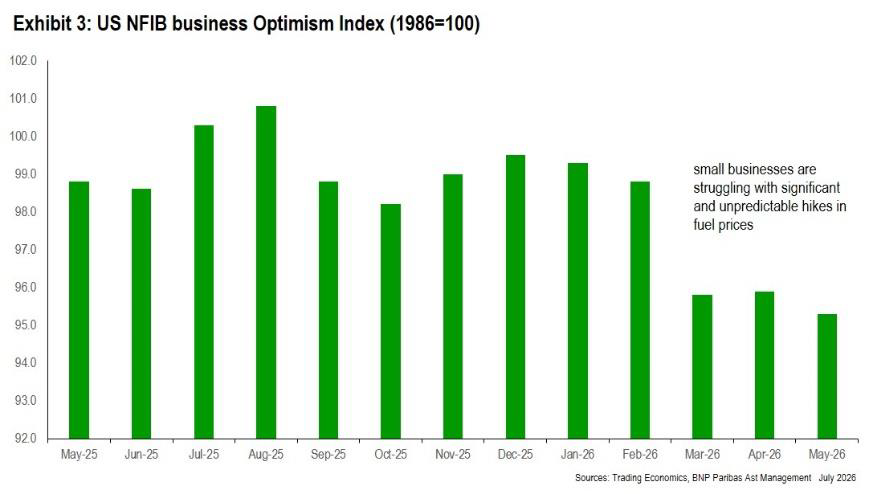
Meanwhile, the Fed is facing a dichotomised economy, with a booming technology sector coexisting with struggling small businesses and a weak real estate market. The National Federation of Independent Business (NFIB) survey (Exhibit 3) – which measures the US small-business sentiment to predict broader economic trends – shows a subdued picture for small businesses, which create more than 60% of US jobs created. So, the Fed will have to be cautious about raising rates, especially if the inflationary impulse is expected to weaken.
So what?
Some market players are expecting oil prices to fall towards USD50/b (currently USD72/b – USD75/b) in the coming weeks if the US-Iran ceasefire lasts. The economic damages of high oil prices on the global
economy should start to emerge later this year. Under these circumstances, inflation should begin to fall later as these shocks pass through the system.
Meanwhile, AI-driven productivity gains could drive inflation lower than currently anticipated, lowering inflation expectations. This will, in turn, reduce the odds of any rate hikes while increasing the likelihood of renewed policy easing in 2027.
Investment implications
The tentative ceasefire between Iran and the US has already boosted asset prices. Falling energy costs will help boost equity performance by lowering inflation expectations and prompting policy easing, supporting consumers and businesses, and boosting corporate earnings. Historically, small caps tend to outperform large caps when interest rates or rate expectations are falling.
Gold performance has suffered a setback due to Fed tightening expectations, a strong dollar, and high real interest rates. Nevertheless, these headwinds are mostly in the price. If rate-hike expectations reverse, and/or if the dollar loses momentum, gold price should rise again. Some players are forecasting USD5,000 an ounce by end-2026. Gold’s role as a hedge against policy uncertainty, geopolitical risk, and a volatile growth-inflation mix has not changed.
[1] OPEC+ is an alliance of 22 oil-producing nations that coordinates global crude oil production to influence market stability and prices. It consists of the 12 member countries of OPEC and 10 non-OPEC allied nations, notably including Russia.