Financial markets have begun considering the possibility of a disputed US presidential election outcome and the uncertainty and volatility that would entail. Before we look at how markets could react, let’s go through where things stand some seven weeks before polling day and review what happened the last time the election was close.
Are the dynamics shifting in Trump’s favour?
It has been a tight race so far and while Democrat candidate Joe Biden has kept his lead in the opinion polls, President Donald Trump has not been far behind with his chances said to have improved as the impact of the coronavirus wanes, the US economy stabilises and the law and order theme that he has embraced resonates with voters.
Markets are concerned that the shift in dynamics might make it even more likely that the incumbent could decide to refuse to concede if he did not win outright. He might also act on threats to challenge the legitimacy of the result, especially if COVID delays counting – and as a consequence the outcome – by days, if not weeks, or irregularities with mail-in ballots surface.
Narrow margins might trigger a challenge
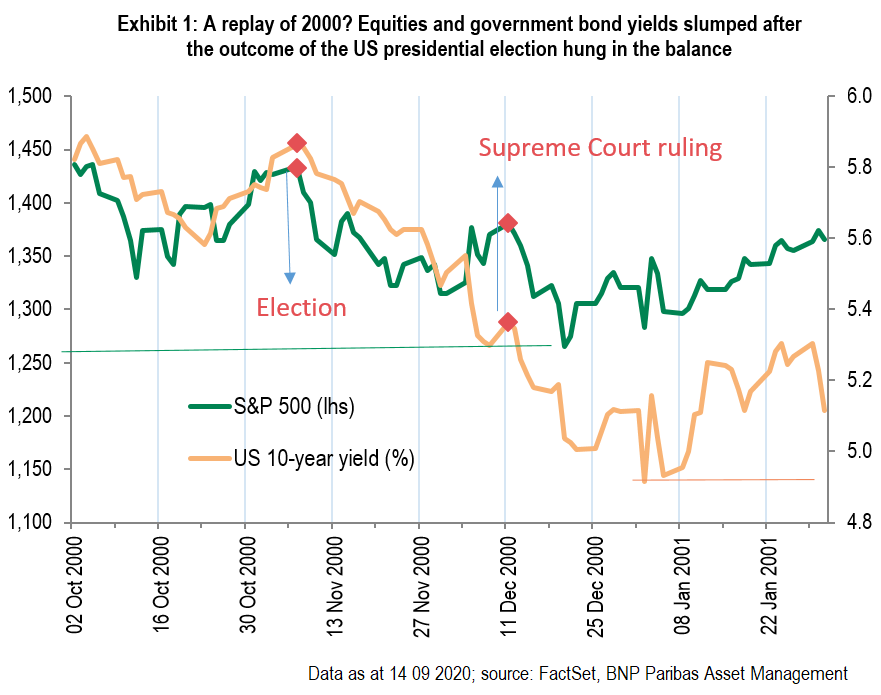
The worries centre on a possible replay of 2000 when Republican candidate George W. Bush won Florida by such a slim margin that a recount of votes was needed. This marked the start of legal battles with Democrat contender Al Gore which went all the way to the Supreme Court. It eventually halted a second recount, allowing Bush to win Florida by a tiny margin and in its wake the electoral college vote and the White House.
We believe there is a 50/50 chance of a stalemate over the result in November. This could then keep markets on edge until almost the end of the year.
A disputed result could push investors out of equities and into bonds
In 2000, the Supreme Court took five weeks to issue its ruling. At the time, the broad S&P 500 index fell by 12% from its pre-election level to a low the week after the court issued its decision. The uncertainty drove investors to traditional havens such as US Treasury bonds. It took 10-year Treasury yields a few more weeks to bottom, having fallen by nearly 100bp (see Exhibit 1).
As the uncertainty faded, markets recovered subsequently.