
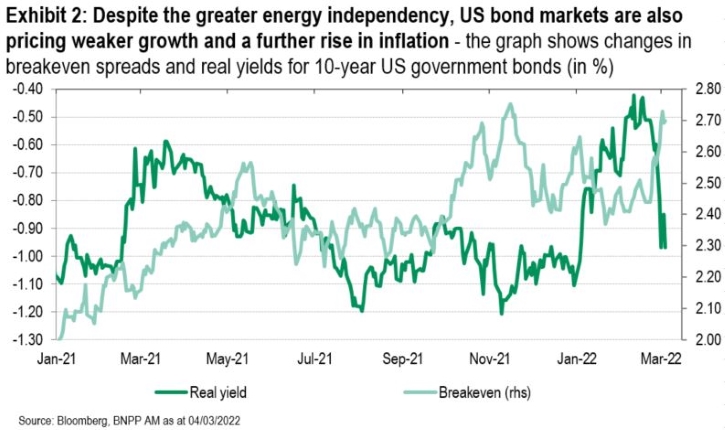
Russia’s invasion of the Ukraine is a new, exogenous supply shock for the global economy. Financial markets are now anticipating the risk of stagflation. Soaring energy and food prices will exacerbate existing inflationary pressures, while higher-for-longer inflation reduces real disposable incomes. The extent of the negative consequences for growth will depend on the duration and extent of the conflict.

At the start of this second week of March, crude oil prices traded at above USD 130 a barrel. Prices for Brent crude oil rose by almost 20% from the close on 4 March, taking them to the highest level since the 2008 financial crisis.
The sharp rise in oil prices followed comments on 6 March from Antony Blinken, US Secretary of State. Reuters¹ reported his remarks that the US administration was in ‘very active discussions’ with European allies over a ban on importing Russian oil.
On Monday 7 March, Reuters² reported that the US was willing to move ahead with a ban on Russian oil imports without the participation of European partners.
European wholesale natural gas prices also surged higher. Futures at one stage on 7 March traded at a record of EUR 345 a megawatt hour, before falling back significantly.
The European Central Bank’s Governing Council meets on 10 March in Frankfurt. Market participants expect the ECB to adopt a ‘wait-and-see’ approach initially, until the consequences of the current crisis become clearer. In the medium term, however, normalisation of monetary policy remains on the table.
References
1. Reuters 07/03/2022: U.S., European allies discuss banning imports of Russian oil
2. Reuters 08/03/2022: U.S. may act alone to ban Russian oil imports, sources say
Disclaimer


