Once again the US bond market will lead global fixed income markets in 2025, with a strong US economy but uncertainty over the new administration’s policies setting the tone. We expect the US economy, over time, to pivot towards structurally slower growth and stickier core inflation. This more ‘stagflationary’ trajectory may result in the Federal Reserve taking a more cautious approach towards further rate cuts.
We expect the eurozone economy to grow at a moderate pace with the ECB continuing the journey back to a deposit rate of around 2%. With risks to economic growth tilted to the downside, the ECB may even be forced to cut the rate to below neutral.
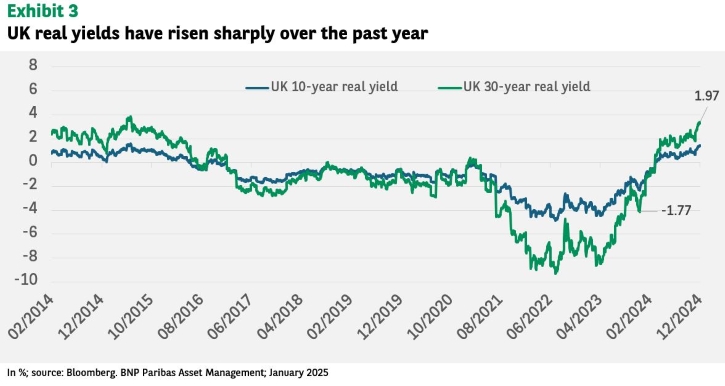
In our view, their recent rise has taken real yields in the US, UK, and eurozone to attractive levels.
Limited action from the Fed
As we wait for more clarity on the US policy landscape following President Trump’s inauguration, we make the following observations on recent economic developments:
- The US economy has exhibited remarkable underlying strength and momentum.
- 2023 and 2024 growth was supported by significant wealth effects, the overhang of fiscal stimulus and a tech investment boom.
- High growth rates were enabled by rising labour force participation rate, rapid immigration, and improvements in productivity as new technologies were deployed.
- On the labour market, the pace of hiring has been slowing, fewer workers quitting, and wage gains moderating. The market now appears to have fully rebalanced, and unemployment seems poised to begin exceeding the ‘natural rate’.
- Favourable immigration, labour force participation and productivity trends would imply the ‘neutral’ policy rate has been higher in recent quarters. Whether that remains the case depends on the persistence of these supply side trends.
With the Republican victories in the presidential and Congressional races, we have made significant revisions to our outlook for the US economy and policy.
The new Trump administration has outlined four key policy priorities:
- Tighter immigration policy, including securing the nation’s borders and forced deportations of undocumented immigrants
- Protectionist trade policy, via increased tariffs and trade controls in sensitive technologies and goods
- Deregulation to spur investment, job creation and financing, as well as energy extraction
- An extension of the 2017 Tax Cut and Jobs Act, with further reductions in corporate and income taxes promised.
Our assessment is that the administration will be keen to make rapid progress on these priorities before the November 2026 mid-term elections.
We believe the new administration will have difficulty pushing through the fiscal objectives. In short, President Trump may not win the backing of several Republican Senators, enjoys only a razor thin majority in the House, and may be advised against largely unfunded tax cuts by his own Treasury Secretary, Scott Bessent.
Furthermore, October’s 2023’s ‘supply Treasury tantrum’ could easily occur again should the administration actually pass large unfunded tax cuts. Correspondingly, we think the fiscal stimulus is likely to be far smaller than promised.
Overall, then, we anticipate the US economy to face supply side headwinds from slow immigration, higher tariffs and supply-chain disruptions. Meanwhile, the gains from deregulation are likely to take longer to be felt. The result is likely to be a pivoting towards structurally slower growth with stickier core inflation, as a result of tariffs, less global competition, and a tighter US labour market.
However, the inflationary impact of tariffs is likely to be modest since the US dollar should appreciate as a partial offset.
A more ‘stagflationary’ economic trajectory should encourage the Fed to take a more cautious approach towards further rate cuts. Our view is that the Fed will pause in the first quarter to assess how supply and demand factors are developing.
US Treasury yields rise as Fed cuts rates
This rate cutting cycle has been highly unusual. White the Fed has lowered rates by 100bp since September 2024, the 10-year US Treasury yield has climbed by about 100bp. This surge was concentrated in 5 to 10-year maturities rather than in 30-year maturities. It has driven implied forward yields back to levels that look attractive, at least from a historical perspective.
At time of writing, 5-year/5-year implied forward real yields are trading above 2.65%, a level that over the last 20 years has repeatedly been a profitable entry point to buy duration (see Exhibit 1).

The Treasury bond sell-off likely reflects a mix of factors:
- The pricing for the fed funds rate at end 2025 adjusting from 2.80% in September to around 3.95% at the start of January
- Anticipation of rising Treasury supply given Trump’s fiscal agenda and the possibility of a shift to notes and bonds issuance
- Higher term premia, as macro-policy uncertainty has risen before and since the election.
We believe the front end of the US Treasury curve could adjust higher in coming weeks once the narrative that the Fed will pause is accepted. On Treasury issuance, supply fears are likely overdone. Macro-policy uncertainty could rise further as the administration releases executive orders and Congress begins legislating. We are also mindful of Trump’s unpredictability, on the economic policy front as much as on the geopolitical stage, likely creating asset price volatility.
An opportunity to increase overweights in euro duration
We expect the eurozone to grow at a moderate pace. On the one hand, we see rising real incomes, easing credit conditions, and strength in the ‘peripheral’ economies. On the other, heightened trade policy uncertainty, malaise in Germany’s manufacturing sector, and France’s tightening fiscal stance will likely weigh on the economic recovery.
Employment growth is slowing in the eurozone. We believe a further loosening in the labour market should contain wage growth, which should help services inflation to moderate, albeit slowly, in the coming year. The ‘last mile’ in the ECB’s fight against inflation will remain difficult as the ‘quick wins’ of lower goods and energy inflation are exhausted.
In balancing a weaker growth outlook with still-sticky price pressures, we believe the ECB is likely to continue its march back to a more neutral policy setting until the depo rate reaches around 2%, a level which we would consider broadly neutral. The ECB may be forced to cut to below neutral if the economy weakens more than expectation in response to an escalation in trade tensions or if trade rerouting causes a larger disinflationary impulse.
At the time of writing, front-dated interest rate pricing implies an ECB depo rate at around 2% by the third quarter of 2025, which we see as largely fair. Nominal 10-year Bunds have reached 2.60%. Given the downside risk to growth, we believe yields at these levels offer attractive value, and the recent sell-off offers the opportunity to initiate or increase overweights in euro duration.
In sovereign spreads, we see scope for France to underperform Spain. We expect Spain’s outperformance versus core economies to continue as activity in Spain’s services sector remains dynamic and investment flows from Next Generation EU (NGEU) funds support growth. In France, the new government faces the challenging task of consolidating public finances at a time of political fragmentation. The risk of successive government collapses until new legislative elections are held cannot be ruled out. Further sovereign credit rating reviews are due in the second quarter. Continued uncertainty over France’s fiscal trajectory suggests market tensions around French sovereign bonds could reemerge.

UK real yields also offer opportunties
The UK suffered a significant loss in economic momentum in the last quarter of 2024. Fiscal uncertainty and impending tax increases led to a decline in business and consumer confidence, which in turn dampened investment and hiring plans. In 2025, we expect the economy to find stronger footing as the government is set to increase spending. Still, the acceleration in growth will likely be modest as many uncertainties remain.
In the near term, we expect the Bank of England to maintain its cautious and gradual approach in its rate-cutting path, keeping with the 25bp per quarter pace. We believe the risk to this baseline scenario is skewed to deeper and faster rate cuts as we expect the labour market to take a more decisive downturn later in the year.
From a valuation perspective, UK real yields are attractive. At the time of writing, the yield of 30-year UK index-linked Gilts has breached 2%. Similarly, 10-year/10-year forward real yield forward is now above 2.7%, a high not seen since 1998.
The attractive valuation and deteriorating employment outlook lead us to hold a bias to be overweight in UK duration, although the sizing should be modest to reflect the general concerns surrounding debt sustainability, resurgence of inflation and potentially inflationary Trump policies.
On a cross-country basis, we would favour an overweight in UK Gilts versus US Treasuries. We anticipate continued slowing growth and loosening in the labour market to help ease concerns over the UK’s inflation problem. The two countries’ growth differential warrants a decline in Gilts yields relative to those on US Treasuries.
On the UK yield curve, we expect steepening of the curve between 2 and 10 years in nominals. In our view, front-dated yields should be well anchored by expectations for steady BoE rate cuts. At longer maturities, the record level of net supply and concerns about debt sustainability could drive further underperformance.