
US inflation expectations have risen over the last year, and with the passage of an additional USD 1.9 trillion stimulus package, any investor who was not already worried about inflation is likely to have started paying attention.
Yields have started to rise from the multi-decade lows set last year, lifting inflation expectations (in other words, breakeven inflation). More recently, real – inflation-adjusted – yields have increased as well (see Exhibit 1).
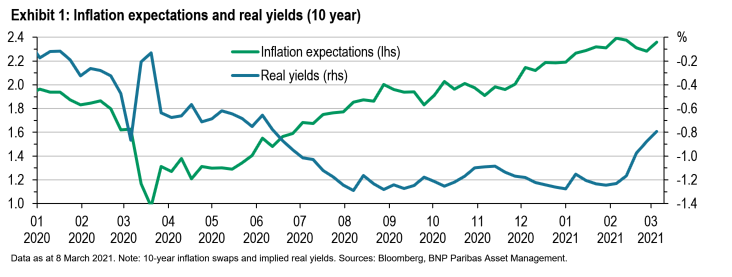
The latest US fiscal stimulus will be hitting a capacity-constrained economy just as lockdowns are being lifted, raising the prospect of accelerated gains in US consumer prices.
Inflation-linked bonds and their effectiveness as an inflation hedge
Investors looking to hedge themselves against inflation could consider inflation-linked bonds. It is true that Treasury Inflation Protected Securities (TIPS) and index-linked Gilts (UK linkers) typically outperform nominal bonds when inflation is rising (see Exhibit 2), but there are two considerations investors should bear in mind when adding inflation-linked bonds to their portfolios.

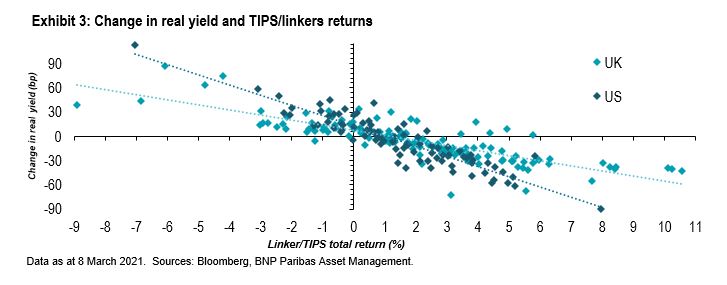
The first consideration is that an investment in TIPS and other linkers fundamentally implies taking a position on real yields, which are currently very low. Given that central banks are likely to remove their extraordinary monetary support as economies recover from the lockdowns-induced recessions, investors have started to price in policy rate increases in the years ahead. This process is likely incomplete and may boost yields further.
On the basis of Exhibit 3 below, we would expect future returns to fall in the upper left quadrant since the real yield will likely rise, resulting in a negative total return.
To be sure, inflation-linked bonds held to maturity will compensate for realised inflation as it occurs over the life-time of the bond through a slow accreting process. The repricing of real yields, however, is instantaneous and often dominates the quarterly and annual returns.
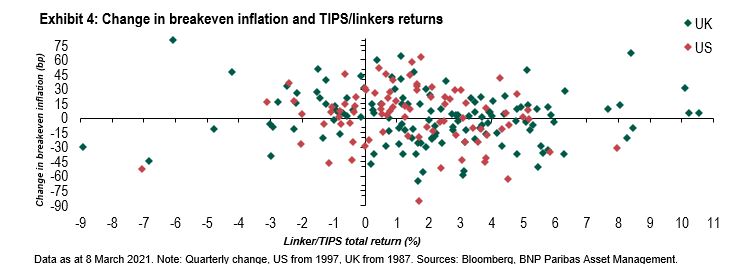
The other factor investors need to consider is that inflation-linked bonds, on their own, do not necessarily provide protection from changes in inflation expectations. The correlation between the return on inflation-protected bonds and breakeven inflation is close to zero (see Exhibit 4).
In a world of rising inflation and negative, but rising real yields, inflation-linked bonds then may not be the most effective inflation hedge, but need to be assessed in a portfolio context. For example, to the extent that portfolio benchmarks contain nominal bonds, investors could still swap out those bonds for inflation-linked bonds as a way to make their benchmark more robust against higher inflation.
Other strategies to hedge against inflation
From an absolute return perspective, going long inflation-linked bonds while at the same time shorting nominal bonds via futures would create the desired breakeven inflation exposure. This can also be achieved with inflation swaps which are designed to track breakeven inflation and which can be used as a portfolio overlay.
Alternative hedges against a strong surges of inflation that investors could consider include floating rate notes, commodities (including gold) and listed real estate investment trusts (REITs). Within equities, value stocks and/or sectors whose performance has a strong correlation with inflation, such as energy, basic materials, and financials, are other options.
Also read
More on fixed income investing


